

Modern industrial economies depend on stable energy supply. Electricity, transport, manufacturing, heating, and digital infrastructure all rely on continuous flows of energy delivered through large physical systems. When those systems remain stable, economic life appears predictable. When they destabilize, disruption propagates rapidly through entire societies.
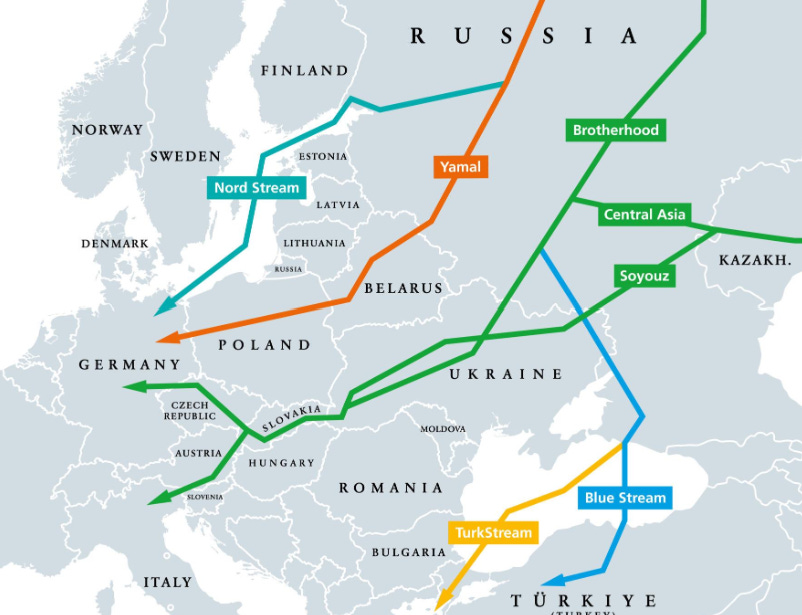
For decades Europe operated within a relatively stable energy structure. Russian pipeline gas flowed west through extensive infrastructure networks linking Siberian reserves to European industry. The supply was geographically close, physically secure once constructed, and priced far below global liquefied natural gas markets. European manufacturing—particularly in Germany and Central Europe—developed around this stable energy foundation.
That structure has now been removed.
The decisive moment occurred with the destruction of the Nord Stream pipelines in September 2022. Nord Stream connected Russian gas reserves directly to Germany, the industrial center of Europe. Once destroyed, the infrastructure could not simply be restarted. Large subsea pipelines require years of planning, financing, and construction. Their removal permanently altered the energy geography of the continent.
Infrastructure determines strategic options. Before Nord Stream’s destruction, Europe possessed a direct energy pathway linking Russian reserves to European industry. After its destruction, that pathway disappeared. Europe was forced to replace pipeline supply with liquefied natural gas transported by ship from distant suppliers.
Pipeline gas and LNG operate as fundamentally different systems. Pipeline networks function as continuous flows between fixed geographic points. LNG supply chains operate through global cargo markets in which buyers compete for shipments. When supply tightens, cargoes move toward the highest bidder.
The destruction of Nord Stream therefore transformed Europe from a region receiving stable pipeline supply into one competing for volatile global energy cargoes. The long-term implications of that structural shift were examined in Nord Stream and the Discipline of Reality and Sovereignty After Nord Stream, which explore how infrastructure destruction converts temporary disruption into permanent strategic dependency.
Energy infrastructure therefore provides the first signal.
A second structural factor emerges from the energy policy direction adopted across much of Europe over the past two decades.
Many European states have pursued large-scale transitions toward renewable energy systems centered on wind and solar generation. These technologies provide electricity under favorable environmental conditions but remain inherently intermittent. Wind output varies with atmospheric conditions, and solar generation disappears during nighttime hours and declines sharply during winter months in northern latitudes.
Industrial power systems therefore require dispatchable generation—energy sources capable of producing electricity continuously on demand. Historically, this role was filled by coal, nuclear power, and natural gas.
Across Europe, however, several of these dispatchable sources have been deliberately reduced. Coal plants have been closed for environmental reasons. Nuclear facilities have been shut down or phased out in several countries, most notably Germany. Natural gas increasingly served as the balancing fuel for intermittent renewable generation.
This structure functioned while pipeline gas from Russia remained abundant and inexpensive.
Once that pipeline system disappeared, the vulnerability of the new energy structure became visible.
Renewable generation can reduce fossil fuel use when combined with stable backup systems. When those backup systems depend on imported fuel obtained through volatile global markets, the system becomes more fragile rather than more resilient.
Energy policy decisions that reduce dispatchable generation while increasing reliance on intermittent supply and imported balancing fuel amplify exposure to global energy shocks.
Energy policy direction therefore provides the second signal.
A third signal appears in the movement of strategic reserves.
Gold has served as a store of value across civilizations for thousands of years. Unlike financial assets or currency reserves, gold carries no counterparty risk. Institutions frequently reposition gold when they anticipate financial instability, geopolitical disruption, or structural changes in the monetary system.
In recent years large quantities of physical gold have been relocated out of European vaults toward the United States and Asia. Central banks have increased gold purchases while financial institutions have adjusted custody arrangements and reserve locations.
Gold movements rarely occur through dramatic announcements. They appear in vault transfers, balance sheet disclosures, and reserve reports rather than public statements. Yet historically such movements have frequently preceded major geopolitical or financial transitions.
Gold relocation represents institutional positioning rather than commentary.
The informational role of these movements was examined in Gold and Monetary Permanence and Gold as Signal, which analyze how physical gold flows function as early indicators of strategic positioning within the global financial system.
Strategic reserve movement therefore provides the third signal.
A fourth signal emerges from demographic and political developments within Europe itself.
Over the past two decades Europe has experienced sustained immigration flows from regions with very different economic and social structures. Integration outcomes vary widely between countries, but many European states have encountered persistent challenges integrating large numbers of migrants into labor markets, education systems, and civic institutions.
These developments have measurable economic implications. Industrial economies under energy pressure must maintain productivity in order to remain competitive. When energy costs rise while fiscal burdens increase, structural strain accumulates within the economic system.
The long-term trajectory of immigration policy in Britain and Europe was examined through Strategic Intent Analysis in UK Immigration: Policy Failure or System Direction?, which traces how policy outcomes persist across multiple governments and political cycles.
Demographic pressure therefore provides the fourth signal.
A fifth signal appears in the expansion of surveillance and speech regulation across several European states, particularly the United Kingdom.
In recent years governments have expanded digital monitoring capabilities, online speech enforcement mechanisms, and regulatory authority over communication platforms. These changes are frequently justified in terms of public safety, misinformation control, or social cohesion. Structurally, however, they represent a significant expansion of state monitoring capacity.
Periods of anticipated instability often coincide with increases in surveillance capability. Governments strengthen internal monitoring systems when they expect social or economic tension.
This pattern forms part of a broader governance trajectory explored in essays including Britain Has Never Had Freedom of Expression, Inside the Warrantless State, and Governance Under Permanent Friction, which examine how administrative systems expand monitoring authority as institutional pressure increases.
Governance structure therefore provides the fifth signal.
A sixth signal has begun to emerge within the industrial economy itself.
Energy-intensive manufacturing sectors are gradually relocating away from Europe toward regions with lower and more stable energy costs. Chemical production, fertilizer manufacturing, steel processing, and heavy industry depend directly on affordable natural gas and electricity. When energy prices rise persistently, these industries face a structural choice: absorb the cost and become globally uncompetitive, or relocate production.
Evidence of this shift has appeared across multiple sectors. German chemical companies have expanded investment in the United States and Asia. European fertilizer production has periodically shut down during energy price spikes. Heavy industry has increasingly examined relocation toward jurisdictions with cheaper energy supply.
Industrial relocation rarely occurs suddenly. It unfolds through incremental investment decisions, plant closures, and the gradual redirection of capital toward more stable energy environments.
Yet once such relocation accelerates, it becomes extremely difficult to reverse. Industrial ecosystems depend on complex networks of suppliers, infrastructure, and skilled labor. When those networks dissolve, rebuilding them requires decades.
Industrial movement therefore provides the sixth signal.
Energy infrastructure loss, renewable policy vulnerability, strategic reserve repositioning, demographic pressure, governance tightening, and industrial relocation now appear simultaneously within the European system.
Each development can be explained independently. Infrastructure can be destroyed through geopolitical conflict. Gold reserves can move through financial repositioning. Immigration flows can emerge through political or humanitarian policy. Surveillance systems can expand through technological change. Industry can relocate through competitive pressures.
The analytical significance emerges when these developments converge.
Strategic Intent Analysis does not require centralized coordination. Systems frequently move in coherent directions through shared incentives, institutional self-preservation, and path-dependent decisions. When multiple domains shift toward the same structural outcome, directional system behavior becomes visible.
Europe now displays such convergence.
The continent has lost its most reliable energy infrastructure. Its energy system relies increasingly on intermittent generation supported by imported fuel. Strategic monetary reserves are increasingly positioned outside the region. Fiscal systems face demographic pressure. Governments are expanding surveillance capacity and internal control mechanisms. Energy-intensive industry is gradually relocating to jurisdictions with more stable energy supply.
Taken together, these developments describe a system operating under increasing structural constraint.
Energy crises rarely emerge without warning. Signals usually appear first in infrastructure decisions, reserve movements, policy direction, and institutional positioning.
In the present global system, those signals increasingly converge on Europe.
If global energy markets tighten further—through geopolitical conflict, shipping disruption, or intensified competition for LNG supply—the continent now stands in the most exposed position within the industrial world.
The system does not need to collapse immediately for this structural reality to matter.
It only needs to become visible when the next shock arrives.