

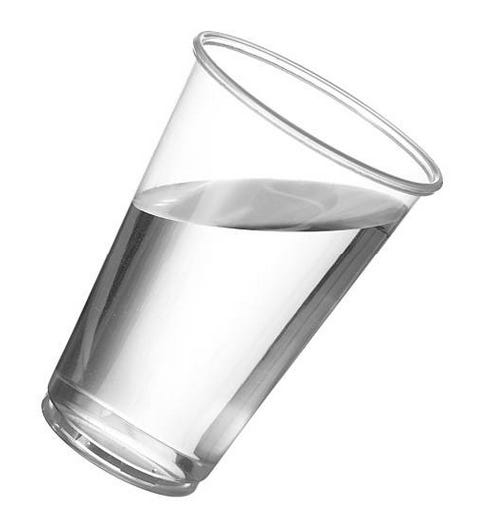
I carried out a small experiment recently with a friend that seemed, at first, almost trivial. I had a clear glass of tea in my hand. I moved it gently—tilting it, rotating it, shifting it from side to side. No matter how I moved the glass, the surface of the tea inside did the same thing every time. It did not follow the angle of the glass. It did not take on the orientation of the container. It simply returned, quietly and immediately, to its own steady position.
We call this “finding its level.” The phrase is so ordinary that we rarely stop to consider what it actually describes.
My friend watched closely. His wife did too. They became unexpectedly uncomfortable with what they were seeing—not because it was dramatic, but because it was so consistent. When I finally drank the tea, they reacted half in jest, half in genuine relief, as if the experiment itself had become something slightly unsettling.
There was nothing special about the tea. Nothing special about the glass. This is simply how water behaves.
Left undisturbed, water establishes its own surface. It does not lean with what contains it. It does not adopt the orientation of the vessel. It returns—always—to the same condition. This is not something that requires instruments or explanation. Anyone can observe it with a cup, a bottle, a basin, or a lake.
Human beings have relied on this behavior for thousands of years. Long before modern measuring tools, water was the standard by which “level” was defined. Builders cut channels and trenches, filled them with water, and used the surface to determine whether foundations were even. Roman engineers used long beams with water troughs to align roads and aqueducts. Masons across centuries trusted water more than rulers or marks because it revealed errors instantly. If the surface was even, the work was true. If it was not, something was wrong.
This was not theory. It was practice. Entire structures—bridges, temples, fortifications, canals—were laid out according to water’s surface. Water did not serve as a metaphor for level. It was level.
What is striking is not that water behaves this way in a glass, but that it behaves this way everywhere it is allowed to settle. In basins, harbors, locks, cisterns, canals, and reservoirs, the same rule applies. Wherever water is free to rest, it forms the same surface. Engineers depended on this because it was consistent, repeatable, and visible. Water did not approximate. It did not interpret. It simply revealed.
We are accustomed now to understanding the world through abstract descriptions—models, diagrams, layers of explanation between ourselves and direct experience. But water does not operate through abstraction. It shows us something immediately and without commentary. Move the container. Tilt it. Rotate it. Carry it across the room. The surface remains the same.
This is why such a small experiment can feel strangely disruptive. It is not making a claim. It is not arguing a position. It is simply showing a behavior that has always been there, one that civilizations once built entire measurement systems upon.
When we say that water “finds its level,” we tend to treat the phrase as poetic. But it is literal. Water establishes its own orientation. It does not borrow it from what surrounds it. It does not defer to the shape of the container. It does not require interpretation. It just does what it does.
My friend later joked that drinking the tea ended the experiment. In truth, the experiment had already said everything it needed to say. Water had once again demonstrated, in the quiet way it always does, that “level” is not an idea imposed by us. It is something expressed by nature itself.
Sometimes the most revealing things are not hidden at all. They sit in plain sight, waiting for us to notice what we have always been looking at.