

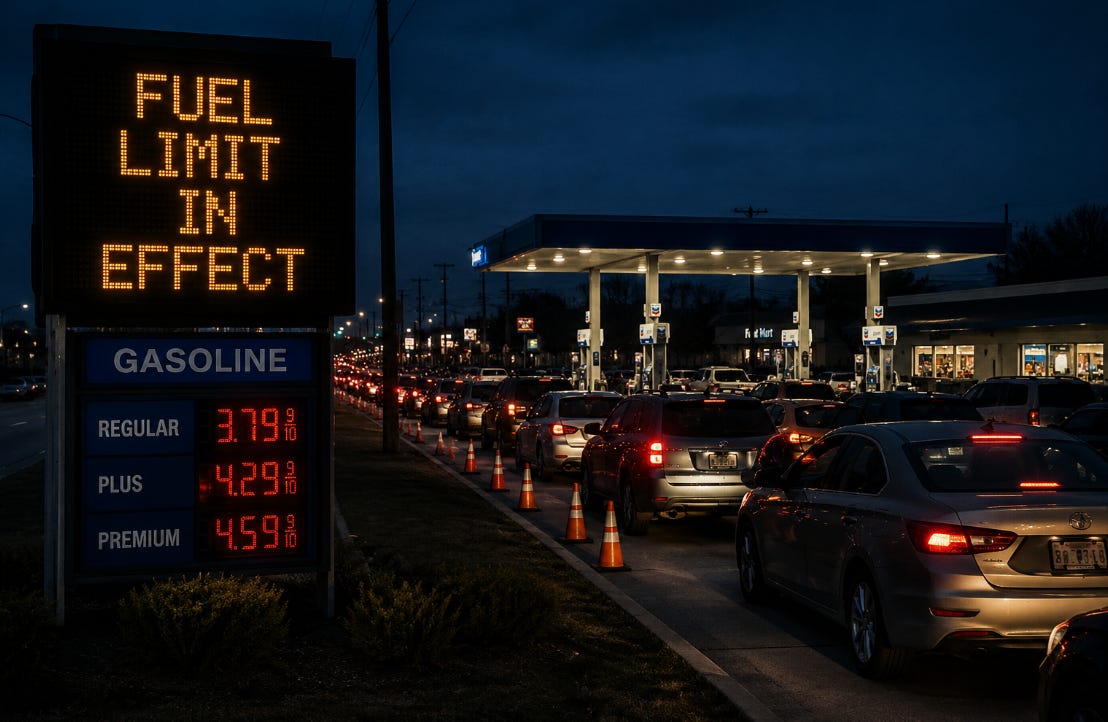
This is a predictive essay in the Strategic Intent Analysis sense. It applies a specific analytic method to the energy-control structure now in place and projects its likely public form: managed access, rationing, priority allocation, and emergency authority. Publication before the public phase is part of the test. If the method is sound, later events should begin to confirm the structure described here.
Energy operations conducted under national-security authority are judged by control, not relief. A successful operation increases leverage over resources, allies, adversaries, industry, shipping, finance, insurance, reserves, and emergency authority. It does not have to make ordinary life easier. It only has to make the system more controllable.
That distinction explains the sequence now visible in the energy system.
The public sees Nord Stream, Venezuela, Iran, Hormuz, inventories, oil prices, and gasoline access as separate subjects. The national-security planner sees routes, reserves, chokepoints, buffers, public tolerance, blame channels, and end states. He asks which supply route must be removed, which reserve base must be brought back under approved management, which waterway must be made unreliable, how long storage can hide the deficit, and what level of public hardship can be carried before authority has to appear as rescue.
The planner in this essay is not a single named person or one publicly visible committee. It is the planning standpoint created when energy is treated as national-security command. From that standpoint, intelligence assessment, sanctions policy, covert action, military pressure, shipping permission, insurance, finance, reserves, and emergency allocation are not separate moral stories. They are instruments inside one energy-security field. Strategic Intent Analysis reads that field through direction, function, beneficiary structure, and repeated reinforcement, not through a requirement that every actor share one formal chain of command.
The Planned Oil Crisis described the public sequence: supply disruption, storage depletion, and public scarcity. This essay reconstructs the operational logic underneath it. It reads the same events from the colder perspective of classified planning, national-security doctrine, and strategic cost-benefit analysis.
Nord Stream was the dependency operation. Venezuela was the reserve-control operation. Iran and Hormuz were the chokepoint operation. Storage was the concealment bridge. The memorandum was the timing device. The fuel line is the public threshold. Rationing is the administrative form the strategy takes when energy dominance reaches ordinary life.
The doctrine is public. The 2025 National Security Strategy identifies energy dominance across oil, gas, coal, and nuclear as a top strategic priority. It frames expanded U.S. energy exports as a tool for deepening alliances, curtailing adversaries, strengthening defense readiness, and projecting power. Energy is no longer treated simply as supply. It is treated as state power.
Cheap, reliable fuel for households, farms, factories, truckers, commuters, and small businesses belongs to a public-abundance model. Energy dominance belongs to a different model. It asks who controls routes, reserves, refineries, export permissions, sanctions exposure, financing, settlement, insurance, naval protection, and emergency allocation.
Once energy is moved into that frame, the public is no longer the controlling beneficiary. The public becomes the managed population.
The planner’s calculation is severe. Public hardship matters as cost, constraint, and instrument. If hardship produces a more controllable energy order at an acceptable political price, it remains inside the plan.
The Method of Structural Inquiry supplies the discipline for this reading. Official narratives are evidence, not verdicts. They are claims to be tested against conduct, omissions, incentives, consequences, and repeated institutional behavior. Strategic Intent Analysis reads direction through preparation, reinforcement, narrative narrowing, beneficiary structure, and recurring outcome. It does not wait for the system to confess.
That matters here because national-security operations do not publish their architecture. They surface through doctrine, warnings, classified assessments, deniable acts, sanctions decisions, shipping behavior, reserve movements, investment flows, emergency planning, and post-event adaptation. The task is to examine whether the fragments form a coherent operation.
They do.
Nord Stream came first because Europe’s cheap-energy option had to be removed. German industry and European stability rested on Russian pipeline gas. The pipeline did more than deliver fuel. It preserved European optionality. As long as Nord Stream existed, Berlin had a possible path back to cheaper Russian energy. That path could weaken escalation, soften alliance discipline, and restore part of Europe’s industrial autonomy.
That future was eliminated.
Nord Stream and the Discipline of Reality carried the evidentiary burden for this conclusion. It narrowed actor capability and access, weighed motive against the implausibility of Russian self-sabotage, set Biden’s February 7, 2022 statement against that motive picture, and read Europe’s post-event conduct as consistent with an accepted rather than investigated loss. This essay does not re-try that case. It takes the conclusion already built there — that Nord Stream’s removal was an act of design, not misfortune, and that its effect was to remove Europe’s cheap-energy option and route Europe into a more dependent replacement structure — and asks what that removal was for.
From the public-welfare perspective, the result was disastrous. German factories lost margin. European households absorbed higher costs. Strategic flexibility narrowed. From the planner’s perspective, the operation solved a problem. Europe became more dependent on seaborne supply, Atlantic infrastructure, U.S.-aligned energy channels, and emergency adaptation.
European industrial pain was not an accidental side effect that invalidated the operation. It was the price attached to a more disciplined bloc.
The operation removed a future from Europe’s map.
Venezuela supplied the next requirement: reserve depth inside the Western Hemisphere. An energy-dominance system cannot rely only on U.S. shale, LNG terminals, and fragile Gulf routes. It needs reserve bases that can be licensed, financed, produced, refined, exported, and settled through approved channels. Venezuela is not marginal. It is one of the largest crude reserve bases in the world. The strategic issue is who controls the return of those barrels.
From Ajax to Caracas gives the pattern. Operation Ajax was not mainly about ideology. It reversed Iran’s control over oil profits and restored allocation through Western-controlled structures. Iran retained formal sovereignty, but the profit system was reorganized. The Venezuelan parallel is structural. The point is not whether Maduro resembles Mosaddegh. The point is whether a state that obstructs expected oil profit streams and concessionary control is allowed to retain operational sovereignty.
The present mechanism now matches the pattern. After Maduro’s removal, sanctions waivers and PDVSA transaction authorizations began moving Venezuelan production, export permissions, investment, and sale proceeds back into approved channels. That is the operational detail the analogy alone could not supply. Ajax gives the historical structure. The current authorizations show the reserve-control mechanism operating in the present.
The modern posture is more open. What once required secrecy is now often said aloud. Strategic territory, reserves, production, and direct supply are discussed in the language of national security, law enforcement, reconstruction, and possession. Sovereignty remains on paper. Access becomes conditional in practice.
For planners, Venezuela does not need to replace Hormuz immediately. It needs to become part of the replacement architecture. Heavy crude, damaged infrastructure, weak production, and investment delays are constraints, not objections. The reserve base still matters because it gives the Western Hemisphere energy order depth. It gives U.S.-approved companies, banks, sanctions lawyers, refiners, traders, and shipping channels a role in deciding which barrels return, when they return, and under whose permission.
The Venezuelan public is not the beneficiary of that design. Neither is the American driver. The reserve base is the asset. The channel is the prize.
Iran and Hormuz supplied the chokepoint shock.
Hormuz is not just water. It is a permission point. A tanker does not move because a lane is passable. It moves because insurers insure it, owners risk it, banks finance it, ports receive it, sanctions lawyers approve it, navies protect it, and payment systems settle it.
The Hormuz Base Case Reconsidered made the point directly. The Strait can be open in a physical or legal sense while remaining non-normal in every commercial sense that matters. The practical question is who controls the conditions under which Hormuz becomes usable again. That control lies across naval protection, insurance pricing, sanctions compliance, cargo eligibility, diplomatic recognition, port access, and payment infrastructure.
A normal Hormuz works against the energy-dominance objective. It restores confidence in the old Gulf-centered energy order. Gulf producers regain leverage. Asian buyers preserve direct access. OPEC remains central. Energy remains more fungible. The old artery continues without enough dependence on U.S.-managed alternatives.
A permanently closed Hormuz is too dangerous. It risks uncontrolled escalation, global panic, military overextension, and a crisis larger than planners can manage.
The useful condition is compromised normality. Open enough to prevent total breakdown. Impaired enough to force adaptation. Passable enough to avoid immediate collapse. Risky enough that insurers, shipowners, refiners, governments, and buyers reorganize behavior around security permission.
The current memorandum fits that logic. It is not stable peace. It is conditional access under threat. At the G7, Trump publicly described the Iran memorandum as unfinished and preserved the option of renewed bombing if the final terms or Iranian conduct did not satisfy him. The agreement creates a ceasefire window while major terms remain unsettled. Tankers begin moving. Markets price relief. The physical system still has to deal with insurance hesitation, sanctions ambiguity, shipping schedules, refinery balances, tanker repositioning, inventory draw, and renewed-war risk.
The political event arrives before the operational repair.
That gap is useful. It lowers immediate panic. It creates a peace headline. It lets oil prices fall before physical circulation has recovered. It moves the decisive confrontation into a later window. The public hears that the crisis is ending while the energy system continues to operate under conditional access.
Storage carries the deception.
The Oil Inventory Illusion explained the mechanism. A market can look supplied because it is drawing down the inventories that make it look supplied. Price can look calm because traders are pricing rescue rather than depletion. The system can look stable because the buffer has not yet vanished.
Oil is not merely a commodity, reserve, price, or weapon. It is the circulatory system of the industrial economy. It has to move continuously through tankers, pipelines, ports, refineries, terminals, insurers, banks, traders, and buyers. Inventory is working blood volume. It keeps the body moving when circulation is impaired.
That makes storage useful to planners. It buys time while hiding consequence. A route is destroyed, a reserve base is reorganized, a chokepoint is destabilized, and ordinary life still continues because stored supply is consumed. By the time the public experiences shortage, the earlier acts look remote. Blame can be moved to foreign bad faith, hoarding, speculators, OPEC, insurers, shipowners, refiners, logistics, or public panic.
Storage is not only a buffer. It is an alibi machine.
The physical weakness remains. Control can be redirected faster than supply can be replaced. Nord Stream can be destroyed faster than Europe can build an abundant substitute. Venezuela can be pushed back toward approved channels faster than it can replace Gulf flow. Hormuz can be demoted faster than the Western Hemisphere can compensate. The gap must be carried by inventories, price, demand destruction, rationing, and public discipline.
This is where the fuel line becomes the threshold.
A fuel line is not a price signal. It is hierarchy made visible. Ordinary drivers do not need to understand tanker insurance, refinery feedstock, sanctions waivers, or strategic reserves. They understand a handwritten sign on a pump. They understand police cars filling while they wait. They understand doctors, ambulances, utilities, military logistics, government fleets, emergency contractors, agriculture, and protected industries moving toward priority status while private access becomes uncertain.
That shift has political value. Emergency authority appears as rescue. Rationing becomes order. Priority allocation becomes prudence. Export controls become necessity. Anti-hoarding measures become public protection. Refinery coordination becomes national management. Shipping controls become security. Fuel access becomes credentialed, categorized, and conditional.
The planner does not need total collapse. Total collapse is inefficient. It threatens control. The useful condition is reliability failure below the threshold of uncontrollable disorder. Enough scarcity to change behavior. Enough lines to create fear. Enough regional shortage to break confidence. Enough official intervention to make managed access appear necessary.
The benefits are strategic. Europe is bound more tightly to Atlantic energy channels. Russia loses a major future lever. Venezuela is brought back toward U.S.-approved reserve control. Hormuz is demoted from normal artery to managed security problem. U.S. exports and Western Hemisphere supply gain value. Insurance, finance, sanctions, naval protection, and emergency allocation become more important. The public becomes more willing to accept conditional access because ordinary access has been made uncertain.
The costs are human. Household margin disappears. Commuters lose confidence. Small businesses contract or fail. Inflation returns through transport and food. Farmers face diesel uncertainty. Hospitals and essential services require priority fuel. Workers reorganize life around access. Political anger rises. People experience fear, delay, humiliation, and dependency.
A national-security planner would defend this calculus as necessity. He would say temporary public hardship is justified if it prevents a worse energy collapse, weakens adversaries, disciplines vulnerable allies, and builds a more secure replacement system. That defense does not change the structure. It confirms it. The public is still being asked to bear the cost of a strategy whose first objective is control, not abundance.
Inside a public-welfare frame, those costs should stop the operation.
Inside a national-security frame, they are weighed against control.
Public hardship is not necessarily a defect in this model. It is the conversion mechanism. Reliable fuel access leaves ordinary life outside direct administrative management. Unreliable fuel access brings ordinary life inside the managed field. The planner does not need to hate the public. He only needs to count public hardship as acceptable if it produces strategic leverage, emergency authority, and obedience to allocation.
The official narrative will isolate each event. Nord Stream will remain a Russia-Ukraine story. Venezuela will remain a sanctions or reconstruction story. Iran will remain a nuclear and regional-security story. Hormuz will remain a shipping-risk story. Inventories will remain a market story. Fuel lines, if they appear, will become a panic or logistics story.
The public will be given fragments because the structure is visible only when the fragments are restored to sequence.
The sequence is clear. Nord Stream removed Europe’s cheap-energy alternative. Venezuela supplied reserve depth inside the Western Hemisphere. Iran and Hormuz created the chokepoint shock. Storage concealed the operational deficit. The memorandum created headline calm and delayed recognition. Fuel lines create the emergency mandate. Rationing and priority allocation convert public scarcity into administrative power.
This is not public welfare. It is control of access under the language of security.
The word “plan” does not require a theatrical document. It requires operational coherence. National-security planning identifies objectives, assets, vulnerabilities, constraints, acceptable costs, public narratives, and desired end states. The objective here is energy dominance. The assets are routes, reserves, refineries, shipping, finance, insurance, sanctions, and emergency authority. The vulnerabilities are public tolerance, inventory depth, allied dependence, and replacement timing. The acceptable cost is civilian hardship below the threshold of uncontrollable disorder. The public narrative is foreign instability requiring domestic strength. The desired end state is managed access.
The fuel line is not an embarrassment to the strategy. It is the social proof that the strategy has reached the public. It teaches dependence more effectively than doctrine. It turns abstract energy dominance into lived hierarchy. It shows who receives priority and who waits.
The public will be told rationing begins because fuel became scarce. The more accurate sequence is that energy was first moved into national-security control, direct arteries were removed or degraded, reserve bases were reorganized, chokepoints were destabilized, storage absorbed the delay, and scarcity then justified rationing.
The rationing is not separate from the strategy. It is the administrative form the strategy takes when it reaches ordinary life.
The fuel line was the plan because the fuel line creates the mandate. It is the point at which public fear becomes usable, emergency powers become ordinary, and energy access becomes conditional. The crisis does not interrupt energy dominance. It completes it.