

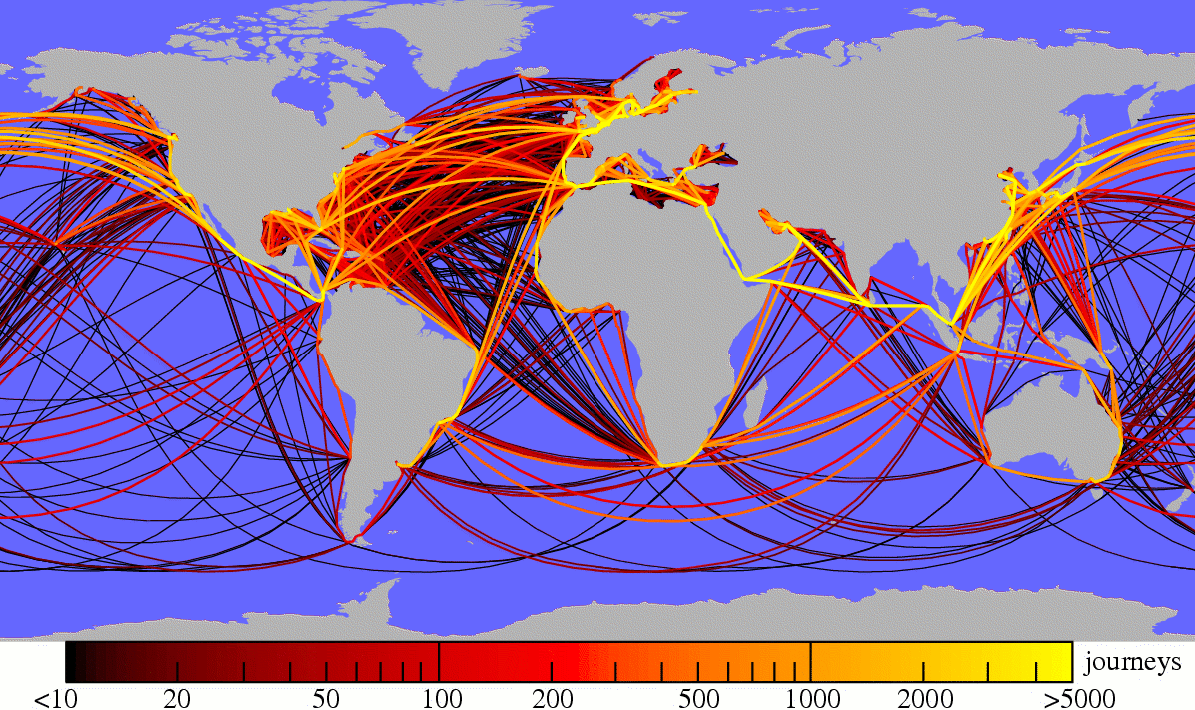
Modern production is often described as if it occurs within national industrial systems. In practice, many goods are produced through extended international supply chains in which extraction, processing, component manufacture, assembly, and delivery occur in different jurisdictions. A finished product may cross multiple borders before reaching the consumer. Production therefore operates not as a single localized process but as a coordinated movement across shipping routes, ports, warehouses, rail networks, highways, and distribution systems, much of it structured around standardized container transport as described in The Container Shipping System and the Architecture of Global Trade.
This structure developed as firms sought lower costs, higher specialization, and more efficient use of capital. Instead of producing entire goods within one geographic location, companies distributed different stages of production to regions offering specific advantages such as labor costs, industrial expertise, energy availability, regulatory environment, or tax treatment. Raw materials might originate in one region, intermediate components in another, precision manufacturing in a third, and final assembly in a fourth.
The result was a substantial increase in economic efficiency. Firms reduced costs by sourcing inputs from specialized producers while simultaneously reducing the need to hold large inventories. Instead of storing months of components in reserve, many industries adopted systems built around continuous replenishment. Parts arrive when required, move directly into production, and leave factories quickly as finished goods. Capital previously tied up in stockpiles is released, warehousing requirements shrink, and overall output increases.
Over time this model became the dominant structure of modern manufacturing. Supply chains were optimized for speed, cost minimization, and asset efficiency. Inventory buffers were gradually reduced. Redundant suppliers were eliminated where possible. Domestic backup capacity was often abandoned as inefficient. Production was reorganized around continuous logistical flow rather than local resilience.
The same structural choices that increased efficiency also created a new form of systemic vulnerability.
A production system designed around uninterrupted logistical flow becomes dependent on the stability of every node within that flow. If maritime shipping routes are disrupted, containers fail to arrive on schedule. If port congestion occurs, components remain stranded. If trucking capacity tightens, goods accumulate at the wrong points in the network. If customs systems slow or regulatory conditions change, production schedules begin to unravel. Where manufacturing depends on specialized suppliers, the failure of a single firm can prevent downstream factories from completing entire product lines.
Modern supply chains therefore distribute production geographically while concentrating operational dependence.
Although a finished product may involve dozens of firms across several countries, production frequently depends on a relatively small number of logistics corridors, container ports, transport routes, and industrial bottlenecks. Multiple industries rely on the same shipping lanes, the same container systems, the same freight networks, and the same critical intermediate inputs. The network appears widely distributed but often operates through shared infrastructure.
For this reason supply chain disruption rarely remains local. Delays within a major maritime corridor can affect inventories across continents. Congestion at a single port can alter delivery schedules throughout entire sectors. Energy shortages affecting transportation can raise costs across multiple stages of production simultaneously. Because manufacturing is synchronized across long-distance logistics systems, instability within transportation networks quickly propagates into the industrial economy.
The fragility of modern supply chains is therefore not accidental. It emerges directly from the optimization strategy used to design them. As examined in The Efficiency Trap: How Optimization Eliminates System Resilience, systems that remove redundancy in pursuit of efficiency become increasingly dependent on stable conditions, even as their capacity to absorb disruption declines.
Efficiency in this system is achieved by removing slack. Inventory buffers, redundant capacity, and alternative suppliers are treated as avoidable costs. The system functions smoothly when transportation networks remain stable because production stages remain tightly synchronized. When disruption occurs, however, the absence of slack means that even small delays can cascade rapidly across the network.
This dynamic produces a structural inversion between efficiency and resilience. The more completely a production system eliminates redundancy in order to reduce cost, the more dependent it becomes on uninterrupted logistics. Efficiency increases under normal conditions, but stability decreases under stress. What appears to be operational strength during periods of stability becomes structural weakness during periods of disruption.
In practical terms this means that logistics infrastructure is no longer merely supportive of production. It has become part of production itself. Shipping fleets, container terminals, freight rail systems, trucking networks, warehouses, customs processing systems, and digital logistics platforms now operate as integrated components of modern manufacturing. When logistics systems slow or fail, factories frequently follow within a short period.
The broader implication is that industrial capability now depends not only on domestic productive capacity but also on the reliability of international supply networks. A country may possess advanced manufacturing facilities and skilled labor yet remain unable to produce certain goods if a critical imported component becomes unavailable. Industrial output therefore rests on a combination of domestic capability and global logistical stability.
The global supply chain system expanded economic output by breaking production into internationally coordinated flows. That structure created remarkable efficiency, but it also embedded fragility within the architecture of modern industry. As production becomes increasingly synchronized across long distances, the stability of manufacturing becomes inseparable from the stability of the logistics networks on which it depends.