

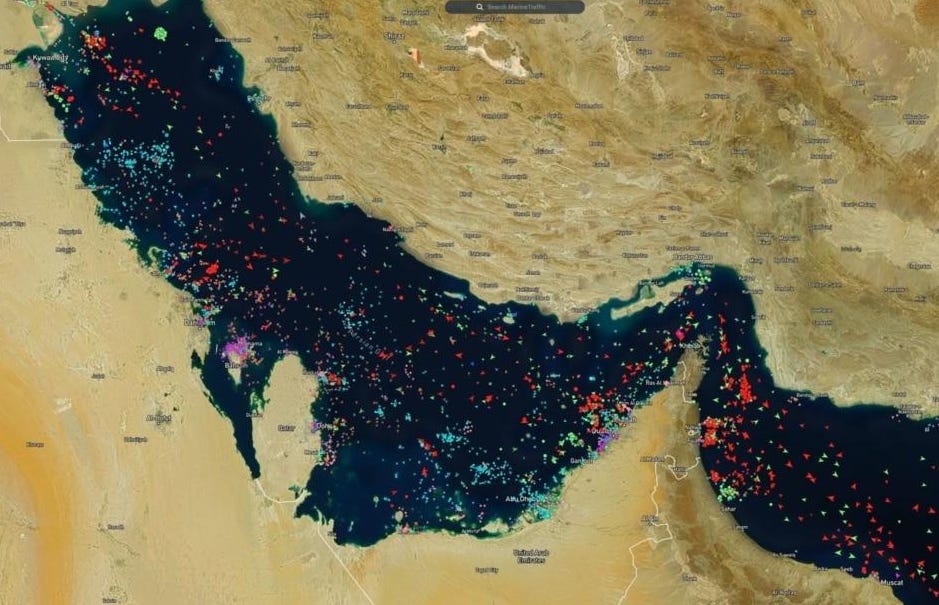
A market base case is supposed to make uncertainty usable. It gives traders, treasurers, policymakers, and risk managers a path to work from. It separates the central scenario from the tails. It tells a hedging desk how long protection may be needed, tells a corporate buyer whether to lock in supply, and tells a lender whether the shock is likely to pass before it damages credit quality.
That is the value of the form. It disciplines panic. It converts noise into a working frame.
Its limitation appears when the event is changing the structure that the base case treats as stable.
A base case built around visible diplomatic branches may be accurate for near-term market navigation while leaving a deeper structural question unresolved. It can track negotiations, statements, ceasefires, strikes, insurance rates, and shipping flows while treating the market structure itself as background. That assumption is safe only when the structure remains stable. It becomes dangerous when the crisis is changing the rules by which the market operates.
The Hormuz crisis is a useful test because the conventional analysis is not weak. In The Hormuz Odyssey: a new base case, Michael Every of Rabobank correctly treats the Strait of Hormuz as a central energy chokepoint, recognizes that reopening is not simply a political announcement, and brings insurance, mines, shipping reluctance, U.S.-Iranian negotiations, regional alignment, and economic statecraft into the same frame. His revised base case is that Hormuz may not return to normal operation for up to three months, with aggressive U.S. economic statecraft as the tail risk. That is serious market analysis, not superficial commentary.
The point is not that Every’s analysis is wrong. It performs the task conventional market analysis is designed to perform. Strategic Intent Analysis asks a different question: whether the crisis may be changing the market structure that the base case must assume in order to function.
Hormuz is the worked example. The larger question is whether Strategic Intent Analysis can produce a more accurate base case when the crisis itself may be reorganizing the market, security, and payment structures that conventional analysis treats as background conditions. The method was set out in Strategic Intent Analysis: Inferring Direction Through Structural Convergence, where institutional direction was framed as something that becomes visible through preparation, selection among alternatives, incentive alignment, and repeated structural reinforcement rather than through public statements of intent.
That question becomes sharper where the stated or implied premises of a war were strained before the war began. The Associated Press reported that a U.S. National Intelligence Council assessment completed shortly before the United States and Israel launched military action against Iran concluded that American military intervention was unlikely to produce regime change. According to that reporting, the assessment found that neither limited airstrikes nor a larger prolonged campaign would likely result in a new government taking over, even if the current leadership were killed; it also found that no powerful unified opposition coalition was positioned to take power and that Iran’s establishment would try to preserve continuity.
Where a stated political rationale is undermined by prior intelligence assessment, it should not be treated as a complete explanation. It may remain part of the public narrative, the diplomatic frame, or the legal justification. But the analysis must also ask what structural effects the action predictably enables.
In Hormuz, the conventional question is whether the strait reopens, when it reopens, and under what diplomatic terms. The stronger question is what the crisis makes possible before reopening occurs.
If Hormuz is treated as a temporary closure, the event is a disruption. If the crisis creates new dependencies before shipping normalizes, it becomes a restructuring mechanism.
The physical importance of Hormuz is already established. As discussed in Energy Chokepoints and Global Vulnerability: The Strait of Hormuz, modern energy systems appear diversified but remain concentrated in narrow corridors that cannot be easily substituted. The EIA describes Hormuz as one of the world’s most important oil chokepoints; in 2024, oil flows through the strait averaged 20 million barrels per day, about 20 percent of global petroleum liquids consumption, and around one-fifth of global LNG trade also moved through the strait.
But a tanker does not move because water is passable. It moves because insurers will insure it, owners will risk it, banks will finance it, ports will receive it, sanctions lawyers will approve it, navies will protect it, and payment systems will settle it. Hormuz is therefore not only a geographical chokepoint. It is a convergence point for commercial permission.
That is where a conventional base case reaches its natural limit. A ceasefire may reduce visible fighting without restoring commercial normality. Demining may begin without restoring insurer confidence. A lane may be militarily available and still commercially unusable. The strait can be “open” in a legal or physical sense while remaining non-normal in every sense that matters to markets.
Rabobank’s note is strongest precisely where it recognizes this complication. Iran may claim the strait is open to cooperative shipping. The United States may claim workable routes exist. Insurers may point back to military and political uncertainty. Shipowners may stay away. The result is closure without a clean legal author. Responsibility diffuses. Costs concentrate.
In that environment, the practical question becomes who controls the conditions under which Hormuz becomes usable again. That control does not sit in one capital. It sits across naval protection, insurance pricing, sanctions compliance, cargo eligibility, diplomatic recognition, and payment infrastructure. Power shifts toward the actors able to certify safety, authorize counterparties, clear payments, provide escorts, and define acceptable traffic.
The likely outcome may therefore be less a clean reopening than a functional bifurcation of permission. One path becomes commercially legitimate because it is naval-protected, insurance-approved, sanctions-compliant, and financeable through Western payment channels. Another path remains available to actors willing to accept Iranian authorization, tolls or equivalent charges, non-Western settlement, and higher legal, insurance, and enforcement risk. Hormuz would be open in physical terms but divided in structural terms. The same waterway would contain competing permission systems.
This is no longer a remote theoretical possibility. Reuters reported that Secretary of State Marco Rubio said a diplomatic deal with Iran would be unfeasible if Tehran implemented a tolling system in the Strait of Hormuz. Reuters also reported that later talks remained divided over control of the waterway, that the White House rejected an Iranian state TV account of a draft framework, and that Trump said the United States would monitor shipping after any deal while no single country would control the strait. The dispute is therefore not only over passage. It is over who defines the terms of passage.
This is where an SIA base case would move the emphasis. The central case is not merely that Hormuz remains outside normal operation for a period of months. The stronger base case is controlled non-normalization long enough to force adaptation by states, shippers, insurers, banks, energy buyers, and military planners. Those adaptations may then outlast the crisis.
That is the recurring pattern in systemic shocks. Emergency arrangements arrive as temporary measures. Over time, they become the operating environment. Risk controls become permission systems. Security measures become alignment tests. Liquidity support becomes dependency. Sanctions compliance becomes market architecture. The crisis resolves at the surface, but the structure does not return to its prior state.
Applied to Hormuz, the central market question is duration only at the first layer. The deeper question is durability. If buyers increasingly require protected routes, if insurers price political alignment into access, if naval guarantees become necessary for movement, if energy markets split into preferred and non-preferred channels, and if dollar-clearing or swapline access becomes part of the energy-security stack, then the crisis has done more than interrupt supply. It has repriced dependence.
Rabobank treats the risk of “de facto Balkanised global energy markets behind defence umbrella, clearing FX, and swapline ‘stacks’” as a tail extension; SIA would bring it closer to the center. It may be the structural direction toward which the crisis points.
Energy markets are never just commodity markets. They are political markets with physical inputs. They depend on geography, naval power, finance, law, insurance, infrastructure, and currency hierarchy. A shock to Hormuz exposes that hierarchy. It shows which countries have reserves, which have naval reach, which have currency power, which depend on imported flows, which exporters need protected passage, and which institutions can turn risk into obedience.
This is why Energy Sovereignty: The Precondition for Freedom matters here. A state that cannot reliably secure energy flows operates under external constraint regardless of formal sovereignty. Once energy access becomes conditional, law, trade, budget policy, industrial policy, and diplomatic independence become conditional with it. Hormuz is not merely testing oil supply. It is testing political option space.
In that sense, Hormuz is a dependency audit. It tests China’s exposure to Gulf energy. It tests Europe’s vulnerability to imported energy and logistics stress. It tests the Gulf states’ reliance on U.S.-aligned security arrangements. It tests the American ability to combine military reach with financial infrastructure. It tests whether global energy remains broadly fungible or becomes openly conditional on political and security alignment.
Strategic Intent Analysis examines function rather than statement. It asks what the crisis changes in practice: who gains leverage, which dependencies deepen, which constraints fall away, which forms of control become normal, and which arrangements are likely to remain after the immediate disruption ends. Applied to Hormuz, it moves the analysis from declared intent to structural result.
On that basis, the Hormuz crisis looks less like a temporary blockage than a forcing mechanism. Countries that treated energy security as a price problem now face it as an access problem. Firms that treated shipping risk as insurable now face the possibility that risk cannot be priced without political certification. States that assumed open global flows now discover that openness depends on military protection, sanctions tolerance, and monetary infrastructure.
The market is not merely reacting to the crisis. It is helping enforce the new conditions. Higher insurance premia, unavailable coverage, stranded cargoes, credit stress, margin pressure, fuel shortages, sanctions exposure, and payment uncertainty all compel adaptation. Repricing becomes discipline.
This is also a risk-management problem. If the crisis is analyzed as a temporary interruption, hedging will tend to focus on duration: how long prices stay elevated, how quickly shipping resumes, when volatility decays. That may lead to short-dated protection, trades built on the assumption that prices will quickly return to normal, or hedges built around crude alone. If the crisis is creating a durable permission structure around energy access, the real exposure is wider. It includes insurance availability, route approval, sanctions compliance, counterparty eligibility, product-specific shortages, dollar-clearing access, and the possibility that different participants face different effective energy prices. The point developed in Insurance and the Illusion of Risk Transfer applies directly here: formal protection can become permission to continue exposure, but it can also disappear, reprice, or exclude when correlated stress arrives. A hedge designed for temporary disruption may fail against structural repricing.
That changes what the analysis would track. The relevant signals are not only front-month crude, headline ceasefire language, or a declared reopening date. They include war-risk premiums, insurance exclusions, naval escort procedures, sanctions guidance, letters of credit, port acceptance, tanker queues, product spreads in diesel, bunker fuel, and jet fuel, and any evidence that Western-cleared and non-Western-cleared traffic are beginning to trade under different practical conditions. If the crisis is producing competing permission systems, the most important indicators may appear first in the plumbing of trade rather than in the public language of diplomacy.
That is why reopening may be the wrong endpoint. A reopened Hormuz under heavier naval supervision, tighter insurance discipline, politicized routing, sanctions-conditioned trade, and more explicit energy blocs would not restore the old market. It would institutionalize the crisis response.
A more accurate base case would therefore read as follows. Hormuz is unlikely to return to genuine pre-crisis normality within the forecast window, even if partial diplomatic arrangements are announced. The primary development is not binary closure or reopening, but the emergence of a semi-managed security, insurance, and payments regime around Gulf energy flows. Persistent disruption is likely to accelerate structural repricing across energy-linked supply chains, with greater reliance on state-backed maritime guarantees and intensified use of economic statecraft. The crisis should be understood as a possible transition point from global energy fungibility toward politically conditioned access.
That formulation does not require predicting every military or diplomatic branch. A ceasefire extension, partial demining, renewed strikes, NATO involvement, Chinese pressure, sanctions escalation, or bifurcated transit arrangements may appear to be different scenarios. Strategically, they can still reinforce the same direction: prolonged non-normality, deeper state involvement, and more conditional energy access.
That is the advantage of SIA over ordinary scenario analysis. Scenario analysis multiplies branches. Strategic Intent Analysis looks for convergence. Where different routes produce the same institutional result, the result matters more than the route.
The strongest objection is that crises are often disorderly. That is true. But disorder and strategic use are not opposites. Institutions exploit disorder without having to create every element of it. They also prepare for disorder in ways that reveal desired capacities. The analytical question is whether the event is being used to produce a structure that would otherwise have faced resistance.
That is the real base-case problem. Conventional analysis is comfortable with stated objectives. It is less comfortable with functional achievement. Yet in major geopolitical crises, stated purpose is often the least reliable guide to structural consequence. A crisis may be justified as restoration while functioning as transition. It may promise reopening while producing conditional access. It may describe emergency measures as temporary while embedding them into the future operating system.
Hormuz should therefore be read in two layers. On the surface, it is a dispute over Iran, uranium, mines, tankers, sanctions, and escalation. At the structural level, it is a test of whether global energy remains a market organized primarily by price or becomes a market organized increasingly by security permission.
That distinction is the investment question.
If normal commercial operation returns quickly and no durable controls remain, the conventional base case will have been sufficient. If the crisis leaves lasting changes in insurance behavior, maritime protection, sanctions enforcement, energy routing, reserve policy, payment architecture, regional alignment, hedging failure, or competing permission systems within the same waterway, the central event will not have been the closure of Hormuz.
It will have been the repricing of global dependence through Hormuz.
Tankers may move again. The old system may not.