

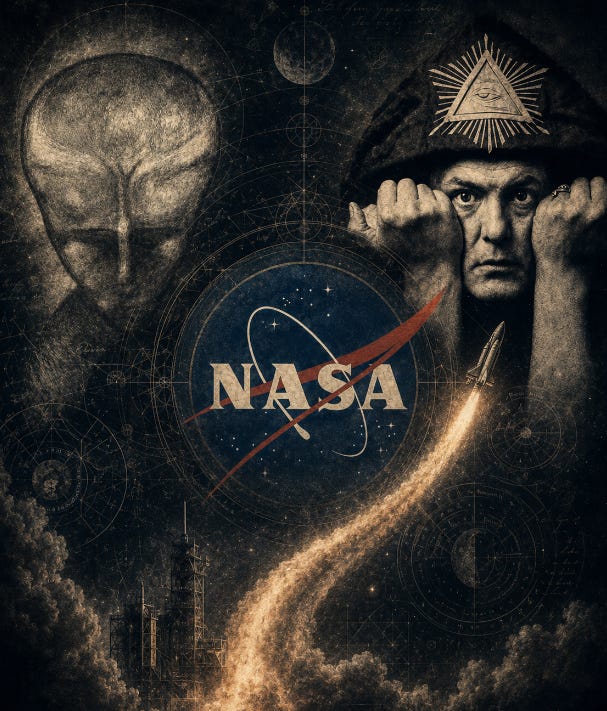
The modern history of the American space program is usually told as a clean story of engineering emancipation. Rockets replaced myth. Mathematics replaced ritual. Laboratories replaced temples. The astronaut became the symbolic representative of a secular civilization that had entered the age of technical mastery. NASA appeared as the public form of that transition: a civilian agency through which modern science crossed the boundary between earth and heaven.
That story is too clean.
The American space age emerged from a convergence field in which experimental rocketry, military intelligence, elite symbolic orders, ritual practice, occult philosophy, Nazi technical transfer, Cold War mythology, and the management of anomalous phenomena repeatedly intersected. The public narrative separated those strands after the fact. The historical record keeps putting them back together.
Jack Parsons is the clearest point of entry because he stands directly at the crossing. He was not a distant eccentric later attached to aerospace history by sensational writers. Parsons was one of the principal founders of the Jet Propulsion Laboratory and Aerojet, a pioneering figure in solid-fuel rocketry, and part of the Caltech-affiliated rocket research environment that later became central to the American aerospace system. He was also a committed Thelemite occultist working inside the ritual system of Aleister Crowley. Those facts belong in the same sentence because they belonged in the same life.
Parsons did not treat magic as metaphor. He treated ritual as operative. He joined Crowley’s Ordo Templi Orientis, became leader of its California Agape Lodge, and lived in a Pasadena house that drew occultists, writers, engineers, scientists, and other figures from the experimental culture of mid-century California. Later accounts of Parsons describe him reciting Crowley’s “Hymn to Pan” during rocket tests. He seems to have understood rocketry and ritual as related attempts to break through boundaries imposed on ordinary human life.
The Babalon Working makes the overlap explicit. In 1946 Parsons and L. Ron Hubbard performed rituals aimed at invoking or incarnating Babalon within the Thelemic system. The operation drew on ceremonial magic, sexual-magical practice, Enochian elements, and Crowley’s symbolic universe. Parsons’ own frame connected the operation to Moonchild and to the idea that ritual practice could participate in the production or reception of a transformative being. Crowley watched the episode with alarm.
The significance of the Babalon Working lies in the historical field in which it occurred. Parsons, Hubbard, Crowley, Babalon, rocketry, intelligence attention, New Mexico, and later UFO interpretation did not remain sealed from one another. They kept reappearing together because they belonged to a single zone of technological, symbolic, ritual, and national-security convergence.
Crowley’s Lam drawing belongs within the same field. Later writers repeatedly linked Lam’s image to the modern Grey archetype, and Kenneth Grant later connected Parsons’ Babalon Working to the beginning of the flying-saucer era. Those claims remain interpretive, but the recurrence matters. Contact imagery, ritual practice, non-human intelligence, altered-state communication, and aerospace mythology overlapped before the UFO issue entered its postwar public form.
The postwar aerospace story then adds a second line of continuity.
NASA did not arise from untouched civilian science. It emerged from military and intelligence structures shaped by the German rocket program and Operation Paperclip, the transfer of German scientists, engineers, and technical personnel into the United States after the Second World War. Wernher von Braun became one of the central public faces of the American space program. Before that, he had joined the Nazi Party, became an SS officer, helped lead V-2 development, and came to the United States through Paperclip.
The V-2 program cannot be separated from the system that produced it. Its production was tied to the underground Mittelwerk facility and the Mittelbau-Dora concentration camp, where enslaved laborers worked under brutal conditions. The rocket later folded into the heroic prehistory of American spaceflight was born inside a weapons system inseparable from forced labor, state terror, and the Nazi war machine.
Paperclip did more than transfer expertise. It absorbed personnel, habits, secrecy structures, strategic ambition, and moral compromise from the defeated Nazi system into the American aerospace-security state. The official story emphasizes necessity and technical advantage. The structural story is harsher. Compromised knowledge was laundered through national-security utility. Technology moved first. Accountability followed weakly, if at all.
That matters because the Nazi state had already joined technology, myth, racial ideology, ritualized elite identity, and civilizational destiny in a single institutional imagination. Himmler’s SS cultivated mythic and esoteric structures around racial origin, sacred history, ceremonial space, and elite identity. The Ahnenerbe pursued pseudo-historical and racial research under SS sponsorship. Wewelsburg Castle became a symbolic SS site associated with Himmler’s attempt to give the SS a ritual and ideological center. The technological state absorbed from Germany was not culturally neutral.
This is the question Paperclip leaves behind.
What else moved with the rockets?
Technical knowledge does not float free of the institutions that produce it. It travels with habits of secrecy, hierarchy, moral insulation, mythic purpose, and elite self-conception. The postwar American space program did not simply import equations and engines. It imported a lineage of weapons development, secrecy culture, aerospace ambition, and symbolic ascent from a defeated regime that had already fused technology and myth at scale.
The same symbolic density appears in the Masonic layer surrounding American space culture.
Buzz Aldrin was openly an active Freemason and is remembered in Masonic sources as the first Freemason to step on the Moon. Masonic accounts record that Aldrin carried Masonic material on Apollo 11 and that multiple astronauts were associated with the fraternity. This is not a peripheral curiosity. The astronaut corps and the aerospace-security environment operated inside elite cultures where initiation, fraternity, hierarchy, celestial symbolism, sacred geometry, ascent, and ritualized identity already had institutional form. The public saw astronauts as technical heroes. The deeper cultural field also made them initiates of ascent.
NASA’s public symbolism belongs to the same pattern. Its insignia places a vector, stars, orbital movement, a celestial field, and a red chevron-like form inside a blue sphere. Officially, this represents aeronautics, space, orbital motion, and national mission. But institutional symbols do more than decorate. They compress purpose into image. NASA’s emblem presents the agency as a threshold institution: earth, sky, vector, orbit, star field, ascent. It is the image of an organization built to pierce a boundary.
The same pattern appears in the terminology. Mercury, Gemini, Apollo, Saturn, Artemis, Orion, and related naming systems did not emerge from sterile engineering language. They drew from classical mythology: divine messengers, twins, titans, hunters, lunar goddesses, celestial archetypes. This was the public symbolic grammar of a civilization presenting spaceflight as destiny, initiation, and transcendence.
The UFO issue entered this field almost immediately after the war. As argued in Disclosure Without Resolution: The UFO Issue as Institutional Containment, the modern disclosure process is not simple transparency. The subject moved from ridicule into controlled seriousness while historical resolution remained withheld. The older containment model used denial, stigma, fragmentation, and ridicule. The newer model permits acknowledgment while preserving ambiguity, custody, and institutional control.
That framework matters here because the occult history of NASA touches the same machinery: aerospace, secrecy, contact interpretation, controlled disclosure, public mythology, and the withholding of integrated historical memory. The issue is not merely what was seen in the sky. It is the institutional and symbolic field through which such phenomena were received, interpreted, hidden, explained, or managed.
The deeper structure appears more clearly in The Intelligence State and the UFO Problem. That essay argues that anomalous evidence entering the intelligence state does not remain simply evidence. It becomes a security object, a classification problem, a technological custody problem, a witness-control problem, and a narrative-risk problem. The intelligence state manages anomalous evidence before it explains it because its primary institutional reflex is control before truth.
This is where the Collins Elite material becomes central.
The Collins Elite were a reported group or tendency within the American defense and intelligence environment, described most famously in Nick Redfern’s Final Events, that interpreted aspects of the UFO phenomenon through religious, occult, and demonic frameworks rather than through the simple extraterrestrial hypothesis. Within that reported framework, the concern was not merely unidentified craft. It was deception, ritual contact, hostile non-human intelligence, portals or entry points, and the possibility that occult operations had opened something later entangled with the UFO phenomenon.
Within that framework, Parsons’ rituals were not treated as symbolic theater. They were treated as operative acts with consequences. UFOs were not treated only as machines. They were treated as manifestations within a wider field involving ritual, deception, portals, non-human entities, and spiritual or metaphysical warfare.
Alleged Collins-related materials submitted or circulated in connection with recent congressional UFO proceedings place the matter in still more explicit form, while remaining materially different from public institutional admission. They refer to a 1997 Collins Elite meeting, to New Mexico Origins: Parsons, Hubbard and Babalon Working, and to concern that public knowledge of “the theory” would negatively affect global social order. Other referenced material speaks of entry points, of how to keep them closed, of the “Parsons technique,” of alleged laboratory manifestations, and of NASA-linked activity directed toward understanding or closing those openings. The status of these materials requires category discipline. They are not identical to public admission. But their content must be stated plainly. The reported framework directly connects Parsons, ritual technique, New Mexico, anomalous material, NASA-linked activity, and the closing of entry points.
That is the hinge. The occult history of NASA is not merely a historical curiosity about Jack Parsons. It is part of a larger pattern in which ritual practice, aerospace culture, national-security secrecy, anomalous phenomena, and institutional containment repeatedly re-enter the same frame.
The referenced titles matter. Parsons, von Karman and Goddard: A Door Unlocked and New Mexico Origins: Parsons, Hubbard and Babalon Working imply that someone inside this interpretive world saw Parsons, Hubbard, Babalon, early rocketry, Goddard, von Karman, New Mexico, Roswell, and the “door” as belonging to the same field of analysis. The titles do not prove the final interpretation. They show that the convergence had become an internal object of analysis rather than merely an outsider’s association.
This is where Compartmentalization and the Structure of Classified Power becomes necessary. Mature secrecy systems do not merely hide information from the public. They fragment visibility inside the state itself, preventing most participants from seeing purpose, scale, and consequence together. If ritual interpretation, aerospace experimentation, anomalous material, intelligence custody, and NASA-linked activity were distributed across compartments, the resulting public incoherence would not be accidental. It would be the predictable form produced by classified power.
Compartmentalization also explains why the pattern can be both visible and officially unresolved. One office can hold technical knowledge. Another can manage witnesses. Another can hold theological or occult interpretation. Another can operate under aerospace cover. Another can control public narrative. Each compartment may see only its own function, while the integrated pattern remains unavailable to ordinary oversight and ordinary public understanding.
That structure is exactly what makes the subject hard to write about. The strongest pattern is not always located in a single admitted document. It appears across the convergence of documented persons, known institutions, reported internal interpretations, symbolic continuity, classified structures, and recurring attempts to manage the boundary between public knowledge and hidden custody.
Claims about advanced German wartime research and unconventional propulsion remain uneven, but they belong to the same wider field of postwar secrecy, Paperclip continuity, aerospace mythology, and anomalous technology claims.
The analytical task is pattern recognition under constraint. Documented facts, reported institutional interpretations, and structured inferences are not identical categories. But they do point in the same direction: the American space age was born inside a field where technology, ritual, military secrecy, mythic ascent, occult operation, Nazi inheritance, elite initiation, and anomalous-contact interpretation were repeatedly entangled.
That entanglement is a form of order, but not natural order.
As argued in The Corruption of Order, institutions become disordered when outer forms remain while animating purposes are severed, inverted, or replaced. A false system can preserve the language and appearance of legitimacy while serving a different internal logic. In the space age, the public form was scientific progress. The deeper structure also contained ritualized ascent, secret custody, elite symbolic culture, weapons inheritance, and mythic projection into the heavens.
Modernity claimed to leave ritual behind. The space program reveals something more complicated. Ritual did not disappear. It was translated into institutional form, technological spectacle, symbolic naming, elite initiation, classified custody, and national myth. The temple did not vanish when the rocket rose. The architecture changed.
NASA therefore cannot be understood only as a technical agency. It was also a myth-producing institution, a threshold system, a symbolic machine, and a public face of a deeper aerospace-security architecture. Its history contains engineering, but also ritual. It contains science, but also secrecy. It contains national aspiration, but also absorbed Nazi power. It contains secular language, but also mythic structure. It contains public exploration, but also the management of anomalous phenomena whose meaning has never been publicly resolved.
That is why the occult history of NASA matters.
It is not a decorative footnote to the space age. It is one of the places where the modern world reveals that it did not abandon ritual, myth, hierarchy, or the management of anomalous contact claims. It mechanized them, classified them, renamed them, and launched them under the sign of science.
The method, subjects, and selected essay index for Strategic Intent Analysis are organized at strategicintentanalysis.com.