

There are moments when price tells the truth. There are other moments when price tells the story the market wants to hear.
Oil is now caught in that second condition. Crude prices have softened on the expectation that a political settlement may reopen the Strait of Hormuz, whose systemic importance was examined in Energy Chokepoints and Global Vulnerability: The Strait of Hormuz. But the physical oil system is telling a different story. Flows remain impaired. Inventories are falling. Strategic reserves are being used. The major oil companies are no longer speaking in the language of distant risk. They are talking about depleted buffers, weakened shock absorbers, and inventory levels approaching territory they regard as abnormal.
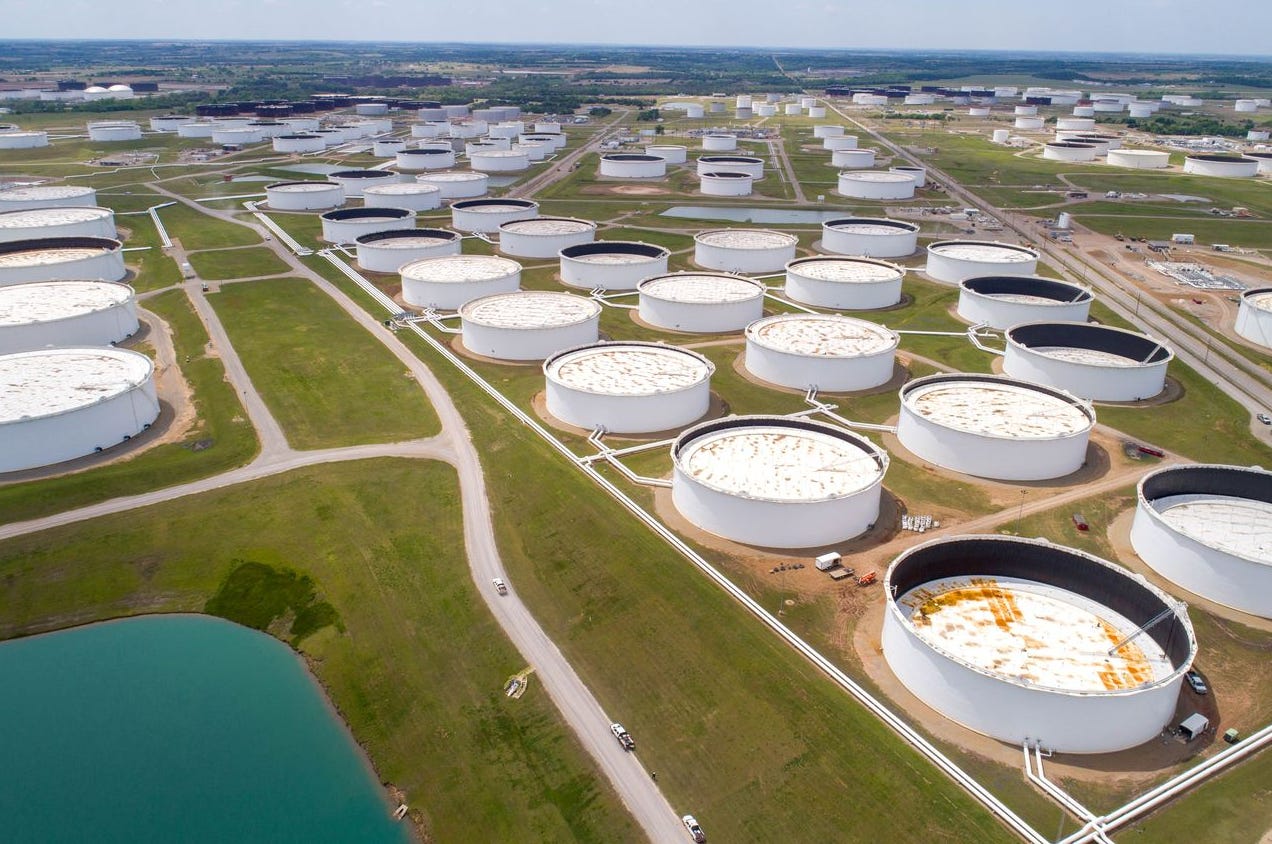
That is the oil inventory illusion. The market appears supplied because it is drawing down the inventories that make it appear supplied. The price looks calm because traders are pricing the hope of rescue rather than the fact of depletion. The system appears stable because the buffer has not yet vanished.
Oil is usually described as a commodity, a reserve, a price, or a geopolitical weapon. In practice, it is closer to the circulatory system of the industrial economy. It has to move continuously through tankers, pipelines, ports, refineries, terminals, insurers, banks, traders, and buyers. Inventory is not just stored supply. It is working blood volume. It lets the system keep functioning when flow is impaired.
That is why inventories can hide stress. A body can compensate for impaired circulation for a time. The pulse may still be present. The person may still be standing. But reserve capacity is being consumed. Once compensation fails, the change is not gentle. What looked manageable becomes unstable. What seemed gradual becomes sudden.
Oil behaves in a similar way. The system does not fail when the world runs out of oil. It fails when circulation can no longer be maintained. A barrel sitting somewhere in the world is not the same as a barrel that can be moved, insured, financed, refined, and delivered where it is needed.
That is why the recent warnings from Chevron and Exxon matter. Speaking at Bernstein’s Strategic Decisions Conference, Chevron chief executive Mike Wirth warned that the market’s buffers and shock absorbers were being steadily drawn down, reducing its ability to absorb the imbalance. He pointed to June and July as the period when physical pressure could become more directly visible. Exxon’s warning at the same conference was even sharper. Senior vice president Neil Chapman described commercial inventories of crude and refined products as having been run down, with strategic reserve releases helping to soften the immediate impact. He then said inventories were approaching unusually low levels and that Exxon’s models showed Dated Brent could move sharply higher, potentially into the $150 to $160 range, before demand destruction restored balance.
The exact price is not the important part. The mechanism is. Inventory depletion can suppress the visible crisis until the system reaches a threshold. After that, price does not have to adjust gradually.
The official inventory data point in the same direction. In the week ending May 22, 2026, U.S. crude stocks fell again. Gasoline inventories fell. Distillate inventories fell. The Strategic Petroleum Reserve also declined, while refinery utilization rose above 94 percent. None of these numbers by itself proves a crisis. Together, they show a system leaning harder on its working buffer while a major supply route remains impaired.
U.S. exposure is often misunderstood. The United States does not import most of its crude from the Gulf, and direct U.S. dependence on Hormuz is limited. But oil shocks travel through more than direct import dependence. They move through global price formation, refinery configuration, product markets, shipping, insurance, regional logistics, and inventory depletion. A country can be relatively secure in production terms and still exposed to circulation failure in the wider system.
That matters because the petroleum system is not one inventory number. Crude stocks, gasoline stocks, diesel stocks, jet fuel, refining capacity, imports, exports, tanker availability, and strategic reserves all perform different functions. A system can look adequate in aggregate while becoming stressed in the specific places and products that matter. This is the structural problem examined in Energy Infrastructure Concentration and System Fragility: modern energy systems concentrate throughput in a limited number of high-value nodes, where efficiency creates hidden vulnerability. The relevant issue is whether the system has enough working stock to maintain circulation under stress.
Failure in an oil system does not begin with empty tanks everywhere. It begins with dislocation. The wrong crude is in the wrong place. Refiners cannot reliably secure the feedstock they need. Ships become harder to insure. Cargoes require higher risk premiums. Product markets start separating from crude benchmarks. Diesel, jet fuel, and gasoline prices move unevenly across regions. Governments intervene more visibly. Buyers stop assuming delivery and start competing for immediacy.
The market is currently pricing a different layer of reality. It is not mainly pricing inventories. It is pricing the possibility of political resolution. In a narrow trading sense, that is understandable. If traders believe a deal will arrive before the inventory floor matters, prices should fall. But that belief creates its own danger. Lower prices reduce the incentive for demand destruction. Consumption remains stronger than it would be under crisis pricing. Inventories drain faster. The market’s confidence that rescue will arrive before the buffer disappears can itself accelerate consumption of the buffer.
This is the physical counterpart to the pattern examined in The Liquidity Illusion. In financial markets, visible stability can coexist with growing fragility when prices reflect expected support rather than underlying repair. In oil, price calm can serve the same function. It may reflect confidence that political rescue will arrive before physical constraint forces correction. The signal does not become fraudulent. It becomes conditional. Price begins to describe expectation more than condition.
A deal would not invalidate the problem. It would change its form. The market can reprice on an announcement. The oil system cannot circulate on an announcement. Political permission may return before physical flow, commercial confidence, and inventory balance are restored. Ships must return. Insurers must cover. Cargoes must be financed. War-risk premiums must normalize. Tankers must be repositioned. Refineries must rebuild schedules. Inventories must be replenished. A signature can be instantaneous. Circulation cannot.
This timing problem is intensified by politics. A president facing fuel-price pressure, war fatigue, party pressure, and approaching elections has every incentive to declare progress as soon as a plausible agreement can be announced. That does not mean an announcement would be false. It means the political system can recognize success before the oil system has restored circulation. The market may then price the political event as if it were an operational event.
The most dangerous outcome may therefore be false stabilization. A deal may be signed before physical flow, commercial confidence, and inventory balance are restored. Prices could fall before supply meaningfully improves. Demand destruction could weaken or reverse. Consumption could continue at levels the physical system cannot yet support. In that scenario, the agreement would not end the inventory illusion. It would extend it. Price relief would arrive before circulation recovery, letting the system draw down its remaining buffer more quickly while appearing more stable than it is.
The Strait of Hormuz makes the problem larger than a shipping disruption. It is a physical chokepoint, but it is also a permission chokepoint. In comments reported from a Bloomberg TV interview, Wirth said Chevron would not pay a toll to move ships through Hormuz. Reuters also reported that Chevron had third-party chartered vessels in the waterway, meaning shipowners, not Chevron alone, would decide whether vessels moved. Wirth emphasized that shipowners and insurers must feel confident before normal movement resumes.
That distinction matters. A waterway does not function merely because it is physically passable. It functions when ships sail, insurers cover, banks clear, crews accept risk, cargoes are financed, and governments tolerate the legal and diplomatic exposure. A ceasefire may reduce immediate fear, but it does not automatically restore normal flow. A disrupted circulation system recovers in stages.
This is the point developed more broadly in The Hormuz Base Case Reconsidered: reopening may be the wrong endpoint if the real change occurs in the permission structure surrounding energy access. Tankers may move again while the old system remains altered. The issue is not binary closure or reopening. It is whether global energy flows return to normal commercial operation or become more explicitly conditioned by security, insurance, sanctions, and payment architecture.
Strategic reserves can also be misunderstood. A strategic petroleum reserve is not a substitute for functioning supply. It is an insurance policy. It transfers stress from price into inventory. It buys time. If that time is used to restore supply, the reserve has performed its function. If it is used to preserve the appearance of normality while physical disruption continues, the reserve becomes part of the illusion.
The oil market is therefore asking a harder question than whether Hormuz reopens. It is asking whether political resolution arrives before operational stress becomes visible to consumers, refiners, shippers, and governments. Timing matters because the adjustment is not linear. As long as inventories can be drawn down, shortage is concealed. Once working inventories approach the operational floor, buyers are no longer competing for abstract supply. They are competing for immediate usable barrels.
This is why the risk is not simply higher prices. It is discontinuity. If flow normalizes before the working buffer is exhausted, the market’s confidence may prove justified. If inventories reach operational stress levels first, the adjustment is unlikely to be smooth. Price would no longer be pricing future supply. It would be pricing immediate access. That is what an oil shock looks like: not the discovery that oil has disappeared, but the abrupt realization that circulation can no longer be maintained at the old price.
That is why the Chevron and Exxon statements are significant. They come from operators whose businesses depend on physical flow rather than narrative resolution. They are describing a system in which the visible price does not yet reflect the exhaustion of the buffer. The market may still be right if disruption resolves quickly enough. But the closer one is to the physical oil system, the less convincing the market’s calm appears.
The lesson is not that oil must reach any particular price. The lesson is that price can fall while fragility rises. A lower price can reflect confidence in rescue, not evidence of repair. A calm market can coexist with a weakening supply system. And when a system remains calm only because it is consuming its own reserves, the calm itself becomes part of the risk.
That is the oil inventory illusion. The market is not calm because the problem has been solved. It is calm because the solution has been borrowed from inventory.