

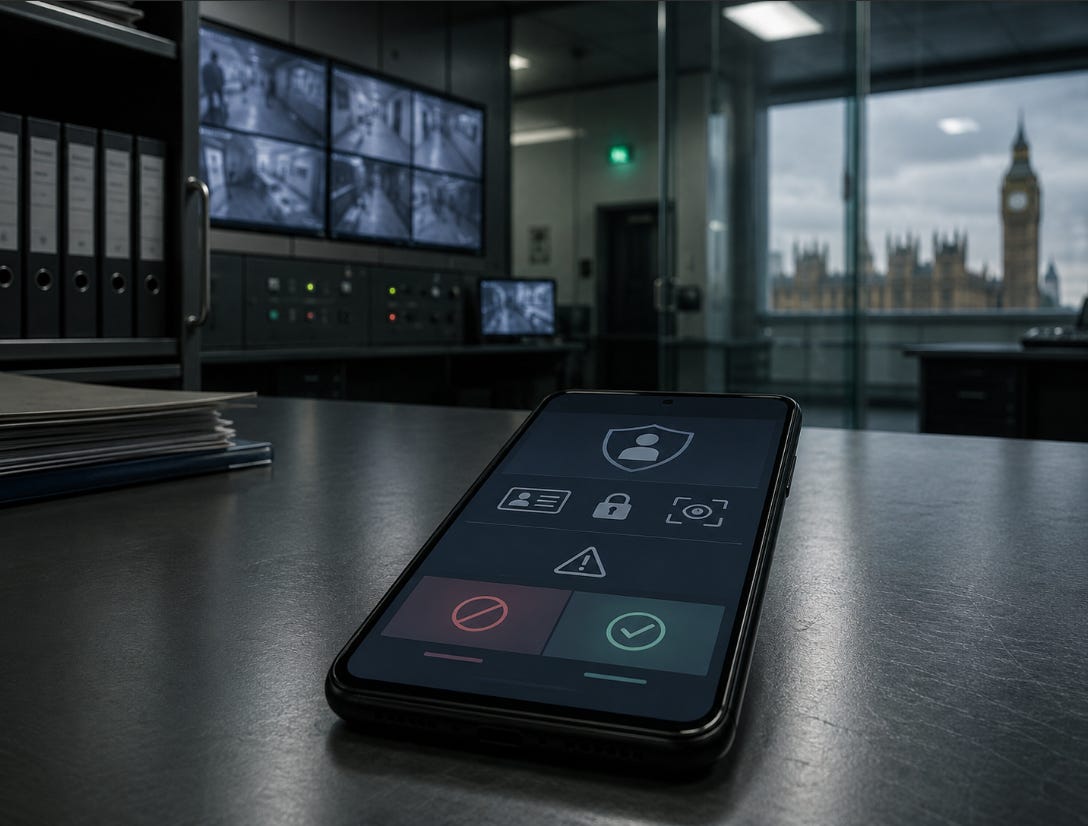
The British state did not fail to protect children because it lacked access to ordinary citizens’ phones. It failed with reports in hand, institutions in place, files open, names known, powers available, and children already within reach of police, prosecutors, councils, churches, hospitals, broadcasters, charities, and safeguarding bodies. The missing instrument was not surveillance. The missing thing was judgment.
That is why the new demand for phone-level control should be read against the record that produced it. The United Kingdom now proposes to make children’s devices block nude images, with Apple, Google, and other technology companies pressed to build safeguards into the device itself. The government presents this as child protection. It says Britain will become the first country where children cannot take, share, or view nude images on their devices. Starmer has reportedly given major technology companies until September 2026 to implement the controls or face legislation, fines, and possible criminal liability.
The stated subject is children. The actual mechanism is the phone. That is the point. The proposal does not merely ask police to investigate offenders or courts to punish crime. It moves enforcement into the operating environment of the device. The phone must classify the user, assess the content, and condition access before ordinary communication occurs. A private instrument becomes a compliance surface.
This is a major change in the relationship between person and state. A lawful order may punish crime without inspecting the innocent. It may protect children without making every device an instrument of supervision. It may pursue offenders without treating the whole population as a suspect class. Once inspection moves to the device, protection remains the public language, but permission becomes the architecture.
The British record makes the claim especially weak. Britain’s central child-protection failures were not failures of technical visibility. They were failures of institutional will. That was the point of Savile and the Architecture of Inversion. Jimmy Savile was not hidden. He was famous, honored, welcomed, and granted access across media, hospitals, charities, schools, youth institutions, and vulnerable settings. Reports existed. Concerns existed. Staff knew. Police knew enough to inquire. The problem was not that authority could not see. The problem was that authority did not move.
In 2009, the Crown Prosecution Service did not prosecute Savile. Keir Starmer was Director of Public Prosecutions at the time. The familiar defence is that he was not the individual reviewing lawyer. That may answer a narrow procedural allegation. It does not answer the institutional one. Savile was not an ordinary suspect. He was a nationally famous figure, publicly honored by the monarchy, knighted, welcomed into royal circles, and associated with the man who is now King. A file involving such a figure was not merely a criminal file. It was a file carrying institutional exposure. It was either escalated within the prosecuting authority or it was not. If it was escalated, responsibility reaches the top. If it was not, the institution Starmer led was so defective that a nationally explosive file did not reach the Director of Public Prosecutions. Neither version gives the later Prime Minister moral standing to invoke child protection as the reason for inspecting everyone else’s devices.
That is the hinge of the essay. Starmer is not incidental. He connects the failed prosecutorial institution to the new compliance demand. The same legal-administrative class that failed when protection required confronting reputation, royal proximity, media power, prosecutorial discretion, and institutional embarrassment now becomes urgent when protection can be translated into technical control over ordinary people.
The pattern is not limited to Savile. Epstein the System showed the American version of the same form: a network processed through legality in a way that narrowed rather than exposed the structure. Epstein’s 2008 resolution contained the case, concealed the settlement from victims, and extended protection to unnamed potential co-conspirators. Years later, public attention expanded. Names circulated. Outrage rose. The central node was removed. Ghislaine Maxwell was convicted. The larger structure largely survived.
That is how protected harm is usually preserved. It does not need to announce itself. It narrows the file. It raises thresholds. It delays. It compartmentalizes responsibility. It isolates the public story around one usable figure. It allows enough truth to appear that pressure can be discharged, while ensuring the surrounding structure is not judged.
The Vatican and the Management of Evil supplies the sacred form of the same problem. The issue there is not merely that abuse occurred inside a religious institution. Evil can enter any institution. The question is what the institution protects after evil is known. The Catholic hierarchy spoke the language of holiness, confession, protection, innocence, and pastoral care while repeatedly managing allegations, protecting reputation, transferring responsibility, and preserving hierarchy. The linked essay records the John Jay figure of 4,392 accused priests and deacons in the United States between 1950 and 2002, and IICSA’s finding in England and Wales of more than 900 complaints involving over 3,000 instances connected to the Roman Catholic Church between 1970 and 2015.
That matters here because protective language can survive after the object of protection has changed. An institution may still say “children,” “safety,” “safeguarding,” and “duty,” while its conduct protects reputation, hierarchy, continuity, or control. The test is not the vocabulary. The test is where the institution acts when protection becomes costly.
Rotherham and Telford bring the indictment into the civic state. The Jay report estimated that at least 1,400 children were sexually exploited in Rotherham between 1997 and 2013. IICSA examined the wider failure of state and non-state institutions in England and Wales to protect children from sexual abuse and exploitation. The Telford inquiry found more than 1,000 children were sexually exploited over decades, with authorities failing to investigate properly and, in some cases, blaming children while offenders were emboldened.
These were not failures caused by a lack of access to private phones. They were failures inside institutions already charged with protection. Police, councils, schools, social services, prosecutors, churches, hospitals, charities, broadcasters, and political authorities did not need universal device inspection in order to act on reports, patterns, witnesses, local knowledge, and files. They needed the will to protect children when doing so imposed a cost on adults, institutions, reputations, and settled arrangements.
That is why the present phone proposal is so revealing. It does not begin with institutional confession. It does not begin with prosecutorial accountability. It does not begin with a review of failed charging decisions, protection for whistleblowers, consequences for officials who buried credible reports, or serious scrutiny of elite access to vulnerable children. It begins with the public’s device.
The burden moves downward. Institutions failed; the citizen is scanned. Authority hesitated; the phone is redesigned. Children were not protected where protection required courage; now children are used to justify compliance where obedience can be automated.
This is the central lesson of The Sacrificial Prince. Powerful institutions do not always protect every exposed figure forever. They protect until protection threatens legitimacy. Then they sacrifice a node large enough to absorb public anger but small enough to preserve the architecture around it. Savile became the dead monster. Epstein became the removed center. Maxwell became the convicted facilitator. Andrew became the reputational sacrifice without criminal exposure. Each loss looked significant. Each boundary mattered more than the loss.
The same logic applies here. The state can admit child-protection failure in limited ways. It can express urgency. It can speak of harm. It can point to the worst cases. Then it can redirect the remedy toward wider authority. Failure becomes the argument for new reach. The institution does not say, “We failed, so our power must be examined.” It says, “Harm occurred, so the public must be monitored.”
That movement belongs inside the longer British surveillance trajectory described in The Architecture of Continuous Monitoring. Britain did not become a monitoring state overnight. It built the condition layer by layer: public cameras, communications-data powers, metadata access, platform duties, identity checks, administrative intervention, online-safety regulation, and increasingly flexible authority over speech and association. Each layer had its own justification. Together they made continuous observation part of ordinary governance.
The phone extends that architecture into the most intimate device most people own. Cameras watch streets. Metadata maps contacts. Platform rules govern online spaces. Digital identity binds people to records. The phone is closer. It holds photographs, messages, movement, money, authentication, health access, family memory, work, reading, and speech. Once the phone becomes the compliance surface, ordinary life becomes conditionable. The person carries a checkpoint in his hand.
This is more durable than old censorship. Old censorship acted after expression. Device compliance acts before expression. It works at the point of capture, storage, transmission, viewing, and sharing. The user does not meet a censor at a desk. He meets an operating system, an age gate, a blocked function, a warning screen, a required verification, or a silent classification. Control becomes ordinary use.
Signal’s objection goes to this architecture because encrypted communication depends on the provider not seeing the message and the device not being turned into the state’s inspection agent before the message is protected. Its warning that age verification and content scanning “will not safeguard children” and “endangers us all” is not only a privacy claim. It identifies the structural impossibility of contained inspection. Once the device must examine content before encryption or transmission, the private sphere has already been pierced at the point where privacy is supposed to begin.
This is constitutional in the older sense: before administration, before balancing tests, before regulatory risk models, there must be a domain of life into which authority does not enter without cause. Private communication is part of that domain. If the device is conscripted into preemptive inspection, the state may still say it does not read every message, the company may still say scanning occurs locally, and the system may still say only one category is being detected. But the deeper change has already occurred. Privacy has been converted from a condition into a permission.
Formal legal limits may slow expansion, but they do not remove the installed capacity. Once inspection exists at device level, future expansion requires redefining the trigger, not rebuilding the architecture. What begins as nudity detection can become detection of other prohibited images, then prohibited speech, then prohibited symbols, then prohibited associations, then categories defined later by regulation, platform policy, risk scoring, emergency, or political pressure. The public is asked to trust that a machine built for inspection will remain confined to the first moral justification used to install it. History gives no reason for that confidence.
The state’s defenders will answer that the measure is for children. That answer is not enough. Children were also the declared concern in the institutions that failed them. The BBC had public-service language. The CPS had justice language. Councils had safeguarding language. Police had protection language. The Church had sacred language. The vocabulary was present. It did not control conduct when power was implicated.
The proper remedy would begin closer to the failure. It would make the prosecuting authority answer for missed cases. It would expose why credible reports were not acted upon. It would protect staff who raised concerns. It would examine access granted to celebrities, clergy, officials, donors, and insiders. It would remove reputation as a shield. It would ensure that hierarchy bends before violated innocence. It would place responsibility where children were actually failed.
Instead, the proposed remedy begins with everyone else’s phone.
That is why this cannot be treated as a narrow child-safety measure. It is the convergence of failed safeguarding, protected harm, controlled accountability, continuous monitoring, and conditional participation. It belongs to a state form in which every failure becomes a claim for more access, every risk becomes a reason for more classification, and every vulnerable group becomes the moral front for wider control.
The British state’s child-protection record does not create an entitlement to inspect private life. It creates a duty of confession, reform, and accountability. The state failed children when protection required confronting protected men and protected institutions. It now invokes children to justify power over everyone else: the institutions that would not judge themselves now demand machinery that can judge everyone else.