

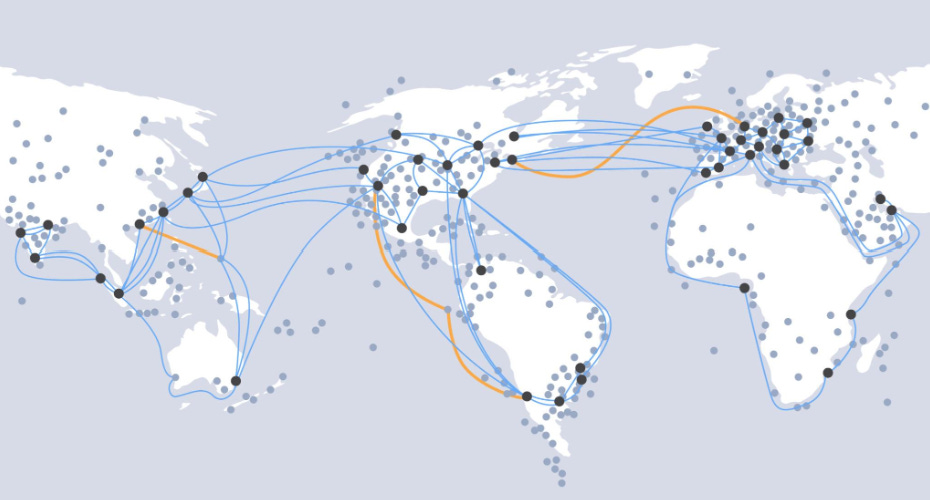
The internet is commonly described as a decentralized network. The term suggests a system designed for resilience, redundancy, and distributed communication. Data appears to move through an abstract digital space—wireless signals, satellites, and invisible connections linking billions of devices.
The physical architecture of global communication is very different.
Nearly all intercontinental internet traffic travels through submarine fiber-optic cables laid along the seabed. These cables carry the overwhelming majority of the world’s international data: financial transactions, cloud computing traffic, video communication, government networks, and ordinary internet activity. Satellite communication exists, but its capacity is small relative to fiber networks. The global internet, despite its digital character, depends primarily on a network of physical cables connecting continents.
The scale of this dependence is rarely recognized. A few hundred submarine cable systems form the backbone of international connectivity. These cables emerge at specific coastal landing points where global networks connect to national terrestrial fiber systems. From those points, traffic moves through domestic networks to regional exchanges, data centers, and local infrastructure.
The apparent fluidity of the internet rests on a chain of specific physical nodes.
This produces a structural contradiction. The internet appears decentralized at the user level but is concentrated at the infrastructure level. Global connectivity depends on narrow corridors of cable routes and a relatively small number of landing stations where cables reach land.
These corridors are not evenly distributed. Many of the most important routes pass through geographic chokepoints where continental networks converge. The Mediterranean corridor linking Europe, the Middle East, and Asia; the Red Sea route connecting Europe and the Indian Ocean; and parts of the North Atlantic carrying traffic between North America and Europe all concentrate large volumes of global communication. Damage or disruption within these areas can affect digital connectivity across multiple continents simultaneously.
The cables themselves are technologically advanced but physically fragile. Submarine fiber-optic cables consist of bundles of extremely thin glass fibers surrounded by protective layers of insulation and steel armor. In deep ocean environments they are relatively secure, but near coastlines they remain exposed to fishing activity, ship anchors, and geological hazards. Many historical cable disruptions have occurred through accidental damage rather than deliberate action.
Repairing a cable is complex and time-consuming. Specialized vessels must locate the damaged segment on the seabed, retrieve the cable, splice the fiber, and relay it to the ocean floor. During this process traffic must be rerouted across alternative systems where capacity exists. Because many cables follow similar routes, localized events can sometimes affect several systems simultaneously.
The strategic implications of this infrastructure are substantial.
Modern financial markets depend on extremely fast communication between global financial centers. Cloud computing systems require high-capacity links connecting data centers across continents. Military communications and intelligence networks also rely extensively on these same cable systems. Modern economies function on the assumption that high-speed international data transmission will remain continuously available.
Despite this reliance, submarine cables remain largely invisible in public discussion of digital systems. Public attention typically focuses on software platforms, social media companies, or artificial intelligence. The physical infrastructure enabling global communication receives comparatively little attention, even though it forms the foundation upon which these systems operate.
Ownership patterns reveal an additional structural shift. Historically, telecommunications companies financed and operated submarine cable systems. Over the past decade, large technology companies have increasingly invested in or directly built cable networks to support global cloud infrastructure. Firms such as Google, Meta, Microsoft, and Amazon now participate in the ownership or financing of many new cable projects.
For these companies, controlling physical connectivity reduces latency between global data centers and increases reliability for large-scale digital services. The companies that operate global information platforms are therefore becoming partial owners of the infrastructure that connects the world’s digital systems.
Seen in this context, submarine cables represent more than telecommunications infrastructure. They are the physical transport system of the digital economy.
This pattern mirrors the role of energy infrastructure in geopolitical power. Political independence depends heavily on control of energy supply, a dynamic explored in Energy Sovereignty: The Precondition for Freedom. Nations that cannot secure their own energy supply remain structurally constrained in their political choices.
A similar principle increasingly applies to digital infrastructure. States whose international communication depends on cable routes and landing stations beyond their control face comparable dependency. Digital sovereignty, like energy sovereignty, ultimately rests on control of physical infrastructure.
The destruction of the Nord Stream pipelines demonstrated how rapidly infrastructure disruption can reshape geopolitical realities, as examined in Nord Stream and the Discipline of Reality. Modern systems often appear abstract until the moment their physical foundations are interrupted.
The internet follows the same pattern.
Digital communication appears borderless and distributed, yet it depends on a relatively small number of fragile physical pathways lying across the ocean floor. The network that connects billions of people ultimately rests on cables no wider than a garden hose.
The internet is often imagined as weightless.
In reality, it is a global physical system built from glass fibers stretched across the seabed.