

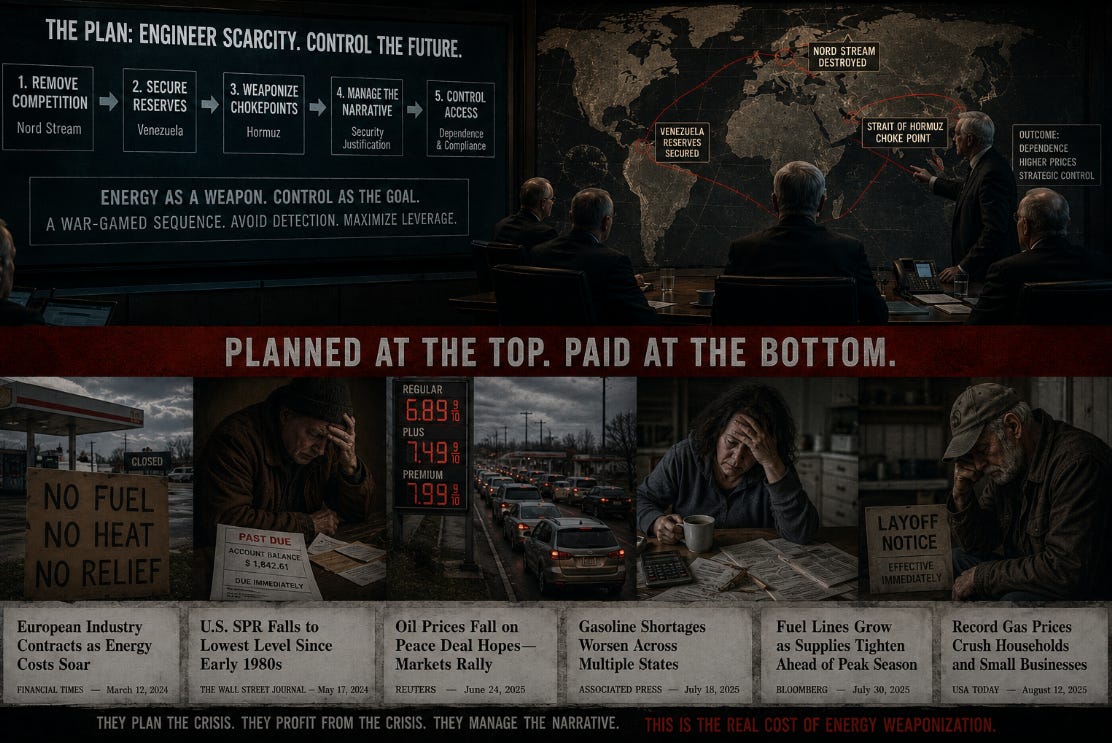
This is a predictive essay in the Strategic Intent Analysis sense. It applies a specific analytic method to an already visible sequence: doctrine, prior operations, physical constraints, beneficiary alignment, narrative preparation, and system behavior. The fuel line has not yet become the dominant public fact. The structure that produces it is already visible. Publication before the event is part of the test. If the method is sound, later events should begin to confirm the structure described here.
The planned oil crisis is already underway. The public phase has not yet fully arrived. That is the part still missing.
The record now supplies the necessary anchors. Energy has been placed inside national security strategy. The 2025 National Security Strategy identifies energy dominance as a top strategic priority and ties energy production, exports, industrial capacity, defense readiness, allied dependence, and adversary constraint into one field of policy. That is the governing fact. Once energy is placed inside national security, oil and gas no longer operate chiefly as public supply. They become instruments of state power.
Cheap and reliable energy for households, farms, factories, transport systems, and small businesses is a public-abundance objective. Energy dominance is different. It asks who controls production, refining, shipping, reserves, payment channels, sanctions exposure, maritime protection, and emergency allocation. Public abundance tries to make energy ordinary. Strategic control makes energy conditional.
The method for reading this structure was set out in The Method of Structural Inquiry. Official explanations are not verdicts. They are claims to be tested against observable conduct, public record, omissions, incentives, consequences, and repeated behavior. Strategic Intent Analysis applies that discipline where the public explanation fails to account for the trajectory. It reads preparation, alignment, reinforcement, narrative narrowing, and repeated structural movement. It does not wait for confession.
Planned is used here in the Strategic Intent Analysis sense. The plan is visible through documented acts, stated doctrine, predictable consequence, beneficiary structure, narrative preparation, and repeated reinforcement. It does not require a single public document announcing centralized authorship. It does not require the system to confess. It requires a coherent operational sequence whose parts move in the same direction. That condition is present here.
The public is shown the energy sequence in pieces. Nord Stream is filed as a Russia-Ukraine story. Venezuela is filed as a sanctions or democracy story. Hormuz is filed as an Iran security story. U.S. crude exports are filed as a market story. Strategic reserves are filed as a technical inventory story. Gasoline prices are filed as a consumer inflation story. Fuel lines, if they appear, will be filed as a temporary emergency. The public is handed fragments in separate folders. The structure appears only when the folders are put back in order.
That order was already identified in Energy Scarcity and Strategic Control. Nord Stream, Venezuela, and Iran do not look like separate crises when read in sequence. First, the cheaper Eurasian energy line was destroyed. Then Venezuelan oil was pulled back toward U.S.-approved channels. Then conflict with Iran tightened scarcity and route insecurity around the world’s most important oil corridor. The result was not random stress inside the energy market. It was a movement of dependency, access, profit, and leverage toward a more controllable order.
Nord Stream was the European dependency stage. Nord Stream and the Discipline of Reality established the baseline. The explosions were not accidental. They were coordinated underwater demolitions in a heavily monitored maritime environment. They required trained personnel, explosives, specialist equipment, planning time, operational secrecy, and access. Russia did not need to destroy its own asset to stop gas flows; it controlled the valves. Germany suffered the loss. Cheap energy vanished. Industrial competitiveness collapsed. Strategic autonomy narrowed. President Biden had already stood beside Chancellor Scholz on February 7, 2022, and said that if Russia invaded Ukraine there would be no Nord Stream 2, adding, “We will bring an end to it.” When asked how, given German control, he answered, “I promise you, we will be able to do it.”
The Strategic Intent Analysis conclusion developed in that essay is direct. Nord Stream was a U.S. operation whose strategic function was to remove a future from Europe’s map. As long as the pipeline existed, Germany retained the possibility of quiet reversion to cheaper Russian gas. That possibility constrained escalation. It limited alliance discipline. It kept open a material path back toward Eurasian energy integration. Once the pipeline was destroyed, that future was gone.
Europe behaved accordingly. There was no serious effort to preserve the remaining intact line as a future option. No urgent European demand to escrow, repair, or protect the asset pending full attribution. LNG terminals were rushed. Long-term substitute contracts followed. Deindustrialization was reframed as resilience. Scarcity became the new normal.
The result was not energy independence. Europe moved from a fixed continental pipeline system into a more expensive, seaborne, volatile, and externally managed replacement structure. German industry lost the energy foundation on which much of its competitiveness had rested. A material constraint on escalation disappeared. Dependency was not removed. It was transferred.
Venezuela is the hemispheric reserve stage. From Ajax to Caracas: When Oil, Not Ideology, Decides Sovereignty supplies the pattern. The decisive question in oil politics is not the moral label attached to the target government. It is who controls extraction, profit streams, pricing power, and operational sovereignty. Operation Ajax did not merely remove Mohammad Mosaddegh. It restored Western allocation of Iranian oil profits after Iran asserted control over its own resources. The 1954 consortium did not abolish Iranian sovereignty on paper. It made the profit structure safe again.
The Venezuela comparison is structural. Venezuela’s oil assets and concessionary arrangements had shifted profit streams away from foreign firms and toward the state. Recent U.S. posture toward Venezuela is therefore not an isolated law-enforcement or sanctions episode. It is reserve control returning as open policy.
That matters because Venezuela is not just another producer. It is one of the largest crude reserve bases in the world. In an energy-dominance architecture, that reserve base cannot remain outside the operating system. It has to be licensed, financed, stabilized, redirected, and integrated. The relevant question is who controls the channel through which those barrels return, who profits, and how the reserve base is positioned inside a wider hemispheric energy order.
The wider Americas complete the structure. U.S. shale, Alaska, Brazil, Guyana, Argentina, and Venezuela form the replacement basin. The purpose is not merely to produce more oil. It is to shift marginal dependence away from the old Gulf-centered energy system and toward a system centered on U.S. production, U.S. refining, U.S. ports, U.S.-protected sea lanes, U.S. finance, and U.S. permission. The chokepoint is not abolished. It is relocated.
Hormuz is the global oil artery stage. Its physical importance is established. It is one of the world’s central oil chokepoints. But The Hormuz Base Case Reconsidered clarified the point ordinary market analysis often misses: Hormuz is not only a geographical chokepoint. It is a permission chokepoint. A tanker does not move because water is passable. It moves because insurers insure it, owners risk it, banks finance it, ports receive it, sanctions lawyers approve it, navies protect it, and payment systems settle it. The Strait can be open in a legal or physical sense while remaining non-normal in every sense that matters to markets.
That is now the operative condition. A normal Hormuz restores the old structure. Gulf producers regain confidence. OPEC regains leverage. Asian buyers preserve direct access. Global customers again treat Middle Eastern crude as secure flow. That outcome works against the energy-dominance objective. The strategic value lies in ending normal confidence in Hormuz.
A permanently closed Hormuz risks uncontrolled escalation. A normal Hormuz restores the old order. A compromised Hormuz creates the new order. It adds risk premium, forces diversification, increases dependence on security management, and strengthens the case for the Western Hemisphere replacement system. Hormuz does not need to stop functioning. It needs to stop functioning normally.
The diplomatic headline is therefore not the end of the crisis. It is the time gap. A paper agreement can move price before it moves physical supply. Oil can fall because traders buy the headline while cargoes, insurers, refiners, storage systems, and shipping schedules remain impaired. The public records the event as resolution. The physical system continues to operate under deficit.
The time gap separates cause from recognition. Without it, the sequence is too visible: disruption, shortage, price pain, public anger. With it, officials can claim success before the shortage reaches the pump. Later blame can be transferred to failed normalization, foreign bad faith, mines, insurers, shipowners, refiners, speculators, OPEC, regional conflict, or public panic. The peace headline becomes the alibi for the later supply failure.
Storage is the concealment stage. The Oil Inventory Illusion established the mechanism. Prices can fall while the physical supply system weakens. The market appears supplied because it is drawing down the inventories that make it appear supplied. The price looks calm because traders are pricing the hope of rescue rather than the fact of depletion. The system looks stable because the buffer has not yet vanished.
Oil is not merely a commodity or a price. It is the circulatory system of the industrial economy. It has to move continuously through tankers, pipelines, ports, refineries, terminals, insurers, banks, traders, and buyers. Inventory is not just stored supply. It is working blood volume. It keeps the body moving when circulation is impaired.
That is why inventories hide stress. The oil system does not fail when the world “runs out of oil.” It fails when usable barrels cannot circulate to the right place, in the right grade, through the right route, under insurable, financeable, refinable conditions.
The public record now matches that mechanism. Global inventories are being drawn down while Hormuz remains impaired. During the Hormuz disruption, Middle Eastern output and export flows were curtailed at a scale large enough to force inventory draws, rerouting, and reserve use. U.S. strategic reserves have fallen to levels last seen in the early 1980s. Commercial stocks are tightening. Record U.S. crude exports and record Americas shipments are not proof that the lost Gulf supply has been replaced. They show a system being rerouted under stress.
A rerouted barrel is not a new barrel. A reserve release is not production. A tanker transfer is not normal flow. A political reopening is not restored confidence. A record export month from the Americas does not prove abundance. It shows buyers being pushed into the replacement system while the old system remains impaired.
This is the physical weakness inside the strategy. Control can be redirected faster than supply can be replaced. Venezuela cannot instantly replace lost Hormuz barrels. Argentina cannot instantly replace them. Brazil, Guyana, Alaska, and the Permian cannot instantly replace the old Gulf flow. New supply requires a whole chain to exist at once: drilled wells, crews, pipelines, terminals, tankers, compatible crude grades, refinery capacity, insurance, finance, and time. The plan can demote Hormuz before the replacement system can physically replace it.
The gap must therefore be closed by storage depletion, price, rationing, demand destruction, and public discipline. That is why the planned oil crisis is not simply a price event. Price is the first signal. Public scarcity is the threshold.
A bank crisis begins in the balance sheet, but it becomes publicly real when depositors line up outside the bank. An oil crisis begins in supply flows, storage tanks, shipping schedules, refinery balances, and insurance markets. It becomes publicly real when drivers line up at gas stations. The line is not the beginning. It is the moment the hidden crisis becomes visible.
That visible moment changes politics. Brent at a high price is painful but abstract. An inventory report is technical. A shipping delay is distant. An empty pump is immediate. A purchase limit changes behavior. A handwritten “No Fuel” sign tells ordinary people that access is no longer assumed. Then behavior becomes part of the crisis. Drivers top off early. Fleets over-order. Distributors protect inventory. Retailers ration. Local shortage becomes regional fear. Fear becomes secondary scarcity.
Public scarcity is useful inside an energy-dominance system. It makes emergency management appear necessary. It permits waivers, priority supply, anti-price-gouging actions, export controls, military logistics, refinery coordination, shipping protection, emergency releases, and accelerated domestic production. Measures that would otherwise look like control are presented as rescue. The system that helped create conditional access becomes the system authorized to manage conditional access.
The inversion is complete when the public accepts the remedy as separate from the cause.
Energy was first moved into national-security operation. Direct supply routes were disrupted. Replacement reserves were pulled into U.S.-managed channels. Hormuz was demoted. Storage concealed the deficit. The public then experiences scarcity. The official answer is more energy dominance. The cause returns as the cure.
This is why the sequence must be called before the fuel lines appear. Once they appear, the narrative will already be prepared. The crisis will be described as sudden, external, temporary, and unfortunate. Officials will say there is enough fuel if people do not panic. They will blame hoarding, price gouging, foreign actors, market disorder, insurance delay, or logistical friction. They will insist that national security requires discipline. They will use visible shortage to justify the same architecture that made normal supply subordinate to strategic control.
Strategic Intent Analysis does not require institutional confession. It examines function, direction, preparation, benefit, narrative, and lock-in. Here the function is energy control. The direction is hemispheric consolidation. The preparation is visible in Nord Stream, Venezuela, Hormuz, storage depletion, and the peace-deal time gap. The benefit accrues to the energy-security architecture. The narrative is already available: unstable foreign supply requires American energy dominance. The lock-in arrives when public scarcity makes conditional access politically acceptable.
Coincidence does not align doctrine, infrastructure, reserves, chokepoints, shipping, inventories, sanctions, exports, and public narrative in the same direction. Direct supply is being replaced by managed supply. Abundance is being replaced by conditional access. Market flow is being pulled into a permission system, with security as the language through which dependency is administered.
The planned oil crisis is therefore a war-gamed sequence of supply disruption, storage depletion, and public scarcity. It does not begin at the pump. It reaches the pump. It begins when energy is removed from the public-abundance frame and placed inside the national-security frame. It advances when direct arteries are destroyed or disabled. It advances when reserve bases are brought into managed systems. It advances when Hormuz is converted from normal artery into permanent security problem. It advances when storage depletion hides the deficit long enough for political cover to settle.
The public will be told the crisis begins when fuel becomes scarce. That is false. Fuel scarcity is the public phase. The crisis began when energy dominance displaced energy supply as the organizing mission. The fuel line is not the first sign. It is the last sign the public can no longer ignore.
The conclusion is direct. The oil crisis is the instrument. It creates the public fear required to reorganize energy under national-security authority. It converts ordinary access into conditional access. It turns scarcity into discipline. It presents dependence as resilience and control as security. The crisis does not interrupt the energy-dominance strategy. It completes it.
The method, subjects, and selected essay index for Strategic Intent Analysis are organized at strategicintentanalysis.com.