

This essay is part of William J. Teesdale’s Strategic Intent Analysis archive at strategicintentanalysis.com. The method is simple: begin with what is observable, then test the story against the structure beneath it.
On February 19, 2026, President Donald Trump directed the Secretary of War and other federal agencies to identify and release government records concerning unidentified anomalous phenomena, UFOs, alien life, and related matters. The resulting Presidential Unsealing and Reporting System for UAP Encounters, or PURSUE, is not confined to a single office. It is a government-wide process involving the Office of the Director of National Intelligence, numerous federal agencies, and tens of millions of records accumulated across many decades.
The structure is revealing before any conclusion is reached about what those records contain. The President cannot apparently ask one office what the United States knows about UAP and receive a complete answer. The information has to be reconstructed across a dispersed governmental system. Records must be located, reviewed, reconciled, declassified, and assembled from institutions that have held different parts of the subject at different times.
This does not establish the existence of a concealed crash-retrieval program. It does establish the institutional condition in which such a program, if it existed, would be unusually difficult to reconstruct from the top.
An August 9 NewsNation report by Ross Coulthart raises the problem considerably further.
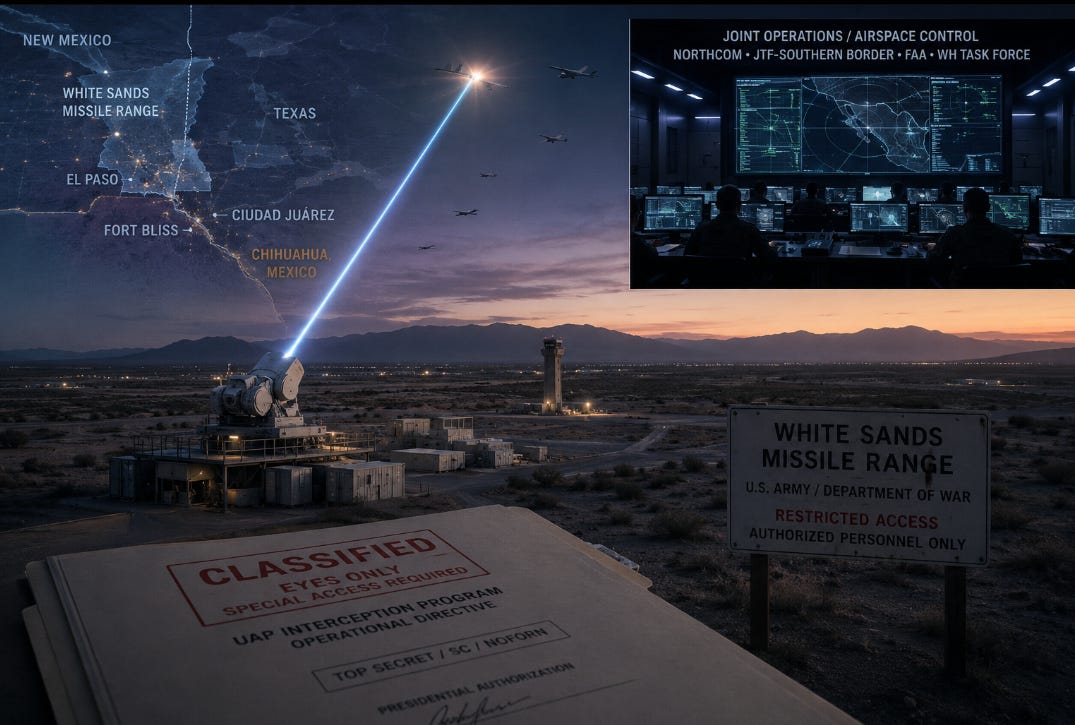
According to Coulthart’s sources, the Department of War is now running a covert operation to intercept anomalous craft. Coulthart says he has been told that objects have recently been brought down both within the United States and across the border near Juárez, Mexico. White House sources, he says, told him that President Trump personally authorized the operation.
Coulthart describes a “full-on effort” by the administration to recover suspected non-human exotic technology through a program completely separate from the alleged historical legacy programs. He says the operation is being run from the White House by the President’s most senior intelligence advisers; that Trump tasked Secretary of War Pete Hegseth with determining what the objects are and capturing them; and that the Office of the Director of National Intelligence is also involved.
Coulthart himself flagged ODNI’s involvement as unusual. The point is worth noticing. The reported operation is concerned with the physical identification, interception, and capture of objects, yet the government’s central intelligence-coordination office is allegedly embedded in its command structure alongside the White House and Department of War.
His description of the purpose is explicit: “This is an attempt by the President to circumvent the legacy program.”
Coulthart’s sources further claim that one of the directed-energy systems being used at White Sands Missile Range is a high-pulse microwave weapon intended to disable aircraft electronically. They say anomalous objects are being targeted there and that the objects display properties corresponding to the five observables commonly associated with UAP.
These remain sourced allegations rather than publicly established facts. No public presidential directive confirms the interception and recovery operation, and the government has not publicly acknowledged that anomalous craft have been brought down near Juárez or at White Sands. The specificity of Coulthart’s report nevertheless matters. He is not describing an ordinary UAP investigation or merely an experimental weapons program. He is describing a White House-directed acquisition effort, operating separately from the alleged historical program, for the stated purpose of obtaining independent access to the technology.
The operational setting, however, is not wholly dependent upon Coulthart’s sources. During 2026, acknowledged directed-energy activity appeared in the same geographic and institutional corridor. In February, an Army directed-energy counter-drone system operating from Fort Bliss, immediately beside El Paso and Juárez, became entangled in an extraordinary FAA airspace closure. Later that month, a military directed-energy system near Fort Hancock on the Mexican border actually brought down a Customs and Border Protection drone after identifying it as a threatening unmanned aircraft. Whatever the explanation for those incidents, directed-energy interception was no longer merely an experimental capability in that region.
The public trail then moved to White Sands. In March, JIATF-401 and the FAA conducted a directed-energy counter-UAS demonstration there, with Northern Command, Joint Task Force Southern Border, and the White House Task Force to Restore American Airspace Sovereignty among the supporting partners. By May, the Department was publicly describing an expanding architecture involving both high-energy lasers and high-powered microwave systems, with Fort Bliss among the selected locations and operational employment on the southern border expressly cited as part of the program’s development.
None of this establishes that the publicly acknowledged targets were anomalous craft. Its significance is narrower but still substantial. The public record independently establishes the capability, geography, operational use, and rapid expansion of the class of directed-energy systems Coulthart says is being used against anomalous objects. It also connects White Sands, the southern border, Fort Bliss beside Juárez, and White House-supported airspace operations before his report became public.
A separate development is also relevant. Skywatcher publicly developed electromechanical “machine calling” and neuromeditative “psionic calling” techniques intended to induce and track UAP activity, with James Fowler leading its technology effort. After Skywatcher’s public field operations ended, Fowler left for a new venture contracting with the U.S. Government. Coulthart now reports that a classified U.S. intercept program is using the same “dog whistle” and psionic techniques to detect and bring down anomalous craft. The sequence shows that the methodology was already being developed publicly before appearing in his account of the classified program.
The extraordinary part of Coulthart’s account therefore begins at a more precise point: his sources say that some of the objects being targeted are not ordinary drones; that they display the anomalous characteristics associated with UAP; that objects have recently been brought down; that Trump personally authorized a separate recovery effort for suspected NHI exotic technology; and that the purpose of the new structure is to circumvent the legacy program.
Strategic Intent Analysis asks what problem such an action would be designed to solve if the reported action is substantially as described.
Here the behavior is peculiar. The President is not merely ordering additional observation, better pilot reporting, improved sensors, or another historical review. Nor is the stated objective simply protection of restricted airspace. The administration is allegedly attempting to acquire the technology through a new program because proceeding through the existing structure will not produce the result it wants.
Circumvention has a specific meaning. One circumvents a structure when the direct route is obstructed, distrusted, incomplete, or otherwise incapable of reliably delivering the required result.
If the President already possessed complete and dependable access to recovered UAP material held by the United States, further recoveries could still have enormous scientific and military value. Different craft might contain different systems. A contemporary object could provide operational data unavailable from historical material. Additional specimens could resolve uncertainties about provenance, capability, or development.
None of those explanations requires a program “totally separate” from the existing one for the purpose of circumventing it.
If Coulthart’s account is accurate, the administration apparently believes that an independent recovery would supply something the inherited structure cannot.
The most obvious answer is control.
A recovery conducted under direct presidential authority would create a new chain of custody. An object could be tracked from interception through recovery, transport, examination, technical exploitation, and storage. The White House could know where it went, who handled it, which laboratories received it, which contractors became involved, what tests were performed, and what was learned.
There would be no inherited uncertainty about events occurring decades ago, no disputed transfer from military custody into a private aerospace facility, no historical access arrangement dependent upon officials now dead, and no immediate question about whether government material had become intertwined with contractor intellectual property.
Possession and control are different things. A technology may be physically located in the United States, held under a government contract, funded through federal appropriations, and still remain practically inaccessible to officials who nominally govern the institutions involved. Ownership on paper does not establish effective command.
The UFO record contains an earlier account of almost exactly this problem.
The Wilson-Davis notes are disputed evidence, but their relevance to Coulthart’s report is striking. The notes attributed to physicist Eric Davis describe an alleged 2002 conversation with retired Vice Admiral Thomas Wilson, former Director of the Defense Intelligence Agency and earlier Director of Intelligence for the Joint Chiefs of Staff. According to the account, Wilson discovered an extraordinarily restricted program associated with recovered UAP technology and a major aerospace contractor. He attempted to obtain access and was refused.
The structure described in the notes matters more here than the disputed details of the technology. Wilson was not an outsider seeking information to which he had no conceivable claim. He had occupied some of the highest intelligence positions in the United States government. Yet the account describes a system in which formal office did not determine access. Wilson allegedly challenged the denial, sought review, and was again refused. He was reportedly warned that continued pursuit could damage his career and cost him rank.
The notes cannot be treated as an authenticated government record. But the institutional resemblance twenty-four years later is difficult to miss. In the Wilson account, a senior intelligence official discovers that formal authority does not produce effective access to an alleged UAP technology program. In Coulthart’s account, a President responds to an apparently similar problem by creating an entirely separate route to the objects themselves.
David Grusch’s 2023 congressional testimony placed the same structural problem into the public record through a different evidentiary channel. Grusch testified under oath that he had been informed of a multi-decade UAP crash-retrieval and reverse-engineering program. When he sought further access to the relevant compartments, he said he was denied the necessary read-ons. He also alleged that programs existed outside proper congressional oversight.
Wilson, Grusch, and Coulthart do not carry the same evidentiary weight. Wilson’s account survives through disputed private notes. Grusch testified publicly under oath concerning information received through his official duties. Coulthart is reporting what unnamed government and White House sources say the current administration is doing.
The recurrence lies in the structure: formal position repeatedly encounters a boundary created by controlled access.
That is the mechanism examined in Compartmentalization and the Structure of Classified Power. Confidentiality and compartmentalization are often treated as different degrees of secrecy, but their effects are different. Confidentiality can protect information while preserving the responsible institution’s understanding of the whole. Compartmentalization divides internal visibility itself. A sufficiently fragmented system allows formal authority to survive while substantive knowledge depends upon admission to the relevant compartment.
One group may study a material. Another examines electromagnetic effects. A contractor holds the physical object. A security office controls access. Another agency possesses provenance records. Funding moves through a classified program whose description reveals little about its actual purpose. A congressional committee receives a briefing that may be accurate within the boundaries of what it has been shown.
Every participant can tell the truth about the piece they see while almost no one possesses enough information to judge the whole.
The Manhattan Project demonstrated the effectiveness of this architecture at enormous scale. Modern special-access structures refined it further. Clearance does not guarantee knowledge. Rank does not guarantee access. Formal office does not necessarily produce visibility.
Once substantive knowledge depends upon admission to a compartment rather than constitutional position, another hierarchy develops inside the visible one. The President remains President. A cabinet secretary remains formally responsible for a department. Congress retains appropriations and oversight powers. Inspectors general retain statutory authority.
Integrated sight may still reside elsewhere.
At that point secrecy has begun to perform a different institutional function. It no longer merely protects information from an adversary. It determines who inside the government possesses enough knowledge to exercise meaningful judgment.
Oversight can therefore remain procedurally complete while becoming substantively weak. Budgets are approved. Lawyers review narrow questions. Committees receive briefings. Contractors operate under agreements. Security rules are followed. Every component may possess a paper trail while the integrated structure remains invisible to nearly everyone nominally responsible for supervising it.
Coulthart’s new reporting gives the Wilson account renewed significance. If his sources are correct, the alleged denial of access to Wilson would no longer stand alone as an extraordinary episode from 2002. It would resemble an earlier manifestation of the same institutional boundary that a President is now allegedly trying to bypass.
AARO’s 2024 historical review creates the obvious counterpoint.
The All-domain Anomaly Resolution Office reported that it found no empirical evidence that the United States government or private companies were reverse-engineering extraterrestrial technology. AARO said that it had been granted full, unrestricted access by the organizations involved and full access to pertinent sensitive government programs. Its review concluded that many allegations reflected misunderstanding of legitimate classified programs, historical confusion, or claims that could not be substantiated.
That conclusion should be taken at full strength.
If AARO identified the relevant compartments, penetrated the programs alleged by witnesses, obtained unrestricted access to them, and established that no hidden retrieval or reverse-engineering structure existed, the central legacy-program allegation should have been substantially resolved.
Coulthart’s report creates an obvious difficulty for that conclusion if it is accurate. Why would a President who had been reliably informed that the alleged structure had been penetrated and found not to exist establish a separate program intended specifically to circumvent it?
Several explanations remain available. Coulthart’s sources may be wrong. The administration may itself have accepted mistaken claims. “Legacy program” may refer to something narrower than the structure alleged by Wilson and Grusch. Trump may want an uncontaminated contemporary recovery regardless of what earlier investigations concluded.
Another possibility is more consequential: AARO may have received unrestricted access to the programs the formal system could identify without reaching the structure the witnesses were actually describing.
“Full access” is meaningful only if the investigator has first identified the correct boundary of the thing being investigated.
A perfectly cooperative examination of every acknowledged compartment would still fail if the relevant activity had migrated into waived structures, contractor custody, differently named programs, fragmented technical projects, or mechanisms absent from the institutional map supplied to the investigator.
The question is therefore not simply whether AARO’s access was unrestricted. It is whether the map was complete.
The same problem changes the meaning of modern UFO disclosure.
Disclosure Without Resolution examined the transition beginning after 2017, when official ridicule became increasingly unsustainable and the subject returned to legitimate public discussion. Military videos were acknowledged. Officials spoke publicly. Congress held hearings. Reporting systems expanded. Offices were created. The language moved from dismissal toward controlled seriousness.
A great deal happened, but resolution did not follow. The public gained increasing permission to know that the issue was serious without receiving an integrated account of historical custody, contractor involvement, reverse engineering, funding, legal authority, alleged human consequences, or the relationship between contemporary UAP encounters and older retrieval allegations.
Coulthart’s report, if accurate, makes that distinction sharper. The public-facing government continues to investigate UAP, release records, and discuss unresolved anomalous observations. The same administration is allegedly conducting a covert operation to identify, intercept, disable, and capture objects that its sources regard as genuinely anomalous.
Public uncertainty and operational certainty can coexist.
Acknowledging that anomalous craft exist is one question. Identifying what has been recovered and who possesses it is another. Explaining what has been learned from recovered material is another. Determining whether historical concealment involved lawful classification or unlawful obstruction is another still. Allowing useful technology to leave the classified estate is something different again.
A government could cross the first threshold while refusing every subsequent one. The public could be told that humanity is not alone while a contractor vault remained closed.
Trump’s 2026 UAP initiative may therefore represent something more significant than another expansion of acknowledgment. PURSUE attempts to reconstruct the documentary history from above. Coulthart’s sources say the administration is simultaneously attempting to establish physical control outside the inherited custody system.
Instead of forcing its way indefinitely downward through an old structure, the White House would be creating a new route from the object upward: detect the phenomenon, intercept it, attempt to disable it, recover it if possible, establish custody immediately, preserve the chain, and examine the material through institutions chosen by the present administration rather than inherited from the historical program.
Seen this way, high-pulse microwave weapons are less interesting as a weapons story than as part of an acquisition strategy. The weapon is the reported means. Independent possession is the institutional objective.
Coulthart’s claim that objects have recently been downed makes the distinction even more important. A successful interception is not necessarily a successful recovery. We do not know from his statement whether the reported objects were recovered intact, where any resulting material went, or whether the White House obtained the independent chain of custody the operation appears designed to create.
If material has already been recovered through the new program, however, then the constitutional-control problem has moved beyond planning. The administration may already possess material obtained outside the historical structure.
A contemporary recovery would have unusual value even if older objects already existed somewhere within the American classified system. The President would not need to determine who transferred the material decades ago, what contractual arrangement later governed it, who inherited access, or whether technical data produced with public money had become inseparable from private corporate rights.
The administration would know where the object was, how it entered government custody, and who controlled it from that point forward.
That would be an extraordinary advantage for a President who did not believe he exercised reliable control over the earlier material.
It also exposes the distinction at the center of UFO Energy Technology and the Problem of Institutional Capture. That essay examined what happens after transformative energy or propulsion technology is obtained and asked how it could escape military or commercial monopoly. The present problem comes earlier: before anyone decides how such technology should be distributed, someone must possess the authority to make that decision.
Recovered material entering a classified defense environment would naturally be treated as a national-security asset. The military would want to understand its implications for strategic mobility, surveillance, concealment, weapons delivery, and foreign capability. Contractors possessing the necessary clearances, laboratories, materials expertise, and engineering capacity would be obvious participants.
None of that is inherently unlawful. A defense contractor holding recovered material at government direction has not seized control merely by possessing it. Scientists inside a compartment may know nothing about the program’s origin or wider legal status. Extreme security may originally have been imposed for reasons officials genuinely regarded as necessary.
The control problem begins when delegation becomes functionally irreversible.
If material can be transferred into a structure that later Presidents cannot reliably locate, inspect, redirect, or remove, custody has become something more than delegated possession. The state may remain the nominal owner while practical sovereignty over the object has migrated to the access structure surrounding it.
The stakes increase if the technology has applications beyond weapons. A propulsion system capable of producing the most anomalous reported UAP performance would imply some underlying relationship among energy, matter, fields, and motion beyond ordinary aerospace engineering. Whatever its mechanism, knowledge of that order could affect far more than aircraft.
Modern states exercise power partly through energy dependence. Fuel supplies, shipping routes, grids, pipelines, industrial prices, and access to infrastructure determine how independently states and societies can function. Technology capable of weakening those dependencies could alter military power, industrial geography, and material sovereignty at the same time.
Its eventual effect would depend heavily upon the institutions controlling it. A breakthrough held exclusively within military secrecy would strengthen military hierarchy. One captured by incumbent economic interests could preserve scarcity in another form. One released without regard to its strategic consequences could create serious danger.
The technology does not determine the structure built around it. Human institutions do.
Coulthart’s account therefore produces a final paradox.
Trump is allegedly trying to defeat one legacy structure by creating another compartmented recovery program.
Even if the new effort succeeds, any recovered object will require extraordinary security, specialized scientists and engineers, secure facilities, intelligence analysis, and probably private contractors. Foreign acquisition would be an immediate concern. Military implications could justify substantial classification.
Every practical necessity surrounding the new recovery could therefore reproduce the architecture that made circumvention necessary.
A parallel program could defeat one legacy structure and become the next one.
The problem cannot ultimately be solved by replacing one group of custodians with another. The constitutional question is whether secrecy remains subordinate to authority. Legitimate classification protects information on behalf of the state. It cannot coherently evolve into a structure through which the protected information escapes the effective control of the state itself.
Secrecy requires a boundary. Delegated custody requires accountability. Compartmentalization requires some point at which the whole can still be seen.
Without that integrated level of sight, constitutional authority becomes increasingly formal while the actual hierarchy is determined by access.
The Wilson-Davis account describes that possibility at the level of a senior intelligence official. Grusch described it again through the congressional oversight process. AARO said it penetrated the relevant structure and found no hidden reverse-engineering program. Coulthart now reports that the President has authorized an entirely separate operation to intercept and capture anomalous craft for the express purpose of circumventing the legacy program.
Those accounts cannot all be reconciled without explanation.
If there is no legacy program, the alleged White House operation reflects a remarkable misunderstanding at the center of presidential decision-making.
If there is a legacy program and the President already possesses complete access to it, the need to circumvent it is difficult to explain.
If there is a legacy program and the President does not possess reliable access to its material and technical knowledge, then the United States faces something considerably more consequential than a UFO disclosure dispute.
It faces a problem of constitutional control.
A government that must recover again what it supposedly already possesses does not possess it in the ordinary meaning of the word. Physical custody somewhere inside the American national-security system is not the same thing as control by the constitutional government of the United States.
If the President must create a new chain of custody to obtain technology already nominally held by his own government, the deepest UFO question is no longer whether the legacy program exists.
It is who controls it.