

This essay is part of the Strategic Intent Analysis archive at strategicintentanalysis.com. The method is simple: begin with what is observable, then test the story against the structure beneath it.
The first mistake is to treat the Egyptian pyramids as isolated monuments.
They are not isolated. They belong to a larger stone record: pyramids, obelisks, granite boxes, underground chambers, hard-stone vessels, casing stones, drill cores, precision joints, massive granite objects inside pyramid structures, and worked surfaces that still do not sit comfortably inside the story we have been given. As argued in The Builders Before the Record, the first fact is not the story. The first fact is the stone.
That order matters.
The object comes first. The label comes second. The expert narrative comes third. If the narrative does not explain the object, the failure belongs to the narrative, not to the observer.
The official story rarely collapses at one point. It gives way by accumulation.
A large stone can be explained. A clean cut can be explained. A polished granite surface can be explained. A monument can be assigned to labor, time, ropes, sledges, copper tools, abrasive sand, pounding stones, ramps, fire-setting, quarry planning, and state organization.
Then the objects are placed beside one another.
The explanation begins to feel too small.
Ancient Egypt obviously possessed skill. No serious argument requires making Egyptians primitive in order to make the monuments strange. The problem runs in the other direction. The builders were more capable than the ordinary explanation permits. The surviving technical signature exceeds the tool kit usually assigned to it.
The monuments themselves say this.
The Great Pyramid remains the central exhibit because it combines scale, precision, age, and coherence in one object. Millions of blocks were placed into a geometrically stable structure that has survived for thousands of years. Its base, massing, internal passages, relieving chambers, granite elements, and chamber system show structural intelligence, not crude burial ambition.
This is not primitive engineering.
Moving stone is only one part of the problem. A stone must be quarried, cut, dressed, transported, lifted, fitted, aligned, and made to serve the whole. “They dragged it” answers almost nothing. It turns a complete technical sequence into a picture of men pulling ropes.
The harder question is stone mastery.
The pyramid builders were shaping a material environment. They worked limestone, granite, basalt, diorite, and other hard stones with a confidence that does not match the simple-tool story. The official explanation usually retreats into quantity: enough men, enough years, enough sand, enough rubbing, enough pounding. But time is not a tool. Labor is not a mechanism. Persistence does not explain every observed result.
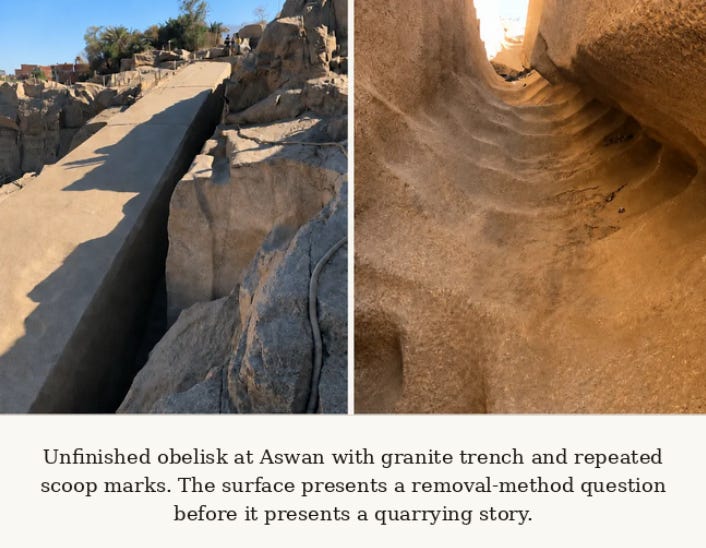
The unfinished obelisk at Aswan makes the difficulty visible.
It lies still attached to the bedrock, enormous, abandoned because it cracked. Had it been completed, it would have been the largest known ancient Egyptian obelisk. This is not a small ceremonial object. It is a single granite mass of impossible ambition.
The trench beside it is more instructive than any museum label. The stone is not a detached block waiting to be moved. It is still part of the granite body of the earth. A long channel runs beside it, deep and narrow, cut down into living bedrock. The worked faces show how much granite had to be removed before the obelisk could even begin its journey. The difficulty is not only the size of the obelisk. The difficulty is the controlled removal of the surrounding granite, along the length of the stone, with continuity and confidence.
The scoop marks around the obelisk sharpen the point. They are not confined to one display face. They appear around the stone body, marking repeated removal from the surrounding bedrock. Their importance lies in their regularity. The hollows recur with a similar rounded form, a similar directional relationship to the trench, and a repeated working pattern along the granite. They do not read as random scars left by uncontrolled impact. They read as the trace of a method applied again and again to remove stone in a controlled sequence.
The usual explanation assigns them to dolerite stones striking granite by hand. That may describe one possible source of impact. It does not adequately explain the visible order of the pattern. The question is not whether one stone can damage another. Of course it can. The question is whether this repeated scalloped removal, around a monumental granite body, along a deep trench, at this scale, is honestly explained by men pounding rock with rock until the desired shape emerged. A serious explanation would have to account for spacing, repetition, depth, removal sequence, tool control, labor rhythm, and consistency of the marks around the obelisk. Merely naming pounders does not do that work.
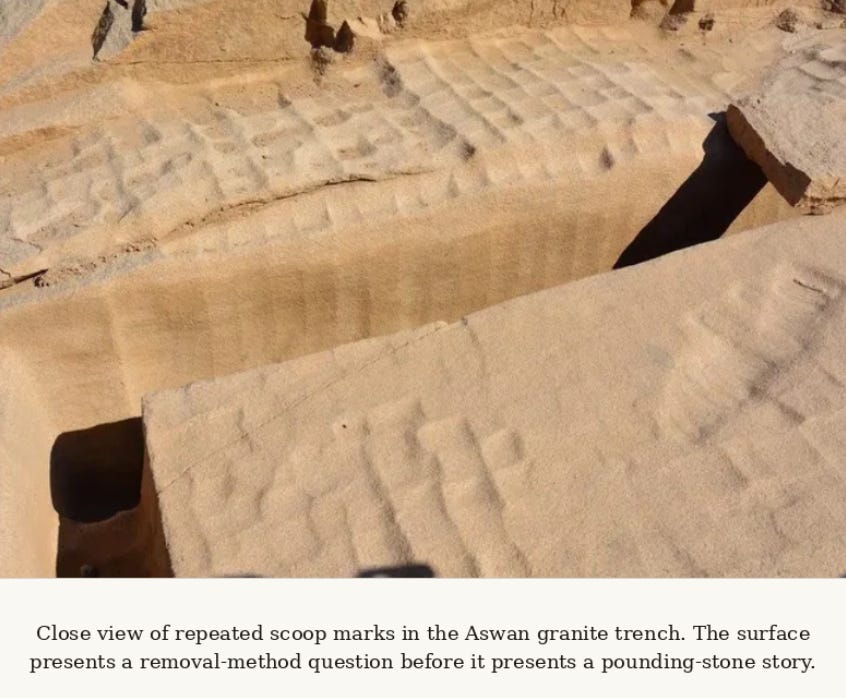
The surface itself appears to remember a tool.
The quarry is therefore not merely a place where an object was attempted. The quarry itself is the artifact. It shows ambition, but also a technical relationship with granite that the ordinary explanation does not adequately describe. The unfinished obelisk is evidence of failure only in the narrowest sense. More importantly, it is evidence of a method large enough, familiar enough, and trusted enough that a civilization was willing to begin a thousand-ton granite operation inside the granite body of the earth.
Then there are the granite boxes.
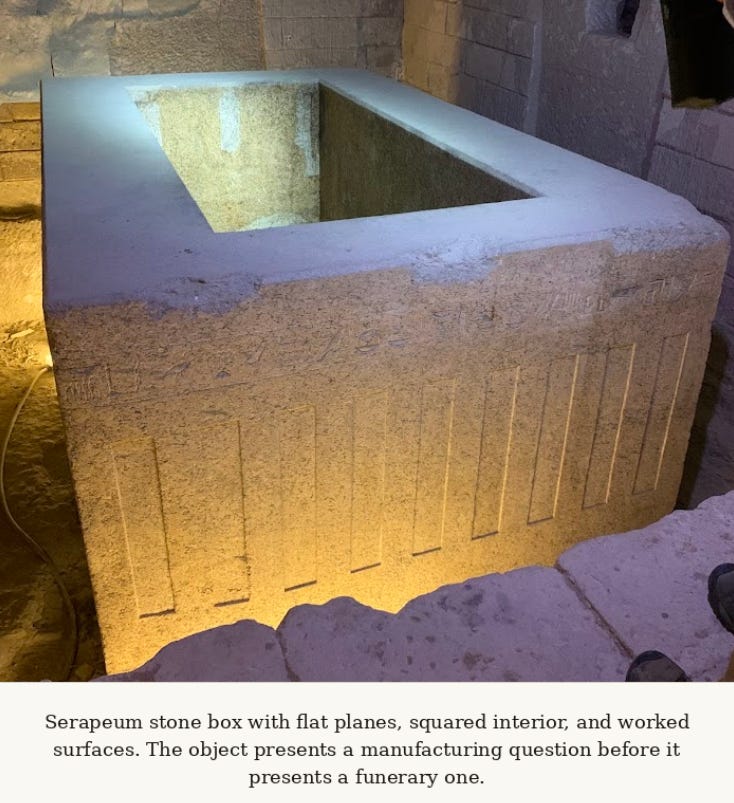
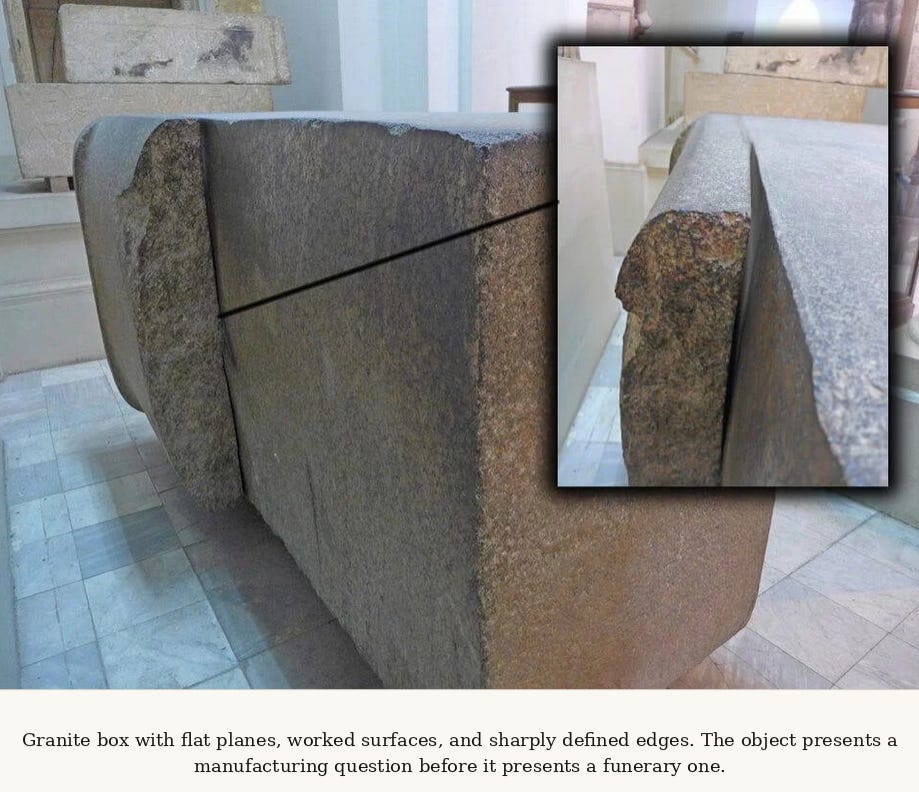
The Serapeum at Saqqara is usually framed in religious terms, as the burial place of sacred Apis bulls. That may explain a later use. It does not explain the technical object. The massive stone coffers sit underground as hard-stone containers of extraordinary mass, with flat planes, squared interiors, heavy lids, worked corners, and surfaces that do not read as casual funerary craft. Their force lies in the contrast between setting and object: enormous stone boxes placed in confined galleries, finished with a precision that pulls the mind away from ritual labeling and back toward manufacture.
Calling them “sarcophagi” does not solve anything.
A name is not an explanation.
The word may describe what someone later did with the box. It does not explain how the box was cut, hollowed, dressed, finished, moved, lowered, and placed underground. It does not explain the interior geometry. It does not explain the surfaces. It does not explain the corner work. It does not explain why a culture supposedly working inside the ordinary tool kit would produce objects whose visible finish still reads as technical work before it reads as burial furniture.
Ancient studies often repeat this maneuver. A structure receives a ritual label, and the label is allowed to stand where the mechanism should be. Tomb. Temple. Shrine. Cult object. Ritual basin. Offering table. Sarcophagus. Once the label attaches, the harder inquiry closes.
Ritual use does not explain manufacture.
A later priesthood could use an older technical object. A dynastic administration could inherit a site it did not originally create. A culture could preserve, imitate, re-inscribe, or repurpose work whose true method had already been lost. That possibility is rarely allowed because it threatens the chronological story. It suggests that the surviving monuments may not sit neatly inside the development curve assigned to them.
The granite coffers make the point unavoidable. Even if they were used for bull burials, that use does not explain how they were made. It does not explain the scale of the blocks. It does not explain the hollowing of hard stone. It does not explain the finish. It does not explain transport through confined spaces. It does not explain why such objects exist in the first place.
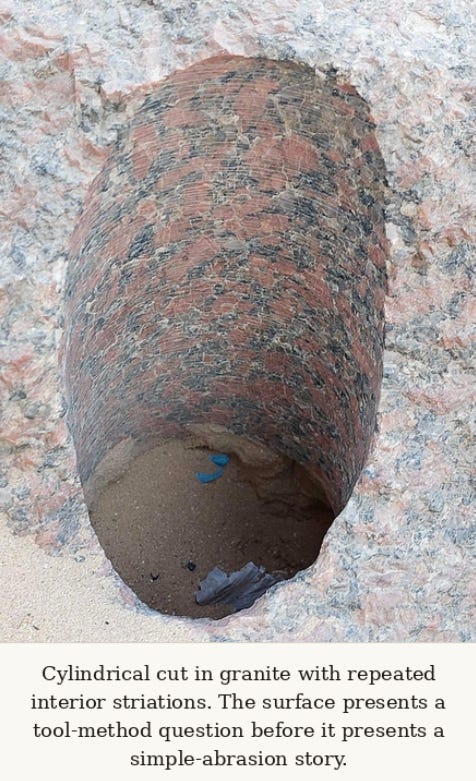
The same problem appears in drill cores, cut marks, bowls, vases, and hard-stone objects whose visible finish remains difficult to reconcile with the simple-tool account. The important feature is not merely that they exist. It is the combination of material, symmetry, hollowing, surface finish, thinness, curvature, and repeatability. A hard-stone vessel with a narrow opening and controlled interior form is not explained by saying that ancient craftsmen were patient. Patience is not a lathe. Skill is not a cutting head. Time does not explain every geometry.
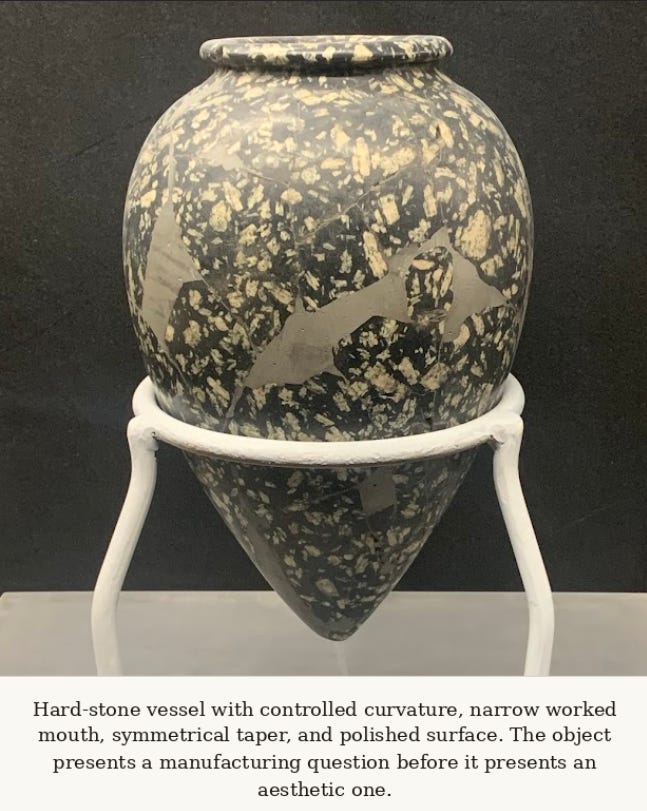
The conventional answer is abrasive sand with copper tools. This explanation has partial value. Abrasives can cut hard stone. Experiments can reproduce some effects. Ancient craftsmen could work stone with patience, skill, and abrasive materials. Pounders, saws, sledges, ramps, fire-setting, and organized labor may explain parts of the record.
But a partial mechanism is not a complete account.
This is where The Method of Structural Inquiry becomes necessary. Official narratives are evidence. They are not verdicts. They have to be tested against what is observed, what repeats, what is omitted, and whether the explanation becomes equal to the thing explained. Applied to Egypt, the method does not begin with the permitted tool kit and then reduce the monuments until they fit. It begins with the monuments and asks what kind of knowledge, method, material control, organization, and continuity would have been necessary for them to exist.
The existence of an official literature does not settle the matter. It supplies claims to examine. Some may be true in part. A pounding stone may produce a hollow. Abrasive sand may cut hard stone. A ramp may explain limited movement. A ritual category may explain later use. But none of these partial mechanisms becomes a complete account merely because it appears in a credentialed source. The explanation must still answer the object. It must explain the pattern, the scale, the sequence, the surface, the repetition, and the physical result. Where it does not, authority has supplied vocabulary rather than understanding.
The error is not that official explanations exist. The error is that partial explanations are used to close perception before the object has been answered.
The stone remains the standard.
The proposed method has to explain the entire class of evidence: scale, speed, precision, surface, volume, logistics, repetition, and regularity. Showing that a groove can be made is one thing. Explaining a civilization-wide technical signature in the hardest stones available is another.
Here the ordinary explanation weakens.
The evidence points toward a missing tool, a missing process, a missing material science, or a misdated technological inheritance. The exact answer remains uncertain. The inadequacy of the ordinary story is already visible.
One strong possibility is that the builders possessed some method for changing the behavior of stone, or for applying force to stone in a way not honestly preserved in the conventional account. That inference should not float above the evidence. It arises from the visible record: the repeated scoop marks around the Aswan obelisk, the controlled granite removal in the quarry trench, the hard-stone boxes at Saqqara, the cut marks in granite, the massive granite elements inside pyramid structures, and the bowls and vases whose symmetry, hollowing, and finish continue to resist the simple-tool story.
Call it softening. Call it reconstitution. Call it casting. Call it thermal treatment. Call it rock melting. Call it an advanced cutting or removal tool. The name matters less than the visible fact that some surfaces and forms do not look like stone merely battered into shape. They look as though stone, or stone-like material, was controlled at a deeper level.
This does not require spectacle. It requires looking.
Ancient Egypt already shows knowledge of chemical transformation: pigments, glazes, faience, plasters, mortars, metallurgy, mineral processing, and surface treatment. The culture was not chemically innocent. The assumption that stone had to be worked only by crude mechanical abrasion is itself an assumption. It is not a law of nature.
The pyramid blocks may not all have been made in the same way. The granite chambers may not have been worked by the same method as the limestone casing. The obelisks may represent a different technical tradition from the hard-stone vessels. The bowls and vases may preserve another. No single answer needs to be forced onto every object.
The simple answer has not solved the problem.
It has not.
The pyramids themselves remain the greatest challenge because they combine mass, geometry, orientation, internal design, granite placement, and durability. They are not mysterious because no explanation has ever been proposed. They are mysterious because the explanations do not fully answer the evidence.
Ramps are proposed. Then the ramp becomes the problem. External ramps become too large. Spiral ramps lack evidence. Internal ramps become speculative. Counterweight theories multiply. Water theories appear. Pulley theories appear. Casting theories appear. Each generation produces another mechanism. The multiplication of mechanisms proves the point: the ordinary story is not settled.
The structure still resists.
Modern people are trained to imagine history as a straight ascent from primitive to advanced. Older means cruder. Newer means better. The pyramids disturb that story. They stand near the beginning of dynastic Egyptian history, not at its end. The highest stone achievement appears early. Later works are impressive, but the Great Pyramid remains unmatched.
That is the wrong shape for the official development curve.
If technology were steadily accumulating from primitive beginnings, the greatest monument should appear after centuries of refinement. Yet the pyramid age looks less like a beginning than a survival. It looks like a peak, or a preserved memory of a peak, followed by imitation, ritualization, and decline.
This does not diminish the Egyptians. It enlarges them. Either dynastic Egypt possessed a far more advanced technical system than admitted, or it inherited a stone tradition from an earlier source, or both.
The falsehood is not that Egyptians built great monuments.
The The falsehood is the use of authority to override visible contradiction.hood is the reduction of those monuments to simple labor stories.
The falsehood is the inflation of partial mechanisms into complete explanation.
The falsehood is the use of expert authority to override visible contradiction.
The falsehood is the use of religious labels to avoid technical questions.
The falsehood is the refusal to admit that the surviving evidence points to missing knowledge.
This is also why Truth Has a Coherent Structure matters here. A coherent explanation reduces strain. It organizes facts without multiplying exceptions. A false or incomplete explanation fragments. It survives by patching one difficulty at a time: labor for scale, ritual for purpose, ingenuity for precision, coincidence for alignment, pounding stones for granite removal, and labels for objects whose manufacture remains unexplained.
The monuments do not ask us to believe in aliens. They do not require fantasy. They require intellectual honesty. The stone record is enough. The unfinished obelisk is enough. The granite boxes are enough. The massive granite elements inside pyramids are enough. The bowls and vases are enough. The drill cores, cuts, surfaces, joints, scoop marks, and logistical contradictions are enough.
They show suppression by explanation.
A weak explanation is placed over a strong object. The object remains. The explanation decays.
That is why the pyramids still have power. They are not merely ancient buildings. They are witnesses against a managed history of human capacity. They stand as evidence that something has been hidden, forgotten, minimized, or misassigned.
The pyramid builders knew stone in a way we have not been honestly taught.
They knew how to quarry it, move it, shape it, align it, finish it, and preserve it inside a symbolic architecture of extraordinary coherence. They may also have known how to soften, cast, transform, or cut it with methods no longer admitted into the ordinary story. The surviving evidence does not allow that story to close the case.
The correct position is refusal.
Refusal to accept labels in place of mechanisms. Refusal to accept scale without method. Refusal to accept “ritual” as an answer to engineering. Refusal to accept expert closure where the visible object remains unexplained. Refusal to accept primitive-beginnings mythology when the oldest monuments remain among the most technically formidable.
The pyramids are not silent.
They speak in mass. They speak in alignment. They speak in granite. They speak in surfaces too clean for the explanations placed upon them. They speak in the unfinished obelisk still lying in its quarry, in the scoop marks surrounding its body, in the stone coffers underground at Saqqara, in the bowls and vases that preserve a technical signature official explanation has not honestly answered, and in the hard-stone cuts that remain after every theory has passed over them.
The remaining question is direct.
Why does anyone still believe the ordinary story explains what is actually there?