

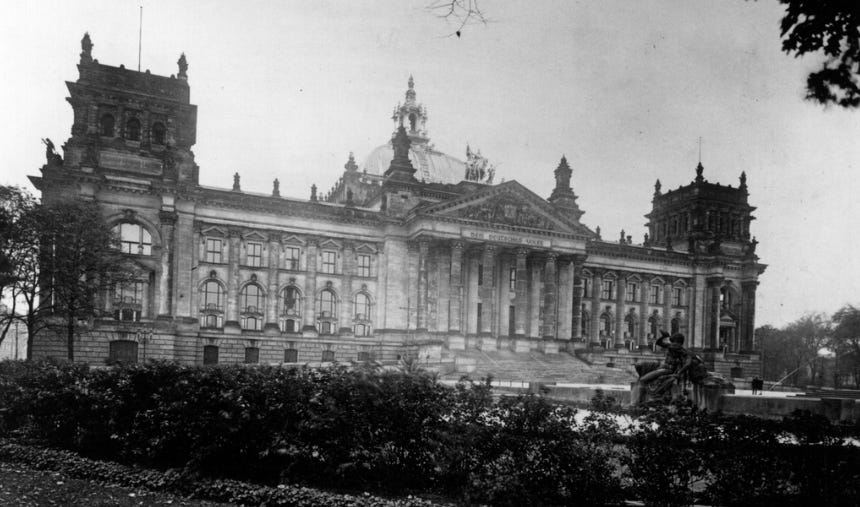
On the night of February 27, 1933, the German parliament building, the Reichstag, caught fire. The blaze was dramatic, visible across Berlin, and immediately treated as an attack on the state. By the following day, February 28, the government issued the Decree for the Protection of People and State. That decree suspended core civil liberties across the nation.
The formal justification was emergency necessity. The state argued that extraordinary conditions required extraordinary authority in order to prevent further violence and preserve public order. The decree removed protections for speech, press, assembly, privacy of communications, and protection against warrantless search and detention. Federal power expanded. Regional autonomy contracted. Preventive arrest became possible without normal judicial safeguards.
The legal form was temporary. The practical effect was permanent. The decree was never meaningfully withdrawn. It became the operating foundation of the new political order.
The significance of the Reichstag Fire therefore lies less in the origin of the fire than in the speed and structure of the response. Crisis created a window. Within that window, authority expanded beyond previously accepted limits. Once established, the expansion did not recede when the immediate danger passed.
Strategic Intent Analysis examines institutional behavior in terms of functional outcome rather than declared motive. The Reichstag event produced four observable structural conditions: rapid attribution of threat, immediate legal transformation, expansion of executive authority, and long-term normalization of emergency powers. Whether the crisis was anticipated, exploited, or simply utilized after the fact, the system behaved as if the emergency provided an opportunity for durable consolidation.
The speed of the legal response is itself a structural indicator. Emergency legislation requires drafting, coordination, and administrative readiness. Institutions cannot transform their authority overnight without existing mechanisms capable of rapid activation. This does not establish prior knowledge of the fire. It does establish institutional preparedness for expanded authority under crisis conditions, a form of Pre-Event Knowledge and Planning expressed as legal contingency architecture rather than operational foreknowledge.
Authority expanded immediately under conditions of fear. What followed illustrates a structural asymmetry that appears repeatedly in crisis governance: expansion is operationally simple, but restoration is institutionally disruptive. New powers create administrative structures, reporting chains, enforcement expectations, and political dependencies. Once these systems are in place, removal generates uncertainty within the governing apparatus itself. The result is a one-way dynamic. Emergency authority does not persist primarily because the threat continues. It persists because the institutional cost of reversal becomes higher than the cost of continuation. What began as temporary protection becomes operational normality.
This transition marks the boundary between temporary emergency and structural transformation. The legal system continues to function. Courts operate. Procedures remain. Yet the underlying balance between state power and individual protection has shifted. Procedure replaces constraint. Legitimacy is preserved through formal continuity even as substantive limits erode.
The human effects of such transitions are indirect but cumulative. Preventive detention without clear cause introduces uncertainty into ordinary life. Limits on speech and assembly narrow the range of acceptable public expression. Privacy protections weaken. Individuals adjust behavior not because they have been directly targeted, but because the boundaries of state authority are no longer predictable.
Institutionally, the Reichstag Decree demonstrates that crisis does not create new power so much as activate latent capacity. Modern states maintain extensive legal and administrative contingency frameworks for emergency governance. These frameworks exist for legitimate reasons, including response to war, terrorism, or natural disaster. Their presence, however, means that the decisive moment in any crisis is not the event itself but the legal and procedural changes implemented during the response window.
Once activated, emergency authority alters institutional incentives. Expanded surveillance, detention powers, and information control increase system stability from the perspective of governance. They reduce uncertainty for the state even as they increase uncertainty for the population. Reversal becomes unlikely unless political pressure for restoration exceeds institutional interest in continuity. The persistence of expanded authority under security justification is not confined to historical cases. Similar normalization dynamics appear in modern governance, where emergency surveillance frameworks have become part of routine operation, as examined in Inside the Warrantless State.
Systems rarely abandon constitutional limits through explicit abolition. More often, limits are suspended during crisis and then preserved through administrative continuity. Legal form remains intact. Elections occur. Courts operate. Procedure continues. What changes is the baseline level of authority the system considers normal.
This is the mechanism by which emergency becomes structure. The event opens the door. The response builds the framework. The framework remains because the system has reorganized itself around the new level of power.
The Reichstag Fire did not end constitutional government through a single decisive act. It reset the operating equilibrium.
The decisive moment was not the fire. It was the creation of a new normal the system would not reverse.