

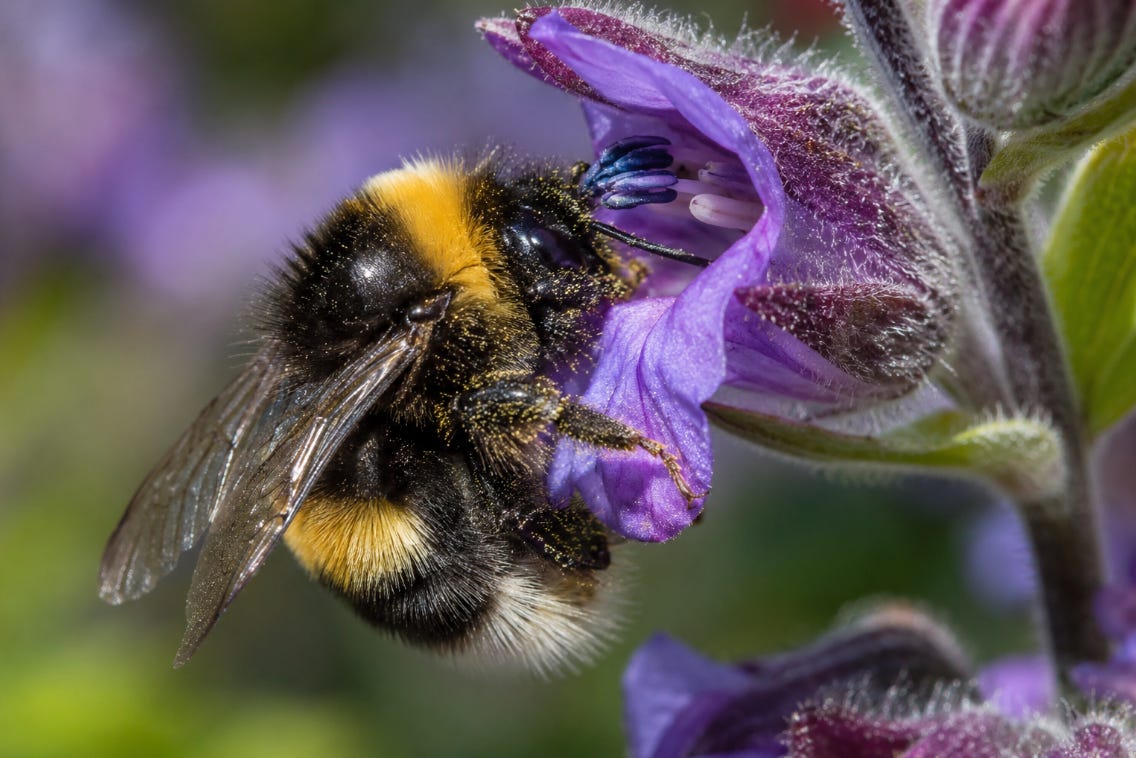
The old saying is that the bumblebee should not be able to fly.
It survives because it carries a distorted truth. The bumblebee can fly, of course. It flies constantly, heavily, audibly, and with unmistakable confidence. It lifts itself from grass, flower, branch, and soil without concern for the theories once used to describe what flight should look like. The error was never in the bee. The error was in the model.
A bumblebee is not a small fixed-wing aircraft. It does not glide through the air by behaving like a machine reduced in scale. Its flight is not a simple matter of wing size, body weight, and forward motion. It moves through rapid oscillation, wing rotation, turbulence, and continuous adjustment. The air is not merely pushed aside. It is engaged. The bee enters a changing field and stays there through rhythm.
This is why the joke matters. It does not prove that nature violates law. It reveals how easily law is misunderstood when living systems are forced into mechanical categories. The bumblebee does not fly against natural law. It flies within a richer expression of it.
The mechanical imagination wants life to be explained by parts. Wing, muscle, body, flower, air, pollen, hive. Each is isolated, named, measured, and placed inside a model. This is useful to a point. Parts are real. Measurement is real. But living order is not exhausted by the inventory of its components. Something essential appears only when the parts are seen in relation. The wing matters because it moves. The movement matters because it has rhythm. The rhythm matters because it interacts with air. The air matters because it responds.
The bee matters because it is not an object acting upon a passive world. It is a coherent body operating within a field of reciprocal constraint.
The bumblebee is a resonant creature.
Its body announces this before any explanation is given. It buzzes. It vibrates. It warms itself through the activity of its flight muscles. It does not wait for the world to become ideal before it moves. It generates internal conditions sufficient for action. Flight begins before visible flight begins. The body first becomes capable of motion.
That is a structural lesson. Living systems do not act only by external permission. They prepare internally. They establish coherence before expression. Where the necessary internal state is absent, motion fails. Where it is present, movement becomes possible even under conditions that look unfavorable from the outside.
This is the companion pattern to the one developed in The Bee and the Observed Sky. There, the bee navigates through observable order: light, place, memory, rhythm, terrain, and recurrent relationship. Here, the bumblebee reveals the same living method through motion itself. It does not require an abstract model before entering the world. It reads the field by participating in it.
The bee’s relation to the flower extends the same principle. Some flowers do not yield pollen easily to touch. Mere contact is not enough. They require vibration. The bumblebee lands, grips, and shakes. Its body becomes an instrument. The flower answers. Pollen is released because the correct vibrational relation has been established between them.
The flower does not open to pressure. It opens to the right note.
This is observation, not metaphor imposed from outside. A living exchange occurs through frequency, contact, timing, and fit. The bee does not simply extract from the flower. The flower is not an inert container of resources. The exchange is structured. It has conditions. The bee must behave in accordance with the form of the plant. Pollen is released when motion, body, and floral architecture correspond.
Here the small event becomes large.
Systems built around pressure often miss this distinction. They assume that failure to produce the desired result requires more force, more scale, more speed, more extraction, or more control. But living systems are not passive material waiting to be driven into compliance. They may submit temporarily to force, but submission is not flourishing. They may produce under pressure, but production is not health. They may be reorganized by command, but command is not coherence.
The bumblebee shows another order of action. It does not dominate the flower. It meets it according to its structure.
This distinction is easy to miss because force is visible and resonance is subtle. Force leaves marks. Resonance leaves relationship. Force can be measured by impact. Resonance must be recognized through response. When the right relation is present, something opens. When it is absent, effort may increase without result.
The living world is ordered relation.
This is the deeper point developed in Consciousness as Presence in a Structured World: life is not best understood as inert matter animated from the outside, but as presence arising where structure becomes coherent enough to support unified experience. The bumblebee does not require that whole argument in order to be seen clearly. But its flight belongs to the same pattern. Living systems are coherent participants in ordered fields of rhythm, resistance, communication, consequence, and response.
This does not make life vague or lawless. It means the opposite. Living systems are more constrained, not less. They possess forms of order that crude models miss because those models look for linear cause where the living world operates through rhythm, threshold, feedback, polarity, and field. The bumblebee’s flight is lawful because it is constrained. Its body must maintain temperature. Its wings must move within viable ranges. Its muscles must fire in patterned relation. Its contact with the air must remain dynamically stable. Its relation to the flower must fit the flower’s structure. Nothing about this is arbitrary. The wonder lies in the precision.
A machine is assembled by fitting parts together. A living system coheres only when its relations remain sufficiently ordered to sustain life.
This is why reduction becomes dangerous when it forgets its own limits. To study the wing is valuable. To study the muscle is valuable. To study the flower is valuable. But if the wing is treated as the bee, the muscle as the life, or the flower as the resource, the structure has already been broken in thought before it is broken in practice. The living pattern disappears when relationship is treated as secondary.
The bumblebee restores the missing relation.
It is heavy, unlikely, and beautiful. Its motion only appears clumsy when judged by the wrong model. It is not trying to be a bird or a machine. It is being what it is: a compact body of vibration, heat, appetite, orientation, and purpose, moving through a world that answers motion with resistance, lift, and possibility.
The same body that flies can pollinate. The same muscles that move wings can vibrate flowers. The same buzz that marks its presence can become the means by which hidden abundance is released. This is structural economy. Nature often works this way. A function is not isolated from the whole. Flight, warmth, vibration, gathering, and reproduction belong to one continuous pattern.
The mechanical imagination asks what force is required to move the part. The living world asks what relation allows the whole to respond.
Once this distinction is seen, the bumblebee becomes more than an insect. It becomes a correction to a habitual error. The world is not best understood as dead material animated by external pressure. It is better approached as structured order, responsive under the right conditions and resistant under the wrong ones. To know such a world requires more than measurement. It requires attention to fit, timing, proportion, and recurrence.
Observation must therefore become more disciplined, not less. Wonder is not an excuse to abandon precision. It is a signal that precision may need to deepen. As Truth Has a Coherent Structure argues in broader form, coherence is not a stylistic quality layered onto truth. It is a diagnostic property of accurate description. An explanation that fits reality organizes what is observed. An explanation too small for the phenomenon requires repair.
The proper response to the bumblebee is not to say that science failed and mystery won. Nor is it to flatten the mystery into a formula and declare the matter closed. The proper response is to make the explanation large enough for the phenomenon.
The bee flies.
The flower answers.
The field continues.
These are not decorative facts. They are structural facts. They show that life operates through relationship before abstraction, through rhythm before command, through coherence before output. They show that living systems disclose themselves when they are observed in motion, not merely when they are disassembled into categories.
The old saying is therefore useful only when corrected. The bumblebee should be able to fly, because the bumblebee does fly. What should fail is not the bee, but any model too narrow to account for it.
The deeper lesson is not that nature breaks law. It is that natural law is more subtle than force.
The bumblebee is a small demonstration of this truth. It does not demand attention, yet it rewards it. It passes through the orchard carrying the sound of a world organized by vibration. Its flight is not an exception. Its buzz is not noise. Its relation to the flower is not incidental. It is a visible expression of the same order that appears wherever living systems remain coherent under constraint.
Life does not disclose itself fully to pressure.
It opens to resonance.