

This essay is part of the Strategic Intent Analysis archive at strategicintentanalysis.com. The method is simple: begin with what is observable, then test the story against the structure beneath it.
The sky was known as order before it was explained as theory. People did not first meet time as a number on a screen or a line in a calendar. They met it as light returning at the edge of the world, as darkness shortening, as the Moon changing face, as stars appearing and disappearing by season, as the Sun rising farther north and south along the horizon and then returning. Time was not abstract. It was visible.
A clock is any ordered structure in which recurrence makes time readable. It needs a returning movement, a stable relation, and a scale by which change can be recognized. The day is a clock. The month is a clock. The year is a clock. A longer movement of the constellational field is also a clock, if the same relation can be observed across a greater interval. The scale changes. The principle does not.
The spring equinox remains one of the fixed points in that structure because it is not made by convention. It happens. Day and night come into balance. The year turns toward expansion. Soil warms. Seeds open. Trees begin to leaf. Animal movement changes. Human beings may name the event differently, or place their civil year elsewhere, but the living year has already begun to move.
That was the central point of The Spring Equinox and the Structure of Natural Time. The equinox is not merely a date. It is a threshold in the world. Winter has contracted the system. Spring opens it. Light begins to overtake darkness, and the annual cycle moves from dormancy toward growth. A year that begins at this point begins where the structure itself begins to expand.
This matters because time is not only counted. It is located. A numerical calendar divides days and months, but the count remains secondary to the recurring position it attempts to follow. Where the count drifts from the observed cycle, correction becomes necessary. Leap days, intercalations, reforms, and administrative adjustments show that arithmetic does not close the cycle by itself. The sky does not require that kind of repair. The reference returns.
That distinction was developed in Solar Cycles and the Search for a True Calendar. Time behaves first as returning position. A true calendar would not merely accumulate units. It would recognize when the reference has returned. Solstices and equinoxes mark turning points in the observed year: maximum light, minimum light, and the two points of balance. The spring equinox is therefore not decorative within timekeeping. It is one of its natural anchors.
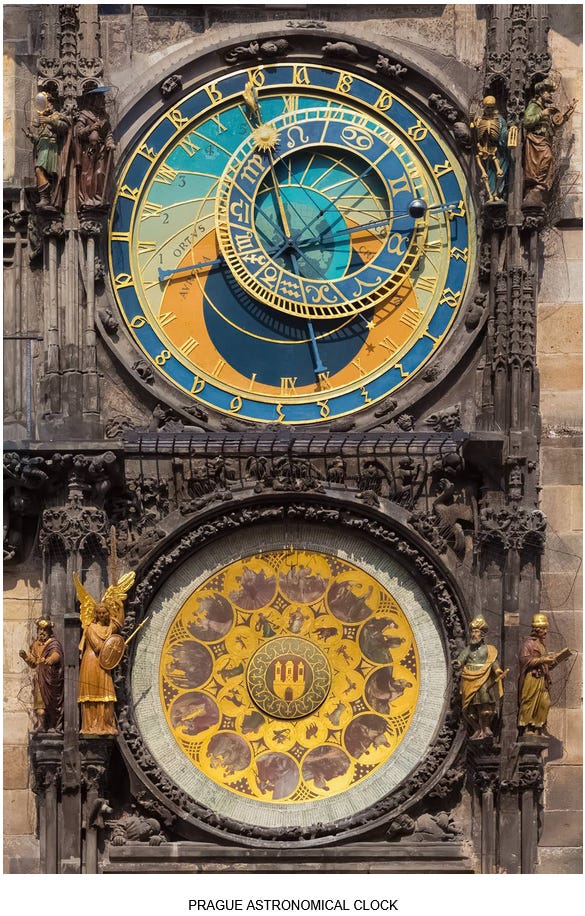
The Prague astronomical clock preserves this older comprehension in public form. First installed on the Old Town Hall in 1410, its upper face gives more than the hour. It shows the relation of Sun, Moon, zodiacal band, horizon, daylight, and darkened sky in one mechanical field. Beneath it sits the calendar face, with months, signs, civic and sacred time, and the cycle of the year. Stone figures flank the mechanism. Gold hands cross blue and ochre fields. The whole façade preserves an older premise: time is nested order.
The evidentiary point should remain limited. The Prague clock does not show that its makers were tracking precessional ages. It shows that the annual relation of the Sun to the zodiacal or constellational band belonged to public timekeeping. The sky behind the year was not treated as empty background. It was built into the face of time.
This is the prior point on which the deeper argument depends. Ordinary hours, solar relation, lunar relation, seasonal recurrence, civic order, sacred observance, and the background field of the sky could be held together in one public mechanism. The Prague clock illustrates that first premise. The Turning of the Age carries the second: the equinoctial marker itself can be read against that field over a longer cycle.
The deeper argument is simple in structure. The year has a reset point. The reset point has a background. Over long periods, the background behind that point changes. The age is the name given to the background field standing behind the spring equinox marker. This begins as a relation: equinoctial point, background field, slow displacement, change of age.
The annual cycle can be watched within a single life. The longer cycle cannot. But civilization can preserve what one person cannot witness fully. It does so through monuments, alignments, calendars, diagrams, sacred stories, civic clocks, and inherited names. A person can watch the Sun’s rising point shift along the horizon through one year. A culture can preserve the recognition that the equinoctial marker itself shifts against the background field over a much longer interval. The difference is scale, not kind.
The constellational field should therefore not be reduced to a ridicule category. The modern label collapses unlike things into one degraded container: popular prediction, personality claims, temple astronomy, sacred calendars, agricultural timing, royal chronology, civic clockwork, and the long observation of the sky as a measuring structure. Once those categories are collapsed, the older order becomes easier to mock and harder to examine. But the structure remains. The background field was observed. It was preserved. It was mechanized. It was placed in public time.
The older world did not encounter the sky as empty space. It encountered center, turning, horizon movement, seasonal return, lunar rhythm, solar balance, and constellational background. These relations formed one ordered field. The Prague clock is powerful because it makes part of that field visible as civic mechanism. It does not ask the viewer to accept a doctrine. It presents a relationship in metal, color, stone, and motion.
Modern time has severed much of this relationship. Time is now met as schedule, deadline, timestamp, fiscal quarter, school term, platform reminder, and workday. The day begins when the device says it begins. The year begins by civil convention, in the depth of winter. Noon is no longer the Sun’s height but the number twelve. Most people know appointments more readily than solstices, and screen calendars more readily than the changing position of the sky.
This displacement is the subject of Industrial Time: When Clocks Replaced the Sun. Mechanical time did not remove the Sun from the sky. It removed the Sun from the schedule. Environmental observation yielded to mechanical authority. Standardized time made railways, factories, finance, telecommunications, and digital systems easier to coordinate, but it also placed a mechanical grid over a living temporal order. The clock began as an instrument for describing natural time. It became an authority that human life was expected to obey.
The same displacement appears at the larger scale. Once people are trained to experience time as schedule, they lose the habit of reading it as recurrence. Once recurrence is no longer read, the sky becomes background. Once the sky becomes background, the constellational field can be dismissed as irrelevant even while it remains visible in clocks, churches, calendars, monuments, language, festivals, and architecture.
This is where permission enters. Permission to Observe examined the difference between seeing and feeling permitted to see. Observation is often filtered through education, prestige, ridicule, authority, and inherited explanation. Under those conditions, a thing can remain plainly present while becoming socially unobserved. The evidence has not disappeared. The permission field has changed.
The Prague clock stands against that loss of permission. It says, without argument, that the older builders did not treat the constellational background as meaningless. They did not isolate the hour from the year, the year from the sky, or the sky from the wider field of recurrence. What modern viewers may treat as ornament was once legible structure.
This does not require romanticism. Not every inherited interpretation must be accepted. Not every symbolic system is complete. Structural inquiry requires something more disciplined than nostalgia. It requires that visible order be allowed to count. The equinox remains observable. The seasonal cycle remains observable. The Sun’s movement along the horizon remains observable. The constellational band remains part of the older architecture of timekeeping. The Prague clock remains a public witness to that fact.
The distinction is therefore clear. The Prague clock supports the legitimacy of the background field within timekeeping. It does not complete the age argument. The age claim begins when the equinox marker, rather than the annual Sun alone, is read against the background field over deep time. If the spring equinox marks the annual point of balance and reset, then the relation between that marker and the background constellational field becomes a possible measure of longer time.
The spring equinox is simple because anyone can recognize the return of balance, the lengthening of light, and the movement toward renewal. It is profound because the same point can serve as an index within a larger structure. Each year it marks the opening of the living cycle. Across deep time, its relation to the background field marks the slow movement of the greater clock.
This restores proportion. Human institutions become less absolute when placed beneath a greater cycle. Administrative time feels total only when natural recurrence has been pushed out of view. Political time measures itself in terms, budgets, emergencies, announcements, and managed crises. Deep time exposes the smallness of those measures. The equinox returns whether institutions notice it or not. The larger movement continues whether the permitted vocabulary preserves it or degrades it.
The recovery begins by allowing observation to precede permission. The sky does not need authorization in order to be read. The equinox does not need a calendar in order to occur. The constellational field does not become irrelevant because a later culture lost the confidence to interpret it. The clock remains, even when the reader forgets how to read.
The Prague astronomical clock survives as a material witness to this older order. Its faces belong together because the year and the sky belong together. Its beauty is not separate from its function. Its function is not separate from its structure. It holds ordinary time, seasonal time, lunar rhythm, solar balance, and constellational background within one public form. To recover the sky as clock is not to invent a new system. It is to see again what was already built in stone, metal, color, and motion.