

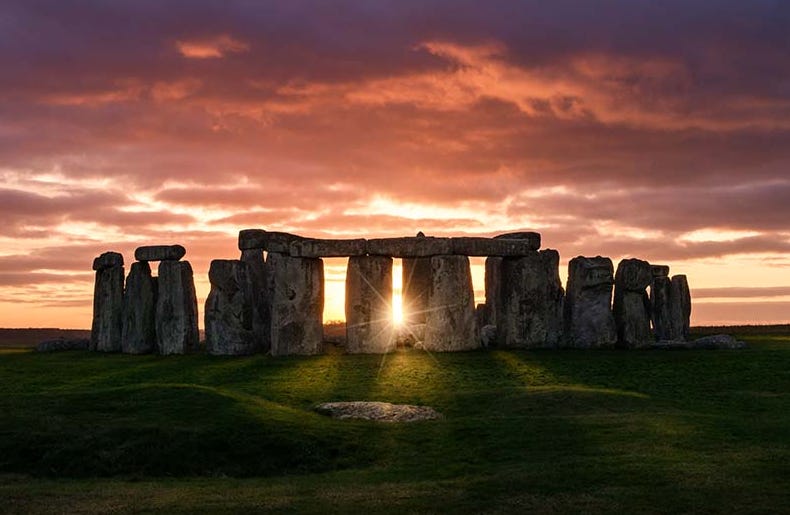
Twice each year the Sun reaches a precise geometric relationship with the Earth’s horizon. On those days the duration of daylight and darkness becomes nearly equal across the world. The event occurs without clocks, calendars, or institutions. It is the consequence of the recurring alignment between the Sun and the Earth’s horizon, a relationship that repeats with remarkable precision.
This moment is known as the equinox. At the spring equinox the Sun crosses the celestial equator moving northward. The visible consequence is simple and observable: daylight begins increasing across the northern half of the world. On this day the Sun rises almost exactly due east and sets almost exactly due west from nearly every location on Earth.
What matters is not the terminology but the structure. The equinox is not a date created by agreement. It is a geometric event that occurs whether anyone measures it or not. Long before the invention of modern calendars, people could observe the moment when winter ended and the balance between light and darkness returned.
The significance of that moment becomes clear when the natural cycle of the year is examined. Winter is the phase of contraction. Growth slows or stops. Many plants enter dormancy. Animals reduce activity or migrate. Agricultural land rests. The system is in its most reduced state.
The spring equinox marks the turning point away from that contraction. Daylight increases. Soil warms. Seeds germinate. Trees begin producing new leaves. Migratory species return. Agricultural activity resumes. In temperate regions the landscape visibly transitions from stillness toward expansion within a few weeks of the equinox.
The cycle of the year therefore has a clear structural rhythm: contraction in winter, expansion in spring, maturity in summer, and decline through autumn before contraction returns again. Within that pattern the equinox marks the beginning of the expansion phase.
For societies that depended directly on the land, this transition was unmistakable. The moment when light begins to dominate darkness signals the start of the growing cycle. It is therefore unsurprising that many early calendars treated the spring equinox as the beginning of the year.
This pattern appears repeatedly across civilizations. The Persian calendar begins the year at the moment of the spring equinox. Ancient Mesopotamian societies marked the renewal of the year at the same turning point. Agricultural festivals associated with renewal and planting were commonly tied to the return of balanced light and the beginning of seasonal expansion.
These traditions were not arbitrary cultural preferences. They reflected direct observation. When the land begins producing again, the year has begun again.
Evidence of this recognition also appears in architecture. Many ancient sites were aligned to the equinox sunrise so that the returning Sun would appear at a precise point on the horizon. Monumental structures in multiple regions were constructed with sightlines or passages that mark the Sun’s position at the equinox, suggesting sustained observation of solar motion across generations.
The underlying pattern is simple enough to detect without instruments. Anyone watching the horizon through the year will notice that the rising point of the Sun slowly shifts north and south. At two moments in that movement the Sun rises exactly in the east and sets exactly in the west. These moments divide the year into balanced halves.
The equinox therefore provides a natural reference point for time itself. Unlike calendar dates, which must be adjusted and corrected, the alignment returns automatically. Human calendars drift and require periodic correction through leap days or other modifications. The equinox does not drift. It is the physical system that defines the calendar, not the reverse.
This difference reveals something fundamental about timekeeping. Natural time emerges from recurring relationships within the physical world: the cycle of day and night, the phases of the Moon, the progression of seasons, and the periodic alignments of the Sun with the horizon. Calendars are attempts to track those cycles.
When a calendar corresponds closely to these recurring patterns, it remains stable and intuitive. When it departs from them, the connection between measurement and experience weakens. The question of how calendars drift away from natural cycles is examined more closely in Solar Cycles and the Search for a True Calendar, which explores the recurring effort to align human timekeeping with the structure of the solar year.
The modern civil calendar begins the year in the middle of winter. In structural terms this placement is difficult to justify. At that point the annual cycle is still in its phase of contraction. Daylight has only just begun to increase after the winter solstice. The natural system has not yet turned toward growth.
Nothing in the observable pattern of seasons suggests that this moment marks the beginning of the year. The land is dormant. Biological activity remains minimal. Agricultural cycles have not yet begun.
By contrast the spring equinox marks the moment when the balance between light and darkness shifts toward expansion. The system visibly moves from contraction toward growth.
From the standpoint of natural structure, the year begins when the cycle begins expanding again.
The placement of the new year in winter therefore reflects the evolution of administrative calendars rather than direct observation of seasonal structure. Over time many societies shifted from solar or agricultural reference points toward institutional timekeeping systems that placed greater emphasis on bureaucratic convenience than seasonal coherence. The broader consequences of this transition are explored in Industrial Time: When Clocks Replaced the Sun, which examines how mechanical time gradually displaced natural cycles as the dominant organizing framework for modern societies.
This contrast illustrates a broader pattern. Natural systems maintain coherence through recurring relationships that remain stable over long periods. Institutional systems often preserve conventions long after their original structural justification has faded.
The equinox makes this difference visible because the underlying pattern remains so clear. On that day the balance between light and darkness can be observed directly. The Sun rises in the east, sets in the west, and begins the long seasonal movement toward greater light.
Most people recognize this transition intuitively even without measuring it. The lengthening of days becomes noticeable within weeks. Temperatures gradually increase. Plants emerge. Human activity shifts outdoors again. The change is experienced directly through ordinary life.
The moment also reflects a deeper structural symmetry in the observed movement of the Sun across the horizon through the year. For a brief period the geometry becomes balanced: light and darkness meet at equal duration before the cycle continues toward the longer days of summer. The role of such alignments in human orientation and symbolic architecture is explored in The Axis Mundi, which examines how ancient cultures used celestial reference points to organize space and time.
Each year the Sun returns to the same point on the horizon and the cycle begins expanding again.
The structure of natural time remains visible for anyone who chooses to observe it.