

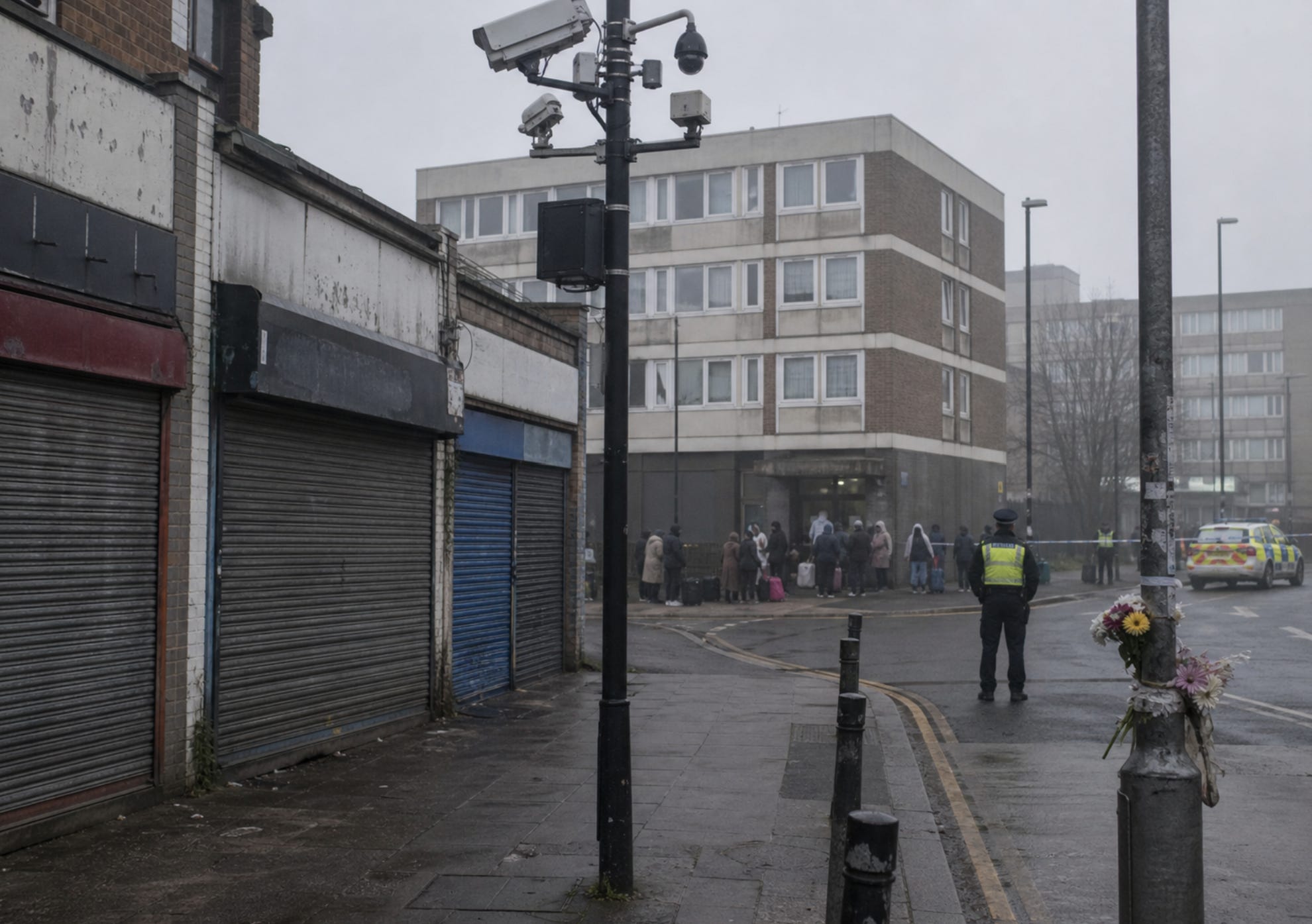
Britain is not merely declining. It is being made less capable of continuing as itself, and the evidence is no longer hidden in mood, impression, or political argument. It is visible in official data, in towns that have lost their economic purpose, in families priced out of formation, in speech treated as a permission, in surveillance treated as ordinary administration, in girls abandoned to institutional cowardice, and in the administrative calm with which all of this is managed.
The Office for National Statistics projects that between mid-2024 and mid-2034 the United Kingdom will see approximately 6.396 million births and 6.846 million deaths, alongside 7.278 million long-term immigrants and 5.096 million long-term emigrants. Deaths exceed births. Millions arrive. Millions leave. Population growth is supplied by migration. This is not national renewal. It is population churn.
The point is not that every emigrant is native-born, nor that every migrant arrival remains permanently. The point is structural. Britain is no longer projected to sustain itself through births exceeding deaths. Its population future depends on movement in and out while internal renewal weakens. A country that does not reproduce itself must find another way to maintain its numbers.
That should dominate national policy. Instead, it sits in the background like a weather forecast.
The weakening of internal renewal is not mysterious. Britain has made it progressively harder for its own people to build stable, rooted lives. Housing is punishingly difficult at the age when families would ordinarily form. Childcare is among the heaviest costs faced by working parents. Work is often insecure. Tax burdens are high. Local economic life has thinned. Family life is increasingly treated as a private inconvenience rather than a shared civilizational good.
People are not being marched out. They are being driven out by conditions.
When a country becomes too expensive to settle in, too unstable to plan within, and too demoralizing to build a future upon, people leave. That outward movement is not theoretical. It appears in the same official figures. Millions are projected to emigrate over the coming decade. A significant share of that movement necessarily falls within the working-age population, the very group on which family formation, economic life, and long-term continuity depend.
This is where the issue crosses into natural law.
A governing system has a primary duty to create the conditions in which its people can live, form families, remain, and continue their communities. When it instead produces conditions under which increasing numbers leave, while births fall and continuity weakens, it is acting against that duty. A state that cannot retain its own people because life inside it has become too constrained, too expensive, too unstable, or too demoralized is failing at the most basic level of governance.
At the same time that internal continuity weakens, external inflow is sustained. The earlier analysis in UK Immigration: Policy Failure or System Direction? showed that this trajectory has persisted across governments, parties, warnings, and political cycles. Integration limits were identified. Housing strain was identified. Service pressure was identified. Social cohesion risks were identified. The direction did not change. Brexit, which was supposed to restore control, did not alter the outcome. The framework changed. The movement continued.
This is the first major Strategic Intent Analysis signal. For more than two decades, British governments of different parties have promised control while the operational trajectory continued. Elections were fought on correction. Ministers announced targets. Reviews documented strain. Public concern grew. Brexit restored formal legislative authority. Yet the same direction remained. Ordinary policy failure produces variation, retreat, experimentation, or correction. Strategy produces alignment, reinforcement, and lock-in. The public was given the language of control while the system delivered continuity of inflow.
The result is a system in which absence is replaced rather than resolved.
Britain makes it harder for its own people to build lives, then compensates for the consequences by importing population. It weakens family formation, then treats migration as the solution to the demographic gap. It produces the absence, then manages the replacement.
That is not one failed policy. It is a structure.
Nor is migration only a question of numbers. That is one of the evasions by which the issue is kept artificially polite. Migration is also about who arrives, whether they can work, whether they obey the law, whether they can live inside the receiving country’s norms, and what happens when they cannot or will not. A serious state distinguishes between people likely to contribute to national continuity and people likely to increase dependency, fragmentation, criminal danger, or social strain. Britain has not made that distinction with sufficient seriousness. It has admitted large numbers of low-skill migrants into a country already under housing, welfare, school, policing, and health-service pressure. It has also failed repeatedly and visibly to remove those who offend, exclude those who pose obvious risks, and protect the settled population from consequences the governing system itself has created.
The public safety issue cannot be brushed aside as anecdote or prejudice. Knife attacks, sexual violence, repeat offenders, grooming-gang scandals, asylum-hotel disorder, and serious crimes committed by people who should not have been present, should have been removed, or should not have remained at liberty are now recurring features of British public life. They are reported with grim regularity. They are not the whole story of migration. They are, however, part of the story ordinary people are forced to live inside.
A state does not have the right to import risk and then moralize public alarm.
The organised rape-gang scandals revealed the same structure in its most unforgivable form. Rotherham, Rochdale, Telford, Oldham: the names have become shorthand for a failure so grave that “safeguarding failure” is almost an insult to the victims. Girls were abused while authorities hesitated, minimized, displaced responsibility, or failed to act with the force the facts demanded. This was not ignorance alone. Repeated inquiries showed that concerns about race, community relations, institutional reputation, and accusations of prejudice affected official response. That is not administrative failure in the ordinary sense. It is betrayal. A state that allows vulnerable girls to be sacrificed because truthful description would embarrass the governing narrative has inverted its most basic duty.
This is where the language of “cohesion” becomes almost obscene. Cohesion for whom? For the abused child whose suffering was inconvenient? For the family afraid to speak? For the ordinary resident told that noticing obvious patterns is morally suspect? For communities expected to absorb consequences while officials preserve institutional comfort?
The same issue appears in the development of parallel communities and informal no-go conditions. These are not always formal “no-go zones” in the cinematic sense. They are often something more insidious: areas where the state still claims authority, but ordinary people understand that authority is uneven, hesitant, politically conditioned, or practically unreliable. There are places where social pressure, intimidation, language separation, clan structures, religious or cultural enforcement, and police caution create conditions in which British law exists formally but does not operate with equal confidence. That is not integration. It is territorial and cultural fragmentation under administrative denial.
In Strategic Intent Analysis terms, this is asymmetric enforcement. In ordinary language, it means the public is policed more carefully for noticing danger than the system is for producing it. The settled population is expected to obey the law, absorb the consequences, and moderate its language. Dangerous entrants, repeat offenders, integration failures, and institutional negligence are often processed with hesitation, explanation, or delay. Public alarm is scrutinized more aggressively than the policy conditions that produced it. That asymmetry reveals what the system is most willing to protect.
The damage is not only physical. It is epistemic. People are made to doubt the legitimacy of their own observations. They see neighbourhoods change, services strain, public safety weaken, and official language narrow. Then they are told that the real danger lies in noticing.
This is where the migration issue connects directly to speech. In Britain Has Never Had Freedom of Expression: Parliamentary Sovereignty and the Permission Model, the central point was that speech in Britain exists within a framework of permission rather than protection. It can be investigated, chilled, recorded, burdened, and managed without dramatic acts of censorship. That matters because a society undergoing visible transformation depends on whether people can describe what they see. If speech becomes conditional, reality itself becomes harder to acknowledge.
The same system that produces demographic churn also shapes the language through which that churn is understood. This is narrative canalization. The acceptable frame narrows: compassion, inclusion, diversity, labour need, economic necessity, anti-racism. Those terms do not merely describe policy. They discipline perception. Capacity, composition, danger, consent, continuity, and betrayal are pushed to the edges of permissible discussion. The more visible the consequences become, the more morally loaded the permitted language becomes.
At the level of governance, the pattern becomes more explicit. In Governance Under Permanent Friction, I examined how institutions adapt when they expect a more fragmented and unstable internal environment. Planning assumptions shift. Public-order frameworks expand. Protest regulation tightens. Administrative flexibility increases. The system behaves not as if cohesion is secure, but as if friction is expected.
That expectation is reinforced by infrastructure. In The Architecture of Continuous Monitoring, the United Kingdom’s extensive surveillance environment—camera networks, communications data, identity systems, platform regulation, and cross-agency monitoring—was examined as a permanent condition rather than an emergency measure. Systems do not build enduring observation capacity for temporary problems. They build it for the future they anticipate governing.
This is institutional lock-in. The state has not merely allowed the trajectory to continue. It has reorganized around the consequences. Public services assume continued pressure. Housing demand assumes continued growth. Employers and universities depend on inflow. Councils and NGOs expand around migrant support and cohesion management. Surveillance and public-order systems expand around friction. Schools moralize the resulting social condition. Reversal becomes increasingly costly because the institutions that should correct the problem have adapted to its continuation.
The state does not appear incapable. It appears selective.
It struggles to make housing affordable. It struggles to support family formation. It struggles to maintain public services under pressure. It struggles to preserve the productive base of the economy. It struggles to protect girls from organised sexual exploitation when doing so would require institutional courage. It struggles to remove dangerous people. It struggles to speak honestly about the consequences of its own policy.
But it does not struggle to monitor, regulate, record, investigate, tax, manage, and correct language.
Capacity exists. It is applied to control, not restoration.
That distinction becomes even clearer in the economic landscape. In Germany Before the Fall, England After It, England’s long-term industrial decline was examined as a visible outcome of sustained policy direction. High streets hollow out. Productive capacity weakens. Local economies lose function. The language used to describe this process—transition, modernization, adaptation—softens its reality. But the material effect is clear.
A country without a strong productive base loses more than output. It loses the conditions that sustain family life, community stability, local dignity, and long-term continuity. When production weakens, the state expands to manage the consequences. Administration replaces vitality. The camera replaces confidence. The betting shop monetizes despair. The charity shop occupies the space where ordinary commerce once stood. The vape shop, the shuttered bank, the broken pavement, the managed high street, the exhausted public square: these are not isolated signs of decay. They are the visible surface of a deeper structural choice.
The same logic appears in education. Children are increasingly introduced to simplified moral narratives about openness and inclusion without corresponding discussion of limits, capacity, public safety, cultural continuity, or consent. Kindness is not the issue. The removal of trade-off is. A five-year-old can understand a smiling animal in a boat. A five-year-old cannot understand housing allocation, public finance, criminal-risk filtering, or national continuity. Children are taught the conclusion before they are equipped to understand the question.
That is not education in the full sense. It is pre-consent.
It prepares the next generation to accept the consequences of decisions they did not make, inside a country whose adults were never honestly asked. It teaches moral reflex in place of civic reasoning. It tells children there is always room, while adults cannot find homes, public services cannot cope, native family formation weakens, and the state imports both dependency and risk while treating objection as pathology.
Britain is being taught to disappear with good manners.
By this point, the pattern is difficult to deny. Britain weakens the conditions for its own continuity, sustains demographic inflow despite visible strain, admits people without sufficient regard to compatibility and risk, fails to protect the vulnerable when truth becomes inconvenient, prepares institutionally for a more fragmented society, expands surveillance, retains control over speech within a permission framework, allows productive life to decay, and teaches acceptance of the outcome.
Each element can be justified in isolation.
Together, they move in one direction.
The persistence of that direction is the final piece. In Policy Failure and Feedback Breakdown, the mechanism was described clearly: modern systems are increasingly able to absorb visible failure without correcting course. The public experiences the consequences. The system manages them. Failure does not necessarily trigger reversal because institutional priorities are not aligned with public outcomes.
This is why so much can visibly go wrong and yet continue unchanged.
The method for recognizing this was set out in Strategic Intent Analysis: Inferring Direction Through Structural Convergence. Intent in large systems is not declared. It is inferred from persistence, preparation, repeated selection, asymmetry, narrative control, institutional lock-in, and the narrowing of alternatives. When independent domains reinforce the same trajectory over time, coincidence becomes less plausible than direction.
Britain now exhibits that trajectory at high strength. The response is not fragmented. It is not reversible in any ordinary political sense. It is not exploratory. It is selective, reinforcing, path-dependent, and increasingly difficult to unwind. The policy direction continues. The narrative protects it. The institutions adapt around it. The public absorbs the consequences. The alternatives narrow.
That is not undisclosed accident.
It is undisclosed policy.
A nation does not have to collapse suddenly to be destroyed. It can be destroyed by breaking the conditions that allow it to continue. Make it harder for its people to form families. Make it harder for them to remain. Allow its productive base to weaken. Replace continuity with churn. Import dependency and risk. Abandon the vulnerable when truth becomes politically inconvenient. Condition children to accept the result. Restrict the ability to speak honestly about what is happening. Expand the systems required to manage the consequences.
The country will still exist. Its institutions will still function. Its forms will remain intact.
But its continuity will be gone.
That is the systematic destruction of Britain.