

Modern people are taught to picture time as a line. The past recedes behind them. The future waits ahead. History is imagined as accumulation: more knowledge, more technology, more administration, more power, more control. The present is treated as superior because it comes later. This is the hidden assumption beneath the modern idea of progress. It is rarely defended. It is simply breathed in.
The older world understood time differently. It saw return. The year returns. Seeds fall into darkness and rise again. The land contracts, rests, opens, flowers, fruits, declines, and rests again. Bodies are born, grow, weaken, and die. Kingdoms rise, harden, corrupt, fracture, and are replaced. Memory is preserved, lost, buried, and recovered. Flood, fire, winter, famine, burial, and renewal recur across human tradition because human beings repeatedly encountered the world as rhythm, not as indefinite improvement.
The turning of the age belongs to that older understanding. But it should not be introduced first as symbol, doctrine, or belief. It begins as observation.
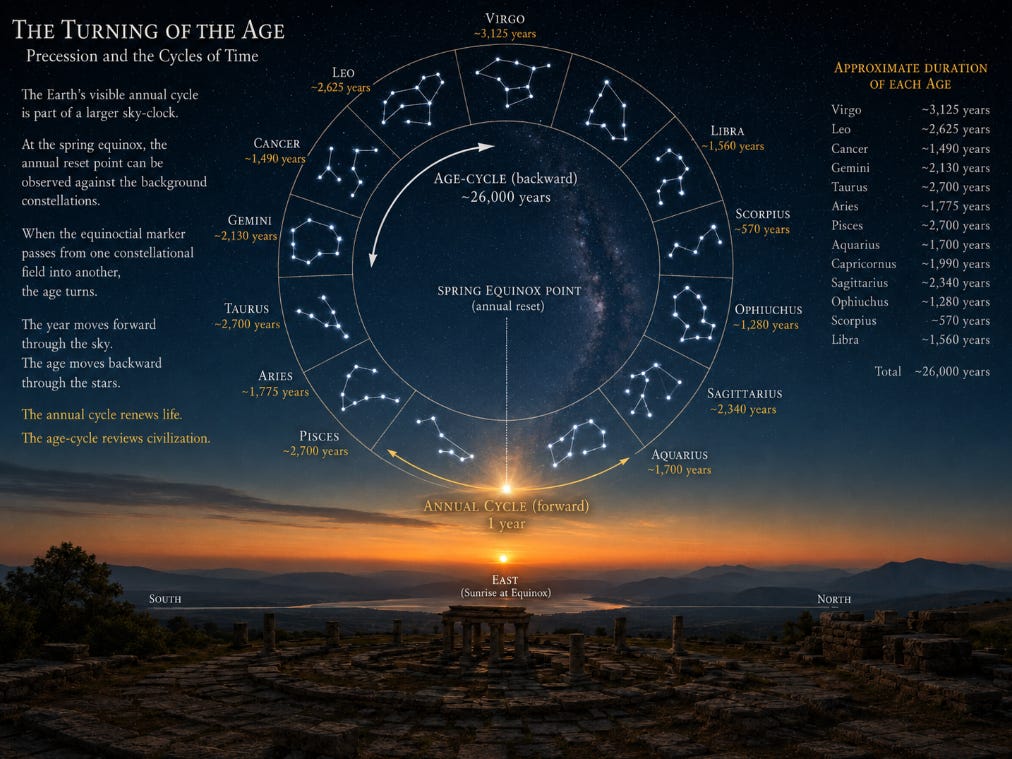
The age is named by the constellational field standing behind the spring equinox marker. The spring equinox is the annual point of balance and reset. It is the moment when light and darkness come into near equality and the year turns from winter contraction toward growth. As described in The Spring Equinox and the Structure of Natural Time, this is not a date created by agreement. It is a recurring event in the observed world. The Sun rises almost exactly in the east, sets almost exactly in the west, and the living year begins moving toward greater light.
That point can be located against the background constellations. Over long periods, the background behind the equinoctial marker does not stay in the same field. It shifts slowly, moving backward through the constellational sequence. When the spring equinox marker passes from one background field into another, the age has turned.
That is the core. The year has a reset point. The reset point has a background. The background changes over long time. The age is the name given to the background field behind the reset point.
The official system concedes this motion. It calls it precession. It describes the equinox marker as slowly changing position against the background of fixed stars, often at the rate of roughly one degree every seventy-two years, or one full circuit in about twenty-six thousand years. It also recognizes that the spring equinox marker is presently in Pisces, near Aquarius. The motion is not the disputed part. Meaning is.
This is where the modern dismissal begins. The subject is pushed into the word “astrology,” usually in a demeaning tone. That word is made to carry everything at once: newspaper horoscopes, personality claims, occult prediction, temple astronomy, agricultural timing, sacred calendars, royal chronology, and the long observation of the sky as a clock. Collapsing those categories into one word makes the older system easier to mock and harder to examine.
The system described here is not a horoscope system. It is not a claim about personality types. It is not a newspaper column. It is an observational sky-clock: spring equinox marker, background constellational field, slow backward movement, change of age. A clock does not become imaginary because a later culture mocks the people who read it.
This is the same observational seriousness examined in The Axis Mundi: Polaris, the Turning Sky, and the Geometry of the Year. Ancient cultures did not encounter the sky as emptiness. They encountered center, rotation, horizon movement, seasonal return, and the fourfold structure of the year. The stars turn around a fixed northern center. Sunrise shifts along the horizon, reaches limits, reverses, and returns. Equinoxes and solstices divide the year into a stable pattern. Ancient forms that later cultures treat as decorative often began as memory systems: compact diagrams of time, direction, recurrence, and order.
The second distinction concerns the constellations themselves. The simplified twelve-sign system divides the circle into twelve equal thirty-degree portions. In that system, each age is usually estimated at about 2,160 years, because thirty degrees multiplied by roughly seventy-two years per degree gives that number. But this is an equal-sign abstraction. It is not the same as observing the actual background constellations.
The visible annual path passes through thirteen background constellational fields, including Ophiuchus. The fields are not equal. Some are broad. Some are narrow. Some hold the marker for a long time. Others hold it only briefly. The twelve-sign system makes the clock symmetrical. The observed background field makes it particular, irregular, and less convenient.
Using the practical estimate of about seventy-one to seventy-two years for each day of apparent annual passage through a background constellation, the approximate duration of each age would be as follows:
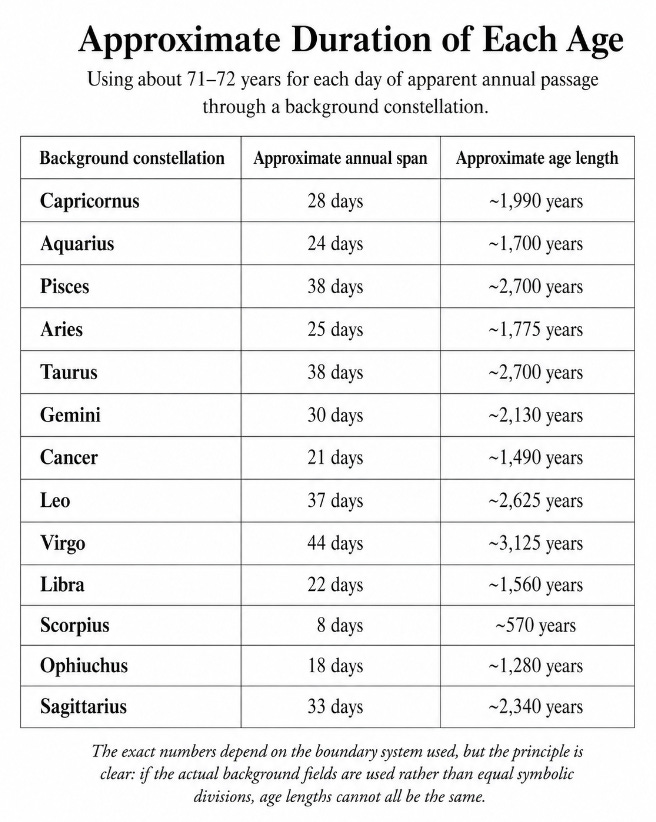
The familiar estimate of 2,160 years per age belongs to the equal twelve-part model. The thirteen-background-constellation model produces unequal ages because the sky being observed is unequal.
The direction of movement is also important. The annual sky moves forward through the constellational sequence. The year proceeds through the visible cycle of return. But the age-marker moves backward against that sequence. In age-time, Pisces gives way to Aquarius, Aquarius to Capricornus, Capricornus to Sagittarius, and so on.
This is a strange idea at first. The surface cycle moves forward. The deep cycle moves backward. Ordinary time unfolds through the year: balance, growth, fullness, decline, death, and return. Age-time moves by a slower counter-motion against the background field. The annual cycle renews life. The age-cycle reviews civilization.
In natural-law terms, this suggests two lawful motions of time. One is generative. One is corrective. The forward annual cycle gives life room to unfold. It governs planting, growth, harvest, decay, and renewal. The backward age-cycle suggests return, review, unwinding, correction, and restoration. The year tells the story of life proceeding. The age tells the story of order being tested.
This is why the movement matters. If the ages move backward through the background fields, the turning of an age is not simply another stage in a straight line of progress. It is not an upgrade. It is reversal pressure. It is the point at which accumulated disorder meets the deeper field of correction. What has been built forward without proportion is brought back under review. What has accumulated without alignment begins to lose coherence.
Ancient time was therefore not primitive time. It was an attempt to describe the world as it behaves. Living systems do not persist by infinite extension. They persist by rhythm, proportion, correction, and renewal. The day does not lengthen forever. The season does not ripen forever. Growth without limit becomes disease. Accumulation without proportion becomes burden. Authority without accountability becomes domination.
The annual cycle is the immediate teacher. Spring does not abolish winter by argument. Winter does not disprove summer by arriving. Each phase belongs to the whole. Each phase becomes destructive only when mistaken for permanence. The cycle does not weaken meaning. It gives meaning a structure.
Calendars reveal the same distinction. A calendar is never merely a neutral device for counting days. It tells a society when the year begins, which rhythms matter, how labor is arranged, how memory is ordered, and which cycles are treated as authoritative. As argued in Calendars, Power, and the Governance of Time, timekeeping becomes a form of governance when administrative systems displace natural rhythm. A calendar aligned to the spring equinox begins with the movement from contraction into growth. A calendar that begins in the depth of winter reflects institutional convention rather than the structure of the living year.
This matters because modern timekeeping trains people to live inside abstraction. The clock replaces the sky. The administrative year replaces the natural year. Institutional scheduling replaces seasonal recognition. Over time, people no longer experience time as relation, rhythm, and recurrence. They experience it as sequence, obligation, and measurement. Once time has been detached from natural order, linear history becomes easier to impose. The modern mind learns to count days while forgetting what the days belong to.
Modern institutions provide a mechanism for the age-marker but no account of meaning. They concede that the ages exist as measurable intervals while treating the sky-clock as a dead instrument. Older traditions understood the point more clearly: a clock that joins the year, the horizon, and the background constellations is not secular. It is an order-bearing form. For them, ages were not merely periods. They were fields of order, decline, correction, and renewal.
The ancient sources preserve another structure.
In Plato’s Timaeus, the Egyptian priest tells Solon that mankind has suffered repeated destructions, especially by fire and water, and that the Greeks remember only one flood because they lack the deeper record. The point is not merely disaster. It is the loss and recovery of memory across recurring rupture. Human beings forget because the institutions and records that preserve memory are periodically broken.
In Plato’s Statesman, the cycle is even more direct. The world passes through great reversals. The motion of the world changes, and this greatest change is destructive to men and animals. Human life itself is described as being reversed like the motion of the world. This is not a progress story. It is a world-cycle story. Reversal belongs to the structure.
Hesiod’s Works and Days preserves another version. The ages of man decline from gold toward iron. The decline is moral and structural. Peace, sufficiency, and right relation give way to strife, impiety, injustice, violence, and the loss of shame. Iron is not worse because it comes later. It is worse because it has lost alignment.
The Hindu yuga tradition is still more explicit. The cycle moves through ordered ages into Kali Yuga, the age of disorder, decline, and loss of dharma. The end of Kali is described as the destruction of wickedness and restoration of right order. The age turns because disorder has exceeded the field that can lawfully hold it.
The Zoroastrian story of Yima’s Vara gives the same structure in another form. A terrible winter is foreseen. A protected enclosure is prepared. Seeds of men, animals, birds, fires, and living things are preserved through the destructive interval. The Vara is warning, enclosure, selection, seed, survival, and renewal. It is ancient continuity through correction.
The Maya Popol Vuh carries the pattern again. Creation is not a single smooth success. Earlier human forms fail. Mud people crumble. Wooden people are destroyed, including through flood. A later human form emerges from maize. This is not the same system as the precessional-age model, but it preserves the same structure: failed forms, correction, destruction, remaking, and a humanity finally fitted to right relation.
These traditions differ in language, symbol, theology, and calendar structure. Their agreement remains visible. Time is not a neutral line. Ages have quality. Disorder accumulates. Law is forgotten. Rulers become unjust. Human beings lose measure. Rupture comes. A remnant remains. Life continues under changed order.
The turning of the age is not presented in the older literature as meaningless catastrophe. It is correction, judgment, purification, restoration, or renewal. Its purpose is not annihilation. Its purpose is the removal of what can no longer remain in order.
This returns the subject to natural law. In An Explanation of Natural Law, natural law is described as structure: the underlying order that governs what can exist, what can endure, and what collapses. Human law may be written by authority. Natural law is discovered through reality itself. It operates whether acknowledged or denied.
The turning of the age is natural law operating at civilizational scale. A structure that violates load-bearing principles will fall. A body that violates biological limits will fail. A society that violates truth, coherence, reciprocity, boundary, and right relation will fracture. These outcomes are not theatrical punishments. They are consequences of misalignment with how the world is organized.
A linear system has difficulty seeing this because it treats the present order as the necessary outcome of everything before it. Whatever exists now is presumed to be the leading edge of history. Modern institutions rely heavily on that assumption. Their authority depends on law, procedure, force, credentialing, and also on the belief that they represent the advanced stage of human development. Their errors become temporary. Their failures become administrative. Their contradictions become problems to be managed inside the same frame that produced them.
Cyclical time makes a different judgment. It asks whether the structure still holds. It asks whether authority remains aligned with truth, proportion, responsibility, and protection of life. It asks whether institutions still serve the order they claim to represent, or whether they have become mechanisms for preserving themselves after their purpose has been lost. In a cyclical frame, age is not only duration. Age is condition. An order becomes old when its forms remain but its coherence has departed.
An age can continue outwardly after it has inwardly ended. Its offices may remain. Its language may remain. Its ceremonies may remain. Its experts may remain. Its currencies, courts, universities, churches, agencies, and media systems may continue operating. Yet their operation may increasingly preserve appearance rather than order. Procedure may replace justice. Classification may replace truth. Compliance may replace consent. Spectacle may replace meaning. The system may still speak in the language of authority while functioning as a defense against accountability.
This is where natural order and corrupted order separate.
In natural order, authority is derivative. It arises from alignment with truth and duty. It exists to preserve life, boundary, justice, continuity, and right relation. Its legitimacy depends on proportion. Power must remain answerable to what it affects. A household, a community, an institution, and a state each have proper scale and proper limits. When responsibility is held close to consequence, order can remain living. When power moves far from consequence, abstraction begins to replace relation.
In corrupted order, authority becomes self-referential. It treats its own continuity as proof of legitimacy. It no longer asks whether it remains true, lawful, or protective. It asks how its position may be preserved. Once this inversion occurs, the institution survives by managing perception, controlling memory, restricting inquiry, and converting failure into justification for further control. It cannot correct itself without surrendering the false premise on which it now depends.
This is the pattern examined in The Corruption of Order. False systems do not always destroy natural order openly. They overlay it. They retain the names, offices, procedures, buildings, credentials, and rituals of rightful order while changing the governing end inside the form. Law continues while losing justice. Finance continues while losing stewardship. Medicine continues while losing healing. Education continues while losing formation. Government continues while losing proportion and limit. The shell remains. The animating principle weakens.
A linear theory of history protects this corruption. If time only moves forward, existing institutions can present themselves as the future. Resistance to them can be framed as backwardness. Older knowledge can be dismissed as superstition. Sacred chronology can be reduced to mythology. Local forms of life can be treated as obsolete. The memory of prior rupture can be placed outside serious thought. The public can be trained to believe that whatever came before modern administration was necessarily less informed, less rational, and less real.
This is why the dismissal of the age system as “astrology” matters. The dismissal prevents people from distinguishing between a degraded popular practice and the older observational structure. Once the whole subject is demeaned, the sky-clock disappears from serious inquiry. The official system can concede the motion while denying the meaning. It can preserve the measurement while stripping it of historical, moral, and civilizational significance.
But the world does not become lawful because modern institutions describe it that way. Natural law is not abolished by language. It remains visible in consequence. Systems that over-centralize become brittle. Systems that sever authority from accountability become predatory. Systems that replace truth with narrative require increasing force to maintain belief. Systems that deny rhythm, boundary, sex, family, land, memory, and death do not transcend nature. They lose correspondence with it.
The turning of the age, understood structurally, is the moment when accumulated misalignment can no longer be carried by the existing field. It is corrective before it is catastrophic. This correction is not sentimental. It does not promise that every innocent person is spared injury or that every wrong is immediately named. Natural law is constraint. It is what holds, what fails, and what follows when misalignment becomes too great.
This is why ancient traditions describe age transitions through flood, fire, winter, destruction, judgment, purification, or renewal. The images differ. The structure repeats. A world becomes disordered. Law is forgotten. Rulers become unjust. Violence, falsehood, inversion, and impiety increase. Rupture occurs. A remnant remains. Life continues, but not under the same arrangement.
Yet human beings still recognize the pattern. They may not have the language for it, but they feel when an order is old. They notice when institutions no longer believe their own words. They notice when public explanation becomes thinner, when contradiction increases, when authority becomes more anxious, when official language loses contact with lived experience. They notice when life must become more local, more practical, more truthful, and more grounded in order to remain sane.
The turning of the age gives a name to that recognition. It says that civilizational instability need not be random. It may belong to a larger rhythm in which false structures are exposed by the pressure of transition. The old order fails because its internal contradictions become too great to stabilize. What was concealed begins to show. What was inflated begins to lose weight. What was abstract begins to require real support. What was unlawful begins to encounter consequence.
The same distinction appears in institutional behavior. If a ruling system publicly teaches linear permanence while privately preparing for discontinuity, then its preparations become part of the evidence. They reveal which model of time the system actually trusts.
This also clarifies the behavior of hidden authority. If ruling systems privately understand time cyclically while publicly teaching linear progress, their preparations take on a different meaning. Continuity planning becomes more than administrative prudence. It becomes evidence that the state knows visible order can fail. Underground facilities, emergency powers, classified command structures, protected records, contractor logistics, and stores of value all belong to a deeper admission: the public order is not regarded by its own managers as permanent.
There is nothing inherently corrupt about continuity. Life itself requires continuity. Seeds are saved. Records are preserved. Children are protected. Tools are maintained. Houses are repaired. Communities carry memory through hardship. A lawful continuity system would preserve life, truth, family, land, skill, justice, and the vulnerable through disorder. It would understand survival as service to restored order.
The corrupted continuity system serves command. It protects the ruling layer rather than the order of life. It may store assets while leaving the public dependent on fragile systems. It may prepare hidden routes while discouraging ordinary resilience. It may preserve records while corrupting public memory. It may speak of safety while concentrating survivability inside classified structures. In this form, continuity becomes inversion. It does not prepare civilization to pass through rupture. It prepares power to survive the consequences of its own disorder.
The turning of the age therefore cannot be understood only as cosmology, mythology, archaeology, or emergency government. It is a natural-law question. What is being preserved? Who is being protected? What form of authority is trying to cross the boundary? Does continuity serve life, or does it preserve the system that has departed from life?
The older view of time does not permit false permanence. It does not allow an institution to become eternal because it has mastered administration. It does not allow language to override consequence. It does not allow power to define truth indefinitely. It gives life room to unfold, but it also gives disorder time to reveal itself. The cycle is merciful because it permits growth and return. It is lawful because it does not permit inversion to become permanent.
The forward annual cycle and the backward age-cycle express the same truth at different scales. Life moves forward through the year, but civilization is reviewed by the deeper counter-motion of the ages. Visible time permits unfolding. Deep time restores constraint. The annual cycle renews life. The age-cycle corrects civilization.
The turning of the age is therefore a recognition of structure. The world is not an endless line of institutional advancement. It is an ordered field of recurrence, correction, and renewal. Human beings survive the turning. Land survives. Water survives. Seeds survive. Families survive. Memory survives where it is carried faithfully. Natural law survives because it is not created by the age that violates it.
What may not survive is the false world-picture: modern authority as permanent, history as endless forward motion, ancient memory as meaningless, hidden preparation as merely administrative, and legitimacy preserved after truth has been abandoned.
The age does not end humanity. It tests order. It reveals what was built in alignment and what was built against the structure of the world. When an age turns, authority without truth becomes weight without foundation. What is coherent may pass through. What is inverted must either be corrected or fail.