

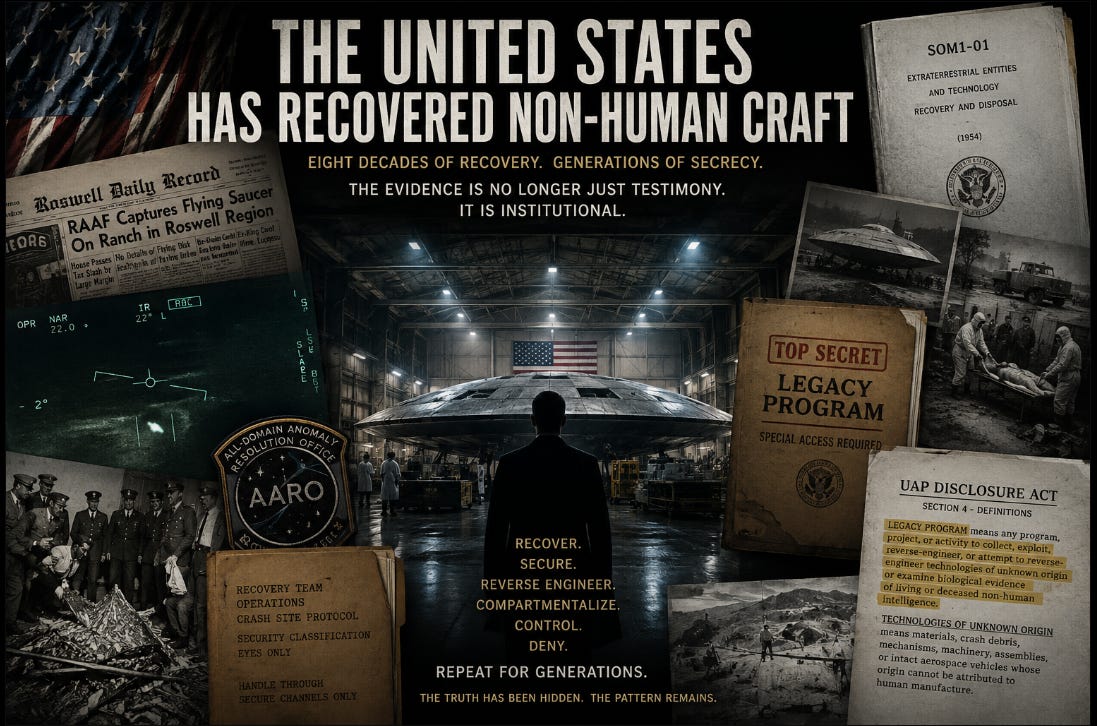
This essay is part of William J. Teesdale’s Strategic Intent Analysis archive at strategicintentanalysis.com. The method is simple: begin with what is observable, then test the story against the structure beneath it.
For most of the modern UFO era, the crash-retrieval question was made to stand or fall with Roswell. If the object recovered in New Mexico in July 1947 could be reduced to a balloon, the larger claim could be dismissed with it. The argument was convenient because it concentrated an enormous historical question into one disputed event. Roswell became the case, and once Roswell became uncertain, recovery itself could be treated as uncertain. That position is no longer sustainable. The evidence now extends far beyond Roswell, far beyond the United States, and far beyond the testimony of witnesses who emerged decades after the events they described. When the historical record is placed beside modern intelligence testimony, congressional action and the increasingly specific statements of people who investigated the subject from inside government, a different picture emerges. The United States has recovered craft of non-human origin. Other major powers have done the same. The programs created to recover, exploit and conceal those technologies have been among the most closely guarded state secrets of the past eighty years.
That is a conclusion, not an official admission. The distinction matters. Strategic Intent Analysis: Inferring Direction Through Structural Convergence developed the method used here: where direct access to intention or hidden activity is unavailable, independent patterns of preparation, decision, incentive, institutional behavior and outcome can still converge strongly enough to establish the most coherent explanation. Intent is routinely inferred this way in criminal law because people seldom provide convenient declarations of their true purpose. Institutions likewise reveal direction through what they repeatedly protect, suppress, fund, compartmentalize and preserve. Applied to the UFO record, the question is therefore not whether the Pentagon has formally announced possession of non-human craft. It is which explanation best accounts for eight decades of witnesses, documents, recovery allegations, classified structures, congressional legislation, private-custody concerns, foreign competition and the behavior of senior officials receiving information unavailable to the public.
The modern military record first establishes that there is something physical to recover. During the 2004 Nimitz encounter off Southern California, Commander David Fravor and other naval aviators encountered the object later called the Tic Tac after the USS Princeton had reportedly been tracking unusual objects in the operating area. Fravor described a smooth white vehicle without wings, rotors or visible conventional propulsion that reacted to his aircraft and departed with extraordinary acceleration. He subsequently testified under oath before Congress. The case does not establish who made the object or where it originated, but it provides an important starting point: the recovery question concerns a phenomenon that has been observed by experienced military personnel and detected by sophisticated military systems.
Once physical recovery occurs, however, the evidentiary problem changes. A sighting can be recorded and forgotten. A recovered vehicle cannot. It has dimensions, mass and material composition. Somebody has to secure the site, move the object, store it, examine it and decide who may have access. Scientists and engineers need facilities. Security personnel have to protect those facilities. Money has to support the work. If the object moves from military custody into a private aerospace company, relationships and authorities are created. If recoveries occur repeatedly, procedures develop. Physical possession therefore creates something a sighting does not: an administrative shadow.
This is the distinction developed more fully in The Intelligence State and the UFO Problem. The public was encouraged for decades to treat UFOs primarily as a belief problem: are they real, is the witness credible, could the sighting have been a balloon, aircraft or atmospheric effect? The intelligence system necessarily faced a different set of questions. An anomalous object could become an airspace problem, a threat problem, a technological problem, a foreign-acquisition problem and, if recovered, a custody problem. The intelligence state can tolerate public uncertainty about things seen in the sky far more easily than it can tolerate public knowledge of what it physically possesses. Once material is recovered, the issue moves from observation into power.
Roswell remains important because the United States military itself announced on July 8, 1947, that personnel from Roswell Army Air Field had recovered a “flying disc.” The explanation changed almost immediately to a balloon and radar reflector and was later refined into the Project MOGUL explanation, involving a classified balloon system intended to monitor Soviet nuclear activity. That provides a plausible reason for secrecy and cannot simply be ignored. Yet the later government investigation also found substantial gaps in the archival record. Roswell Army Air Field administrative records covering several years around the event and outgoing messages covering the critical period had been destroyed, with the surviving disposition documentation failing to explain who destroyed them, when, or under what authority.
Those missing records do not establish that Roswell involved non-human technology, but they prevent the surviving archive from being treated as complete. More importantly, Roswell no longer has to carry the retrieval case. Even if Project MOGUL is accepted as the explanation for the 1947 event, the modern crash-retrieval case remains substantially intact.
Long before David Grusch appeared before Congress, researchers had accumulated a much larger record of alleged recoveries. Leonard Stringfield spent decades collecting accounts from military and government sources concerning recovered craft and bodies. Ryan Wood later assembled a broader corpus in Majic Eyes Only. The original edition examined seventy-four reported crash-retrieval cases, while the expanded body of work now exceeds one hundred. The cases vary greatly in quality. Some depend heavily upon later testimony or anonymous sources; others involve multiple witnesses, contemporary records or unusual official activity. Treating the collection as though every case were equally reliable would be an evidentiary mistake. Treating the entire corpus as meaningless because some cases are weak would be another.
Wood’s work matters because it demonstrates that crash retrieval was never merely the Roswell story repeated under different names. The allegations extend across decades, involve different vehicle forms and occur in different countries. They describe recovery as a recurring activity rather than a single historical anomaly. Seen only from within the older UFO literature, that pattern could still be explained as folklore reproducing itself. Its significance changes when modern government-linked witnesses begin describing a recovery structure of comparable scale.
The international dimension has also become considerably more important. Grusch has publicly described a recovery in Fascist Italy in 1933, saying that the object was ultimately obtained by the United States near the end of the Second World War with assistance through Vatican channels. The public Italian documentation associated with the story remains contested and cannot independently establish the event, but Grusch has said his information arose from the classified historical record he examined rather than simply from later UFO literature. His 2023 congressional testimony deliberately placed government awareness as far back as the 1930s while declining to impose a simple extraterrestrial origin upon what had been recovered.
If the Italian account is correct, Roswell was not the beginning of the recovery problem. It was an American event occurring within a retrieval history that had already become international. That possibility also fits the strategic logic of the phenomenon. Objects reported throughout the world would not conveniently become recoverable only inside the territorial United States. Any technologically capable state obtaining such an object would have overwhelming incentives to secure it, study it, prevent competitors from learning what had been acquired and attempt to penetrate whatever equivalent programs its adversaries operated.
The historical record contains another body of evidence that has to be reconsidered in light of what has emerged since 2023. One of the most disputed documents in the subject is the purported 1954 Special Operations Manual SOM1-01, titled Extraterrestrial Entities and Technology, Recovery and Disposal. Its provenance is imperfect from the outset. The manual became public after UFO researcher Don Berliner received undeveloped 35-millimeter film through the mail in 1994. The original government copy has never been produced through an authenticated archival chain, and the document has generated decades of argument over terminology, typography, printing methods, security markings and alleged anachronisms. Robert and Ryan Wood have mounted a detailed defense of its authenticity, but that does not provide the clean provenance required to treat the surviving copy simply as an authenticated government publication.
The mistake is to assume that disputed provenance ends the analysis. SOM1-01 should not be asked to prove the retrieval program. Its contents should instead be compared with evidence that emerged independently of the document. The manual describes organized recovery operations for unusual vehicles, crash-site security, transportation of recovered technology, receipt and handling at designated facilities, biological entities, procedures distinguishing living organisms from non-living remains, and technical examination of recovered craft. It discusses more than one vehicle configuration and presents the problem not as an occasional anomaly but as a mature institutional activity requiring standardized operational procedures.
That bureaucratic character was already examined in The Intelligence State and the UFO Problem. A genuine retrieval structure would not operate indefinitely on improvisation. Repeated recoveries would produce procedures, reporting lines, transport protocols, custody rules, site-control instructions, security classifications and methods for handling witnesses and public explanation. SOM1-01 is not interesting merely because it mentions extraordinary objects. It is interesting because it describes the administrative machinery that would become necessary if the underlying activity were real.
When the manual became public in 1994, much of that content could also be dismissed at the level of premise. The government did not recover non-human craft; therefore a government manual describing retrieval teams was inherently fantastic. There were no recovered occupants; therefore procedures for handling biological entities belonged to science fiction. There was no mature recovery apparatus; therefore the administrative sophistication described in the manual became an argument against it. The modern evidence does not authenticate SOM1-01, but it removes that shortcut. If a printing feature is genuinely anachronistic, it remains anachronistic. If provenance is absent, provenance remains absent. The institutional activity described in the manual, however, can no longer be rejected simply because no such activity could exist.
The same principle applies to earlier witnesses. A witness who described a military recovery in 1980 was often judged against an assumed background fact that no recovery system existed for the witness to have encountered. Better later evidence cannot repair a false biography, inconsistent testimony or demonstrable fabrication, but it can remove an assumption that previously prevented the underlying account from being evaluated fairly. New evidence can therefore change the analytical position of old evidence without changing a single word of it.
David Grusch has changed that position dramatically. He was not an outside researcher attempting to penetrate government secrecy. He was an Air Force intelligence officer who served within the National Reconnaissance Office and National Geospatial-Intelligence Agency and became officially involved in the government’s investigation of unidentified anomalous phenomena. Beginning in 2019, he was tasked with identifying highly classified programs relevant to that investigation. He later testified under oath that his work led him to a multi-decade crash-retrieval and reverse-engineering program from which he was denied the additional access he sought.
His investigation did not consist of reading old UFO literature. Grusch says he interviewed current and former officials with direct knowledge, examined documentation and photographs, and supplied information through formal intelligence and congressional channels. He subsequently testified publicly before Congress in July 2023 and provided much more extensive evidence in classified settings. His central claim was therefore not simply that people had told him unusual stories. He said his government assignment led him into the edges of an existing classified structure.
The development of his account in 2026 is more consequential still. Grusch now says personnel from the retrieval program provided him with photographs and videos to examine, including imagery of recovered vehicles and dead occupants. He has been careful to distinguish that from personally participating in the original recoveries or standing beside the craft themselves. The distinction should be preserved, but it also means that describing Grusch merely as a recipient of secondhand testimony is no longer an adequate account of what he says happened. According to Grusch, people inside the retrieval structure showed him audiovisual evidence produced from the program and he then brought people with direct participation into formal oversight channels.
He has also given a scale to the American holdings. Grusch now says more than twenty-five recovered vehicles exist or have existed within the recovery structure, accumulated over approximately eight or nine decades. He has described discs, egg-shaped craft, Tic Tac-like objects, boomerangs, crescents and other configurations. Some were apparently occupied and others were not. The precise number may eventually require revision when the underlying records become available, but the significance does not depend upon whether the final inventory is twenty-six or forty-six. Several dozen vehicles constitute an inventory, and an inventory implies a mature institutional system.
The scale changes the question. More than twenty-five recovered vehicles cannot reasonably be understood as one anomalous accident followed by generations of confusion. Repeated recovery requires procedures, storage, transportation, security, specialized personnel, technical exploitation and decisions about custody. Some objects may be moved easily and others may not. Different configurations may require different facilities. Records must persist beyond the careers and lives of the people involved. An activity maintained over generations requires institutional succession.
This is where Compartmentalization and the Structure of Classified Power becomes essential to understanding how such an operation could persist without requiring thousands of participants to know its full nature. Compartmentalization is more than confidentiality. Confidentiality withholds information while leaving the responsible institution capable of seeing the whole. Compartmentalization fragments internal visibility itself. One team can study a material, another its electromagnetic properties, another propulsion effects, while a contractor holds the physical object, a security office controls admission, another agency retains provenance records and funding moves through classified channels whose descriptions reveal little about ultimate purpose. Each participant can understand the task immediately before him without possessing enough information to reconstruct the system.
The Manhattan Project demonstrated that this architecture can operate at enormous scale. Modern special-access structures refine the principle further because clearance, rank and formal office do not themselves guarantee access. Knowledge depends upon admission to the relevant compartment. Once that occurs, the visible hierarchy of government and the hierarchy of actual knowledge begin to diverge. A cabinet secretary can formally supervise a department without knowing everything within it. A congressional committee can receive truthful briefings that remain incomplete because the map from which the briefing was constructed is itself incomplete. An inspector general can possess broad statutory authority without automatic access to every specially controlled compartment. Large numbers of people can therefore work within fragments of a system while very few see its full purpose, history and holdings.
Grusch’s own experience fits that structure. He says he was formally charged with identifying relevant programs but was denied the read-ons required to enter some of the compartments he identified. He also says personnel from the retrieval system supplied him with audiovisual evidence and that he brought individuals with direct participation to the Intelligence Community Inspector General. Those witnesses, according to Grusch, could identify where physical material was held, where archives existed and who participated in the programs. His complaint entered the intelligence oversight system, and he subsequently provided many hours of classified testimony to the House and Senate intelligence committees.
The classified process was already underway before the public hearing exposed its visible edge. Grusch’s claim is that he did not merely tell Congress a remarkable story and ask members to believe him. He supplied names, participants, locations and records that the government had the legal and institutional capacity to investigate.
What Congress did after receiving classified information therefore matters enormously. In July 2023, Senate Majority Leader Chuck Schumer, Senator Mike Rounds and other senior senators introduced the UAP Disclosure Act. Its language did not resemble legislation drafted simply because military pilots had encountered unexplained objects. It defined “legacy programs” to include government, commercial, academic and private-sector efforts to collect, exploit or reverse-engineer technologies of unknown origin or examine biological evidence of living or deceased non-human intelligence. It contemplated commercial companies and other private entities as possible controlling authorities physically possessing such technology or biological material.
The proposed definition of technologies of unknown origin was still more revealing. It expressly included materials, crash debris, mechanisms, machinery, assemblies and damaged or intact aerospace vehicles whose origin could not be attributed to human manufacture. Congress was not legislating merely around unidentified lights. It was legislating around physical possession.
The proposed remedy matched the problem. The federal government was to exercise eminent domain over recovered technologies of unknown origin and biological evidence of non-human intelligence controlled by private persons or entities. The proposed review structure was intended to obtain physical access to such material and determine what it was. The legislation sensibly preserved the legal contingency that the material might not ultimately exist, but its institutional design is unmistakable. Senior senators receiving classified information concluded that federal law might need a mechanism capable of locating and physically recovering anomalous technology and biological material from custody outside normal government control.
The legislation also contemplated foreign possession by directing attention toward governments that might hold relevant UAP material, technologies of unknown origin or evidence of non-human intelligence. That provision fits the international recovery literature and the ordinary strategic consequences of possession. If one major power acquired technology of this kind, every capable rival would seek the same advantage.
The chronology is especially important under Strategic Intent Analysis. Grusch had already entered the formal intelligence oversight process. Other witnesses and classified sources were also providing information. Congress then produced legislation using the concepts of legacy programs, reverse engineering, recovered intact vehicles, NHI biological evidence, private controlling authorities and foreign holdings. There is no need to claim that every phrase came from Grusch or to know precisely which classified witness supplied which proposition. The more useful question is what Congress did after receiving the information. It drafted a law designed to find and recover the structure those witnesses were describing.
That is substantial institutional evidence. Legislation does not itself establish the physical object, but institutional behavior reveals what problem senior legislators believed they might be confronting. If the issue consisted merely of misidentified aircraft, balloons and unresolved sensor returns, eminent domain over privately held technology of unknown origin would be an extraordinary solution to a nonexistent custody problem. If legislators had received credible evidence that recovered vehicles and biological material had moved beyond ordinary governmental access, the language becomes immediately intelligible.
More recently, Representative Eric Burlison has moved the congressional position further. Burlison says Congress continues to receive “credible claims of recovered craft and reverse-engineering programs” that may have operated for decades outside ordinary oversight, with the reports identifying specific facilities, contractors, records and people. He has also described whistleblowers coming forward about these programs as having been “terrorized.” The significance is considerable. A member directly involved in UAP oversight is publicly judging the underlying reports credible while describing the same structure the witnesses allege: long-running compartmented programs, contractor involvement, exclusion of lawful oversight and coercive pressure against those attempting to expose them.
Luis Elizondo independently reinforced the same underlying proposition. In November 2024, the former Defense Department counterintelligence official testified under oath that secret UAP crash-retrieval programs existed and that their purpose included reverse engineering recovered craft. He also stated that the United States possesses UAP technology and that some American adversaries possess it as well, describing a multi-decade competition hidden behind classification and restricted oversight.
That international dimension is not incidental. If the United States recovered a vehicle representing technology beyond conventional aerospace capabilities, its strategic value would be almost impossible to overstate. Russia, China and other major powers would have every incentive to obtain examples of their own, penetrate competing programs, identify relevant scientific personnel and determine how much progress rival states had made. The first state capable of reproducing even part of the apparent propulsion, energy or material performance could acquire an enormous military advantage. A covert international arms race follows directly from ordinary state behavior once technology of this strategic value becomes recoverable.
The older evidence must now be read against this modern institutional record. SOM1-01 provides the clearest example. The document was public by 1994, nearly three decades before the UAP Disclosure Act. It purported to describe retrieval teams, transportation and custody of anomalous technology, technical examination, different vehicle forms, biological entities and separate procedures for living and dead occupants. Those propositions once appeared to describe an elaborate institutional mythology for which no modern government analogue existed. Today government-linked witnesses describe retrieval personnel, multiple recovered vehicles, distributed facilities, classified technical exploitation and biological material while Congress has drafted legislation around essentially the same categories of physical custody.
None of this authenticates SOM1-01. Its present relevance lies elsewhere. Generic flying-saucer material already circulating by 1994 carries little retrospective significance because a competent forger could have borrowed it. Distinctive operational details require more careful analysis. Which features were obscure when the manual appeared? Which later sources could have encountered it? Which later information came through classified channels genuinely independent of the document? Where independent later evidence reproduces unusual institutional details, the analytical weight of the convergence increases even though the provenance of the manual itself remains unchanged.
The same reassessment applies to earlier witnesses, including those who are now dead. Death does not make testimony true, and any allegation that a particular death resulted from suppression requires its own evidence. The relevant point here is chronological. An account recorded decades ago is fixed. A witness who described a distinctive recovery procedure in 1980 cannot now have altered that statement to conform to Grusch, Elizondo or the Schumer-Rounds legislation. Where the original account can be established and later evidence is genuinely independent, chronology becomes a source of evidentiary value rather than a reason to discard the older material.
Roswell should be reassessed in exactly the same way. Grusch does not prove that the object recovered in 1947 was non-human. What changes is the background assumption against which Roswell has traditionally been judged. If the United States has recovered more than twenty-five non-human vehicles during the period beginning around the Second World War, the proposition that the military could never have recovered such a vehicle in 1947 is no longer available as an argument against Roswell. The event must then stand or fall on its own evidence: the original Army announcement, the rapid reversal, Project MOGUL, the testimony of participants and the incomplete archival record.
More importantly, Roswell can now be removed entirely without destroying the crash-retrieval case. Assume for analytical purposes that Roswell was Project MOGUL. Set aside the Italian recovery because its public documentary provenance remains contested. Disregard SOM1-01. Remove the weakest cases in Wood’s catalogue. Discard anonymous witnesses whose access cannot be reconstructed. The central modern structure still stands.
What remains is a former intelligence officer who was officially tasked with identifying highly classified UAP-related programs and who says that work uncovered a multi-decade retrieval and reverse-engineering system. He says personnel from that system showed him photographs and video of recovered vehicles and occupants. He says he delivered direct witnesses, program information, locations and archival leads into formal intelligence oversight channels. He says the American inventory exceeds twenty-five craft and that appropriately authorized investigators could be taken to physical evidence.
What also remains is the conduct of Congress. After receiving classified information from multiple sources, senior senators drafted legislation explicitly addressing legacy reverse-engineering programs, recovered intact vehicles, biological evidence of non-human intelligence, private-sector custody, eminent domain and foreign holdings. Burlison says Congress continues to receive credible reports identifying specific facilities, contractors, records and people, while describing whistleblowers exposing the programs as having been terrorized. Elizondo has testified under oath that crash-retrieval and reverse-engineering programs existed and that adversary states also possessed UAP technology.
These are not all the same kind of evidence, and that is precisely why their convergence matters. Historical witnesses describe recovery. Modern intelligence personnel describe the program. Congressional action reveals the kind of custody problem lawmakers receiving classified information believed they needed authority to solve. Foreign provisions reveal concern that the material is not uniquely American. The persistence of classification explains why the decisive hardware remains outside public inspection. Different forms of evidence are describing different parts of the same structure.
AARO, the Pentagon’s All-domain Anomaly Resolution Office, offers the principal official alternative. Its historical review concluded that it found no empirical evidence of government or private reverse engineering of extraterrestrial technology and attributed much of the retrieval narrative to circular reporting, misidentified classified programs and repetition among a network of people already interested in UFOs. Circular reporting is a genuine evidentiary danger. Ten people repeating one source do not become ten independent sources, and any responsible analysis has to determine whether apparently separate accounts ultimately derive from the same information.
The problem is that circular reporting does not adequately explain the whole record. It does not dispose of historical evidence merely by establishing relationships among modern participants. It does not resolve the contemporaneous Roswell announcement. It does not determine the provenance of SOM1-01. It does not negate Grusch’s official assignment or his account that retrieval personnel showed him audiovisual evidence and that he supplied direct participants and locations through classified channels. It does not explain why the Senate drafted legislation around intact recovered vehicles, NHI biological evidence, private custody and foreign holdings. It does not remove Elizondo’s sworn testimony or Burlison’s public assessment that the reports reaching Congress are credible.
The no-retrieval explanation consequently has to carry an increasingly heavy burden. It requires decades of recovery testimony, historical documents, repeated descriptions of compartmented technical programs, modern intelligence testimony, highly specific legislation and continuing institutional secrecy to arise from some combination of misidentification, folklore, bureaucratic misunderstanding, deception and circular reporting. Any one of those explanations can account for particular pieces. Their capacity to explain the whole structure diminishes as independent indicators accumulate.
That is the precise analytical situation for which Strategic Intent Analysis: Inferring Direction Through Structural Convergence was developed. Individual indicators can remain ambiguous while their alignment becomes increasingly difficult to explain by coincidence. Direction appears when preparation, institutional incentives, repeated behavior and resulting structure reinforce the same trajectory. Here the trajectory has persisted across generations: serious internal attention paired with public dismissal, technical interest paired with denial, collection paired with stigma, recovery allegations paired with the bureaucratic machinery retrieval would require, and finally congressional action aimed directly at physical custody.
The conclusion from that sustained behavior is clear. The United States has recovered craft of non-human origin and has done so repeatedly. Other major powers have recovered or acquired such technology as well. The resulting recovery and exploitation programs have been maintained as one of the most closely guarded state secrets of the modern era for at least eighty years and, if the Italian history is correct, for more than ninety.
This conclusion does not depend upon accepting every UFO witness, every disputed document or every alleged crash. Its strength becomes clearer when weak evidence is removed. Roswell can be set aside. SOM1-01 can be set aside. Magenta can remain unresolved. Many historical crash cases can be discarded. The modern institutional structure remains. That is why the conclusion is no longer speculative within this analysis. The recovery of non-human craft is the explanation that best accounts for the surviving evidence after reasonable subtraction.
The conclusion also changes the meaning of the historical record. Stringfield’s witnesses no longer exist in an evidentiary world where recovery programs are presumed impossible. Wood’s catalogue is no longer merely a collection of stories for which no modern institutional analogue exists. SOM1-01 no longer describes an administrative structure wholly unlike anything government-linked witnesses and legislators now discuss. Earlier evidence must still carry its own evidentiary weight, but it must be judged against the world revealed by the newer evidence rather than against an assumption that the central activity could never have existed.
Successful secrecy does not produce an absence of evidence. It produces fragmented evidence. One person sees a recovery. Another knows where the material went. A scientist works on a compartmented technical problem without being told its origin. A contractor holds the physical object. A security office controls access. An intelligence officer discovers that formal authority does not produce admission. A senator receives classified testimony and writes legislation addressing custody. The architecture described in Compartmentalization and the Structure of Classified Power explains why no individual participant needs to possess the entire map for the larger system to remain real. Fragmentation is not evidence that the structure cannot exist; at sufficient depth, fragmentation is one of the mechanisms by which the structure survives.
The scale of Grusch’s present account makes those institutional consequences unavoidable. More than twenty-five vehicles accumulated over decades require storage, transportation, security, technical personnel and succession arrangements. Different vehicle sizes require different physical solutions. Objects that cannot easily be moved create enduring sites. Reverse engineering requires laboratories and specialized teams. Compartmentation allows participants to work on individual questions without knowing the whole origin or history of what they are studying. Moving material into private industry can further separate physical custody from ordinary governmental discovery.
International possession deepens the secrecy. If the United States, Russia, China and other major powers possess examples of technology with extraordinary propulsion, energy or material capabilities, the secret is no longer merely whether non-human intelligence exists. It is what each state possesses, where it is held, what has been learned from it, what remains incomprehensible and how far competitors have progressed. A state can acknowledge anomalous objects without revealing an inventory. It can release videos without opening laboratories. It can publicly investigate sightings while protecting the far more consequential fact of possession.
That was the central distinction in The Intelligence State and the UFO Problem: the intelligence state can survive sightings, anomalies and partial disclosure. What it cannot easily survive is an integrated history of custody—who possessed the material, who studied it, where it went, who acquired access, who was excluded, and what technological or institutional consequences followed. The deepest secrecy boundary is therefore not the existence of UFOs. It is custody of the technology.
Custody, however, raises a still more difficult question: possession by whom? The President and the UFO Legacy Program: The Problem of Control examined the difference between technology being physically located somewhere inside the American national-security system and that technology being under effective constitutional control. The two are not necessarily identical. A recovered object can sit within the United States, be supported with public money and be held under government-related authorities while remaining practically inaccessible to officials who nominally sit above the structure. Formal office does not guarantee access when substantive knowledge is organized by compartment.
That distinction has acquired particular force in 2026. Current reporting indicates that President Trump’s administration has been attempting to reconstruct the historical UAP record while simultaneously pursuing an independent means of obtaining anomalous technology outside the inherited Legacy structure. If that account is substantially correct, the behavior is difficult to explain under the proposition that constitutionally responsible officials already possess dependable access to everything held by the existing program. A government that must create a new chain of custody to obtain technology it supposedly already controls does not possess that technology in the ordinary meaning of control.
Grusch’s latest statements bring the issue directly to the same boundary. He says he knows where some of the material and records are located and that properly authorized officials could be taken to physical evidence. He has publicly offered a route from allegation to inspection. The government does not need to settle eighty years of UFO history before testing that claim. An appropriately authorized team can obtain the names and locations he says he previously supplied, preserve the relevant records and inspect the facilities he identifies.
If the objects are not there, the modern recovery case suffers an enormous evidentiary blow. If they are there, one of the most consequential state secrets in modern history becomes physical fact. More importantly, the question immediately changes from whether the United States possesses recovered non-human technology to who has actually controlled it, who was permitted to exploit it, and how a structure of that magnitude remained beyond ordinary constitutional visibility for generations.
There is another reason the investigation cannot stop with the machines. Stringfield’s historical work included bodies. SOM1-01 described procedures for biological entities. The congressional legislation expressly contemplated biological evidence of living and deceased non-human intelligence. Grusch testified in 2023 that non-human biological material had accompanied recoveries, and he now says he has personally viewed photographs and video showing dead occupants. More recently still, he has said that some occupants were recovered alive.
If that account is correct, crash retrieval was only the beginning. Recovery of a craft created a technological relationship with the phenomenon. Recovery of a living occupant created the possibility of an actual relationship with the intelligence associated with it. The next question is therefore no longer what the United States recovered. It is what happened after something it recovered could communicate.