

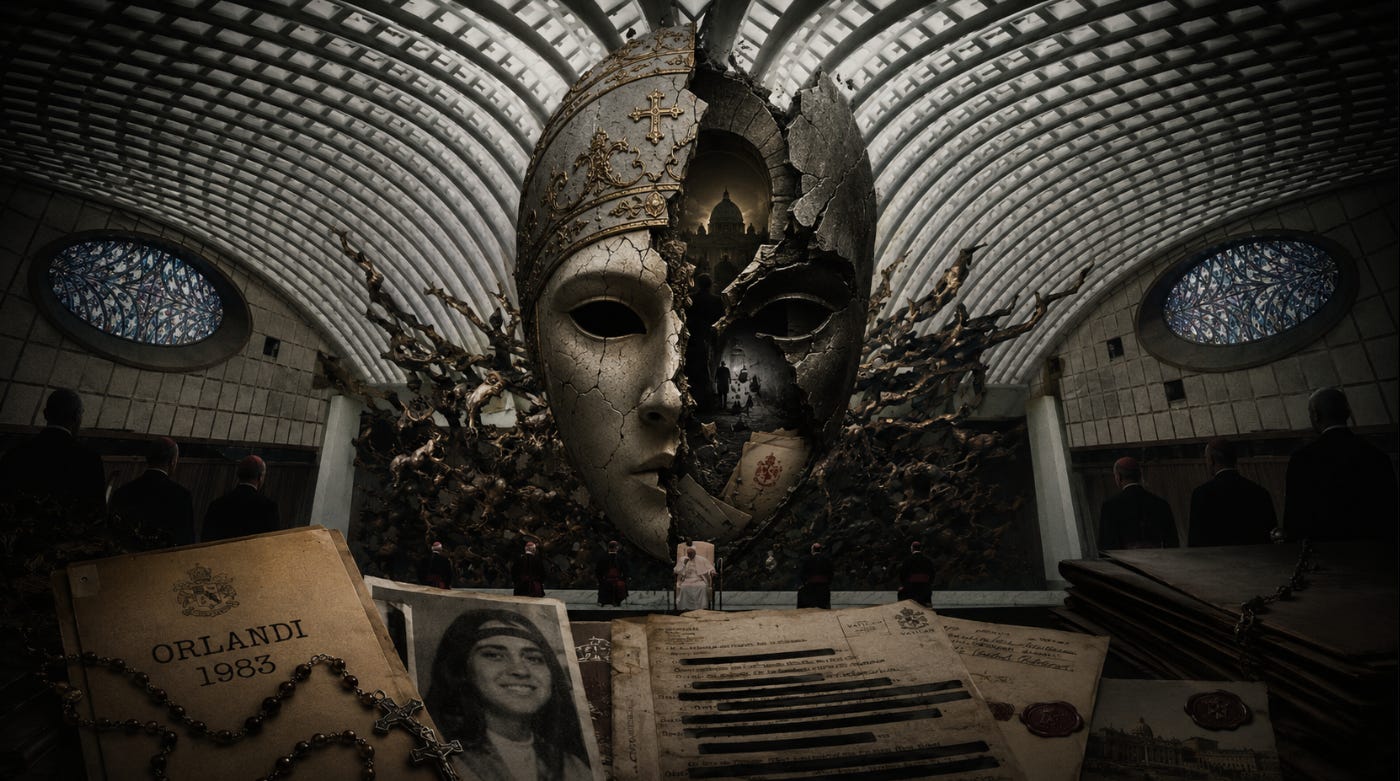
This essay is part of William J. Teesdale’s Strategic Intent Analysis archive at strategicintentanalysis.com. The method is simple: begin with what is observable, then test the story against the structure beneath it.
The question is no longer simply whether the Catholic Church believes in demons. It plainly does. Nor is the question whether some Catholic exorcists believe that the modern UFO phenomenon can involve the same hostile non-human intelligence their tradition has historically called demonic. They have now said so publicly. The more difficult question is what follows when those same exorcists describe occult activity, ritual pacts, serious crimes and spiritual corruption extending through the hierarchy of the institution whose purpose includes identifying and opposing precisely that intelligence.
Strategic Intent Analysis does not require an institution to confess the conclusion before the conclusion can be examined. It looks instead at repeated behavior, protected relationships, information flows, institutional boundaries, incentives, omissions and the testimony of people positioned close enough to the underlying activity to reveal its structure. Applied here, the evidence points beyond accidental encounters with hostile NHI. Elements within the Vatican hierarchy appear to have deliberately engaged it.
The word demonic is used deliberately but not exclusively. It is the term supplied by the Western religious tradition for a class of intelligence understood as non-human, deceptive, hostile to human flourishing, capable of interacting with consciousness and willing to enter relationships with human beings. Other traditions employ different language for related categories of intelligence, and the vocabulary matters less than the behavior. The Dangerous Intelligence Behind the UFO Mask examines the wider evidence that the beings encountered in the modern UFO phenomenon may be intermediaries or presentations of an older and more deeply concealed intelligence, and why people approaching the phenomenon through very different routes have repeatedly converged upon the possibility that this intelligence is deceptive or adversarial. The present inquiry asks a narrower and more disturbing question: what happens when the institution claiming special competence to recognize that intelligence discovers evidence of engagement with it inside its own hierarchy?
Father Chad Ripperger provides the most important public testimony. Ripperger is not merely a priest commenting on UFOs from a theological distance. He is a longtime exorcist whose work places him directly within the Church’s institutional response to what it identifies as hostile non-human spiritual agency. He has compared alien-abduction reports with cases he regards as demonic and has said that other exorcists known to him have encountered entities manifesting with the familiar morphology of the Grey. According to Ripperger, these entities have identified themselves as Greys while denying that they belong to the category of demons. He regards the claimed identity itself as deception.
Monsignor Stephen Rossetti reached a substantially similar conclusion after many years as an exorcist. He publicly argued that many, perhaps most, UFO manifestations were demonic and emphasized deception as a defining characteristic of the phenomenon. The significance of Rossetti’s position is not merely that another Catholic priest agreed with Ripperger. His public application of the Church’s own demonic category to the modern UFO question became part of the institutional controversy surrounding his removal from the exorcist role.
For present purposes, the important point is straightforward. Catholic exorcists are not speaking only about an abstract theological possibility; they say the intelligence they confront can appear through the same modern alien presentation that has dominated public understanding of UFOs.
Ripperger’s testimony then moves into far more consequential territory. He has described powerful people engaging deliberately in occult activity and has explained the logic of what he calls demonic pacts. Human beings seek wealth, status, influence, knowledge, power or some other perceived advantage and enter into a reciprocal relationship with a hostile intelligence capable of providing it. Something is sought, something is offered and something is received, while the relationship can create continuing obligations beyond the initiating act. Whatever terminology is preferred, that is an agreement. A pact is an agreement, an accommodation is an agreement, and a relationship does not become less reciprocal because the exchange occurs through ritual rather than diplomacy.
This is where The Collins Elite and the Architecture of Deception remains directly relevant. That essay examined Ray Boeche’s account of two Department of Defense scientists who approached him because they had become deeply disturbed by government work involving attempts to contact and utilize non-human intelligences. According to Boeche, the activity crossed into ritual methods and participants initially believed they were successfully exploiting the intelligence. The scientists eventually reached the opposite conclusion: they believed the humans were not controlling the entities at all but had merely been permitted to believe that they were.
The comparison matters because it supplies an institutional analogue outside Catholicism. In both settings, human actors encounter an intelligence believed to possess capabilities beyond ordinary human reach, and some seek advantage through engagement. Ritual becomes an interface, while participants assume the relationship can be controlled because they believe themselves to understand its terms. The Collins warning is that the human party may fundamentally misunderstand the relationship from the beginning.
The Vatican problem becomes much darker when Ripperger describes what exorcists say they have learned about their own institution. He has stated that entities confronted during exorcisms reveal highly specific rituals and crimes involving people within the Church hierarchy. Other exorcists obtain additional pieces, names recur and information is compared. Ripperger says that the accumulated material gives the exorcists a reasonably developed picture of what is occurring and that spiritual corruption reaches close to the highest levels of the Church.
That testimony changes the inquiry because Ripperger is describing something more substantial than one priest’s suspicion that senior churchmen may be morally corrupt. He describes an information network in which different exorcists working different cases obtain information concerning rituals, crimes and identities, communicate with one another and identify recurring information from which a larger picture emerges.
The evidentiary quality of that material depends heavily upon chronology and independence. If one exorcist tells another that a particular name appeared in a case and the same name later emerges during a second exorcism, the recurrence carries little independent weight. If two or more exorcists separately record the same unusual name, crime, location, victim or physical detail before comparing their results, something very different has occurred. Ripperger himself appears to understand the distinction, having described situations in which separate exorcists can be asked the same question without first being given another practitioner’s answer.
The appropriate response is therefore investigation rather than theological argument. Original records should be preserved, what each exorcist knew before each encounter established, the timing of information-sharing reconstructed, genuine independent convergence separated from later contamination, and externally verifiable facts identified and tested. Where the information concerns crime, that investigative obligation becomes considerably stronger.
Emanuela Orlandi provides the clearest test. Orlandi was a fifteen-year-old Vatican citizen who disappeared in Rome in 1983 and whose fate remains one of the most consequential unresolved cases connected to the Vatican. Father Gabriele Amorth, perhaps the best-known Catholic exorcist of his generation, did not speak vaguely about some possible Vatican connection to her disappearance. He described an organized circle in which girls were recruited by a Vatican gendarme for sexual purposes, identified the involvement of personnel connected to a foreign embassy to the Holy See, said that Emanuela became a victim of that circle, and described what followed as sexual exploitation, murder and concealment of her body. He publicly attributed at least part of his information to Monsignor Simeone Duca, a Vatican archivist, and also entertained a satanic dimension to the case.
The significance of that account becomes much greater when Amorth is placed within the exorcist information environment Ripperger describes. Ripperger specifically says that Amorth had complained about this same problem within the Church decades earlier, while Amorth himself was a central institutional figure among Catholic exorcists and a co-founder of the International Association of Exorcists. Ripperger says that exorcists working separate cases obtain pieces of information concerning rituals, crimes, names and identities, compare what they receive and gradually assemble a larger picture. Amorth therefore occupied precisely the informational environment in which such convergence was said to occur. His attribution to Duca establishes one source of information, but it does not establish that Duca was the only source of the remarkably detailed account Amorth gave. If Amorth knew the structure of the circle, its recruiting mechanism, the institutional connections, what happened to Emanuela and that her body was concealed, it is highly likely that he knew substantially more than he publicly disclosed, including names and further details concerning her death and the disposal or burial of her remains. Ripperger’s description raises the further possibility that Amorth’s confidence reflected not only ordinary Vatican sources but convergent information arising within the exorcist network itself.
That possibility changes the Orlandi question fundamentally. The institutional significance of her disappearance was examined earlier in The Vatican and the Management of Evil, where the case was treated not simply as an enduring Vatican mystery but as part of a broader pattern in which information concerning grave wrongdoing within or around the institution was repeatedly controlled or contained. The public record has never established precisely what happened to Orlandi. But Amorth’s account suggests that people inside the Vatican possessed a far more developed understanding of her fate than the unresolved public record would indicate. If information concerning her abduction, exploitation, murder, perpetrators or remains was known within an internal Vatican network—and particularly if some of that information also circulated among exorcists—the continuing failure to resolve her disappearance becomes more difficult to understand as merely an investigative failure.
The immediate questions are therefore concrete. What did Amorth actually know about Emanuela Orlandi, when did he know it, and from whom did he obtain each part of the account he eventually disclosed? What did Monsignor Duca know? Did Amorth or other exorcists receive independently recurring names, locations, circumstances or identities relating to her disappearance? Do contemporaneous notes or case records exist? Have Ripperger or other surviving members of the network ever encountered information concerning the people responsible, the place where Emanuela was taken, the circumstances of her death or the location of her remains? These questions follow directly from the exorcists’ own description of how their information network operates.
The proposition is also capable of empirical testing. If several exorcists working unrelated cases independently recorded the same obscure location, name or non-public detail in connection with Orlandi before exchanging information with one another, an investigator need not first resolve whether the asserted source of that information was genuinely demonic. The relevant question would be whether the information corresponds to reality. If a location contains nothing and the supposedly independent details prove traceable to ordinary information-sharing, the proposition loses force. If remains or some highly specific non-public evidence are recovered, or genuinely independent records reveal details later corroborated by physical evidence, then the information has acquired evidentiary significance regardless of the mechanism through which the exorcists believe it was obtained.
That is why the exorcists should be examined separately within a competent criminal, judicial or parliamentary process. Their contemporaneous records should be preserved and obtained where lawful, the chronology of their knowledge reconstructed, conventional Vatican sources separated from information allegedly arising during exorcisms, and genuinely independent convergence distinguished from subsequent contamination. Any information already supplied to Italian police, prosecutors, the Vatican inquiry or the parliamentary commission should be identified; if potentially verifiable information was never supplied, the reason matters. Emanuela Orlandi is therefore more than an unresolved historical case within this essay. She provides a direct test of whether the restricted information network described by the Church’s own exorcists contains knowledge of serious crimes that has never escaped its institutional compartment. If it does, secrecy has ceased to be spiritual discretion. It has become institutional containment.
This is precisely the mechanism examined in The Vatican and the Management of Evil. The Catholic abuse crisis reveals something considerably more serious than an institutional capacity for secrecy. It demonstrates an established capacity for moral inversion. The Church publicly places extraordinary value upon innocence, protection of children and opposition to grave evil, yet when sexual predation occurred within its own structures, parts of the institution repeatedly subordinated those principles to protection of hierarchy, reputation and institutional continuity. Allegations were contained internally, offenders were moved or managed, records remained restricted and victims frequently bore the consequences of decisions designed primarily to preserve the institution. The significance is structural. When protection of innocent human beings conflicts with preservation of institutional power, the historical record shows that parts of the system have been capable of choosing the system.
The abuse crisis therefore demonstrates more than the existence of corrupt individuals. It demonstrates institutional mechanisms capable of absorbing conduct directly contrary to the Church’s professed moral purpose while leaving the larger structure substantially intact. Obedience, jurisdiction, confidentiality, restricted records, internal process and the separation of office from officeholder can all serve legitimate purposes, but the abuse record shows that the same structures can also contain grave wrongdoing when exposure threatens institutional authority. The question raised by the present inquiry is therefore not whether the Vatican possesses mechanisms capable of protecting serious corruption. History has already answered that question. The issue is what else those mechanisms may have protected.
Rossetti’s experience fits the same architecture. Demons remain an acceptable category within Catholic theology, exorcism remains an accepted ministry, and UFOs can remain a subject of speculation. What becomes institutionally difficult is the joining of categories when that joining has implications beyond controlled doctrine. An exorcist publicly saying that the modern UFO phenomenon may involve the same deceptive intelligence his office is charged with confronting moves the question from abstract theology into institutional discernment.
This is also a problem of controlled recognition. An institution need not abolish the language of evil to prevent that language from threatening the institution. It needs only to control where the category may be applied. Evil can be named at a safe distance while recognition is contained when it points inward.
The symbolic environment of the institution becomes considerably more significant once that behavioral evidence has been assembled. The Paul VI Audience Hall, created as the principal modern setting for papal audiences, presents from its central axis an extraordinary serpentine geometry: two enormous oval windows occupy the position of eyes, the ribbed vault suggests the scaled structure of a head, and the papal stage sits at the focal point of what visually resembles a mouth.

At that focal point stands Pericle Fazzini’s Resurrection, shown below, commissioned through the personal involvement of Paul VI, in which the risen Christ emerges from an enormous field of twisted, skeletal and apocalyptic forms. Fazzini conceived the scene through imagery of catastrophic destruction surrounding Gethsemane. Taken together, inside a deliberately commissioned papal environment, they form a symbolic composition too coherent to dismiss casually as architectural accident.

Strategic Intent Analysis does not require the participants to publish an explanatory key before symbolism can be interpreted. Intention is routinely inferred from selection, repetition, placement, context and effect. Here the institution’s own religious tradition identifies the serpent with deception and hostile spiritual intelligence; the hall presents the Pope to the faithful at the focal point of an overwhelmingly serpentine visual architecture, literally framed between the two fang-like structures forming the mouth; and the dominant sculpture at its focal point employs imagery of violent transformation that is itself deeply unsettling. Placed beside the testimony of Catholic exorcists concerning occult pacts, deceptive intelligence and corruption within the hierarchy, the symbolism is not merely decorative. In my judgment, it is evidence of occult intention within the institutional environment.
The convergence substantially changes the scale of the problem. The abuse crisis establishes an institution capable of protecting grave violations of the innocent when exposure threatens hierarchy and institutional power. The exorcists describe pacts, rituals, crimes and spiritual corruption extending upward through that hierarchy. The symbolic environment then places imagery associated by the Church’s own tradition with hostile and deceptive intelligence at the ceremonial heart of the papacy itself. These are different forms of evidence, but they point in the same structural direction. The problem becomes increasingly difficult to explain as the misconduct of isolated individuals operating against an otherwise untouched institution. What emerges instead is an institutional order in which protection of power, containment of damaging knowledge and the subordination of innocent human beings can coexist with public claims to represent precisely the opposite moral principles.
Ripperger’s own response to the alleged corruption makes that problem still clearer. Asked about what he describes near the upper reaches of the Church, he does not present himself as a reformer charged with exposing the hierarchy. He describes his responsibility as defending his own “foxhole”: handling the cases entrusted to him, praying and continuing his particular work while regarding broader institutional correction as outside his responsibility.
Ripperger’s stated position is entirely consistent with a man who believes he is faithfully performing the work assigned to him, and that is precisely why the institutional logic matters. He can simultaneously maintain that occult corruption exists inside the hierarchy, that exorcists possess information concerning rituals, crimes and identities, that corruption extends close to the highest levels, and that continued obedience to the same institutional structure remains appropriate.
Catholic theology provides considerable capacity to absorb that tension. A corrupt priest remains a priest, and a wicked bishop does not cease to hold episcopal office. The legitimacy of sacramental authority is not ordinarily treated as dependent upon the moral quality of the individual officeholder. At limited scale, that principle prevents an institution from collapsing whenever one of its members sins.
At sufficient scale, however, the same principle creates a serious problem. Corruption can climb through the hierarchy while the legitimacy of the hierarchy remains insulated from the corruption. A corrupt priest does not invalidate the priesthood, a corrupt bishop does not invalidate episcopal authority, and corruption near the top can be understood as evidence that evil has infiltrated the Church rather than as evidence that continuing institutional allegiance itself requires reconsideration. The institution thus possesses a theological mechanism through which knowledge of profound corruption can be metabolized without producing institutional rupture.
Ripperger’s “foxhole” is the practical expression of that mechanism. Responsibility is localized even as knowledge expands, allowing the exorcist to oppose evil in an individual case while leaving the larger structure intact even when he believes that structure has been penetrated by the same evil he confronts locally. That is where responsibility changes with knowledge. A priest working faithfully in an ordinary parish may know nothing about concealed corruption elsewhere in the Church, while an exorcist who says that his own cases, combined with those of other exorcists, reveal specific crimes, rituals, identities and compromised spiritual authority occupies a different position. The moral significance of continued institutional participation cannot remain identical after the person claims to know what the institution contains.
Large government systems present the same problem. A scientist can work on a classified component without knowing the purpose of the entire program, an investigator can perform legitimate work while remaining ignorant of a deeper compartment, and a lawyer can serve a lawful function inside an institution containing activity he has never seen. Compartmentalization allows enormous quantities of legitimate work to coexist with activities that many participants would reject if they knew of them. Knowledge therefore changes the moral status of continued participation.
Boeche’s alleged Department of Defense scientists supply a much more severe institutional contrast. According to his account, they were not merely troubled by an abstract program of contact. They believed elements of the government had entered an obsessive effort to contact and control deceptive non-human intelligence, using ritual methods while attempting to exploit the resulting capabilities for remote viewing, psychotronic weapons and other military purposes. They eventually concluded that the apparent successes were themselves part of the deception: the government had not mastered the capabilities at all, but had been allowed by the intelligence to believe that it had. Boeche’s account goes further still. He said the men described ritual activity extending in its darkest form to human sacrifice and showed him postmortem photographs of three people allegedly killed during the experiments. If their account is substantially correct, they were confronting not merely questionable research but a classified structure involving occult engagement, human death and continued pursuit of power from an intelligence they had come to regard as profoundly deceptive.
The consistency with the exorcist testimony is striking. Taken on their own terms, the two bodies of testimony arise from completely different institutional environments yet describe substantially the same structure. Boeche’s sources describe government actors seeking knowledge, capability and strategic advantage through ritualized engagement with a deceptive non-human intelligence, only to discover that the relationship was far less controllable than they had believed and that serious human harm had followed. Ripperger describes powerful people seeking wealth, status, influence, knowledge or power through pacts with hostile intelligence, while exorcists working separate cases allegedly encounter recurring information concerning rituals, crimes and identifiable people within the Church hierarchy. In both accounts, human actors deliberately seek advantage from an intelligence they do not control; ritual functions as an interface; the relationship becomes corrupting and dangerous; and knowledge of what has occurred remains concentrated within restricted institutional compartments. The convergence does not depend upon the Pentagon scientists and Catholic exorcists sharing a theology. They appear to be describing the same category of relationship from opposite sides of institutional life.
The difference lies in what the insiders did after recognizing the nature of the relationship. Boeche’s scientists concluded that the activity had crossed a moral boundary and took information outside the classified system because they wanted it known. Ripperger, despite describing an exorcist network possessing information concerning rituals, crimes, identities and corruption close to the summit of his institution, localizes his responsibility to his own “foxhole.” The comparison is therefore not between one institution that encountered corruption and another that did not. Both accounts describe institutional engagement with deceptive intelligence. The distinction is that Boeche’s sources attempted to break containment when their knowledge became morally intolerable, while the exorcist response described by Ripperger leaves the larger institutional compartment substantially intact.
That separation becomes harder to defend if the hostile intelligence is not merely encountered by corrupted individuals but engaged through reciprocal relationships. Ripperger’s own description of pacts provides the conceptual mechanism: human participants seek advantage and enter into exchange with a hostile intelligence. If such conduct occurs among people holding authority within the Church, the distinction between isolated personal corruption and institutional accommodation becomes progressively more difficult to sustain.
This is where The Human Harvest and the Secret Treaty with NHI helps clarify what an agreement with non-human intelligence need not look like. That essay examined the alleged national-security bargain involving technology and human access, but its relevance here lies less in the specific treaty allegation than in the underlying structure of agreement. A reciprocal relationship can exist without a publicly authenticated diplomatic instrument. Access, advantage, permission, performance and continuing obligation can form the substance of agreement even when nothing resembling an ordinary treaty exists.
The evidence therefore points toward something more consequential than isolated members of the hierarchy entering private occult relationships. The Vatican’s own symbolic environment places imagery associated within its tradition with deceptive and hostile intelligence at the ceremonial heart of the papacy, while its exorcists describe pacts, rituals, crimes and spiritual corruption extending upward through the hierarchy. The question is no longer whether a few individuals secretly crossed a forbidden boundary while the institution around them remained untouched. The deeper possibility is that reciprocal accommodation with hostile intelligence became embedded within the institutional structure itself. Where authority, ritual, symbolic expression, continuing performance and the pursuit of power converge around relationships with the intelligence the Church itself identifies as demonic, the architecture of agreement already exists.
Nor does the visible form of the intelligence necessarily identify the party to the relationship. As examined in The Dangerous Intelligence Behind the UFO Mask, the Grey and other reported beings may function as intermediaries, biological interfaces or controlled presentations rather than as the intelligence ultimately directing the phenomenon. If that model is substantially correct, human beings can interact with something physically real while still misunderstanding the identity of the principal behind it. Ritual contact may therefore represent a different interface with the same underlying intelligence rather than contact with an entirely different class of being.
That possibility gives the Vatican evidence particular importance. Religious traditions have described hostile or deceptive non-human intelligence for centuries, and their vocabulary existed long before modern aerospace culture supplied the alien frame. If exorcists are correct that the same intelligence can present through the Grey mask, occultists within the Church would not necessarily experience themselves as negotiating with technological visitors. They might engage precisely through the older ritual structures their own religious tradition already understands as contact with hostile spiritual intelligence.
The question then becomes what the institution knows about those relationships and what it has done with that knowledge. Ripperger says exorcists possess pieces of a larger picture: names recur, rituals and crimes are disclosed, and the Church’s authority structure is spiritually compromised. He has also indicated that only a very small number of people outside the exorcist community know the identities involved. Knowledge is therefore concentrated within a restricted network even as the larger hierarchy remains intact, public disclosure remains fragmentary and the practitioners themselves continue to operate largely inside the institution.
The secret survives not because the evidence is invisible, but because every institution that possesses part of it has a reason not to assemble the whole. That principle applies beyond the Vatican, but here its meaning is unusually severe. The Church claims a special office in discerning evil. Its exorcists say they have encountered an intelligence they identify as demonic, while those same exorcists say people inside the hierarchy deliberately engage occult forces, enter pacts, commit crimes and participate in a spiritually compromised authority structure. The institution therefore cannot plausibly treat the problem as wholly external to itself.
The question is not whether evil entered the Church; every human institution can be corrupted. The question is what follows when the institution charged with identifying evil discovers evidence of evil operating through its own authority structures. If the response is exposure, separation, protection of victims, preservation of evidence and external investigation, the institution is acting against the corruption. If the response is restricted knowledge, continued hierarchy, internal containment, obedience and jurisdictional control, the distinction between opposing corruption and preserving the structure containing it begins to narrow.
Strategic Intent Analysis therefore reaches a conclusion considerably stronger than the claim that the Vatican has merely studied or encountered hostile NHI. The accumulated evidence points toward ritual accommodation and exchange with the intelligence its own exorcists identify as demonic becoming embedded within the institutional structure itself. That structure need not be universally understood in order to function. Compartmentalization allows particular people exercising authority to maintain relationships, preserve knowledge, control disclosure and protect continuing arrangements while much of the institution remains unaware of what is being contained. The relevant question is therefore no longer whether isolated churchmen entered occult relationships, but how deeply those relationships penetrated institutional authority and how much of the surrounding structure came to serve their preservation.
Those questions are answerable in principle. Names can be identified, records compared, independent convergence distinguished from information-sharing, alleged crimes investigated, locations searched and institutional decisions reconstructed. Exorcists claiming knowledge can be questioned separately. Orlandi provides an obvious place to begin because the proposition can be tested against a real unresolved case rather than left inside theological abstraction.
The greatest secret may therefore not be the existence of non-human intelligence. It may be the history of human collaboration with it. The Human Harvest and the Secret Treaty with NHI approaches that possibility through the alleged exchange of technological advantage for access to human beings. The present inquiry reaches it from another direction: religious specialists say the hostile intelligence is real, deceptive, capable of entering pacts with humans, and already entangled with people inside the hierarchy of the institution charged with opposing it.
The essential question is not whether a document exists but whether reciprocal relationship exists, and on the evidence described by the Church’s own exorcists, the answer appears to be yes. The remaining questions concern who participated, what they sought, what they offered, what crimes followed, how far institutional knowledge extends and how much independently verifiable information the exorcist network already possesses. Emanuela Orlandi makes the last question impossible to leave abstract. She is not important merely because her disappearance supplies a potentially testable case, but because she represents the human beings who disappear behind systems of secrecy, protection and institutional containment. The abuse crisis has already established how many victims can accumulate when preservation of an institution outranks exposure of what occurred within it.
An institution claiming to confront evil cannot invoke obedience, secrecy or jurisdiction to contain evidence of evil within itself without compromising the distinction on which its authority depends. When containment of the institution begins to outrank exposure of the evil inside it, the boundary between opposing corruption and protecting it begins to disappear.