

The deepest inversion of sacred authority does not occur when an institution abandons sacred language. It occurs when sacred language is preserved while its proper use is narrowed, managed, or suppressed. The form remains. The office remains. The vocabulary remains. Sin, evil, demons, confession, exorcism, discernment, holiness, protection, and pastoral care remain available as official categories. But the categories are controlled so that they may not judge the institution itself or expose the structures through which evil operates.
That is the central problem of the Vatican in the modern age. The issue is not whether sincere Catholics exist. They do. It is not whether faithful priests exist. They do. It is not whether the Catholic tradition contains real sacred truth. It does. The issue is whether the Vatican, as an institutional power structure, has become an inverted sacred form: an office charged with naming evil that instead manages the recognition of evil, protects the hierarchy through which evil is concealed, and disciplines those who apply spiritual discernment where the hierarchy does not want it applied.
This is not ordinary hypocrisy. Hypocrisy says one thing and does another. Inversion is deeper. Inversion uses the claim to oppose evil as the structure through which evil is protected. Evil does not need sacred authority to deny its existence. It only needs sacred authority to control where the category may be applied.
The Catholic abuse crisis is the clearest public evidence of this inversion. Priests raped and abused children under sacred authority. The institution then repeatedly protected itself, its reputation, its hierarchy, and its offenders while failing the children whose innocence it claimed to defend. In the United States, the John Jay study found allegations against 4,392 Catholic priests and deacons from 1950 to 2002, about four percent of the clergy population studied. In England and Wales, the Independent Inquiry into Child Sexual Abuse reported more than 900 complaints involving over 3,000 instances of child sexual abuse against more than 900 people connected to the Roman Catholic Church between 1970 and 2015, and concluded that responses to disclosure failed victims while protecting alleged perpetrators and the reputation of the Church.
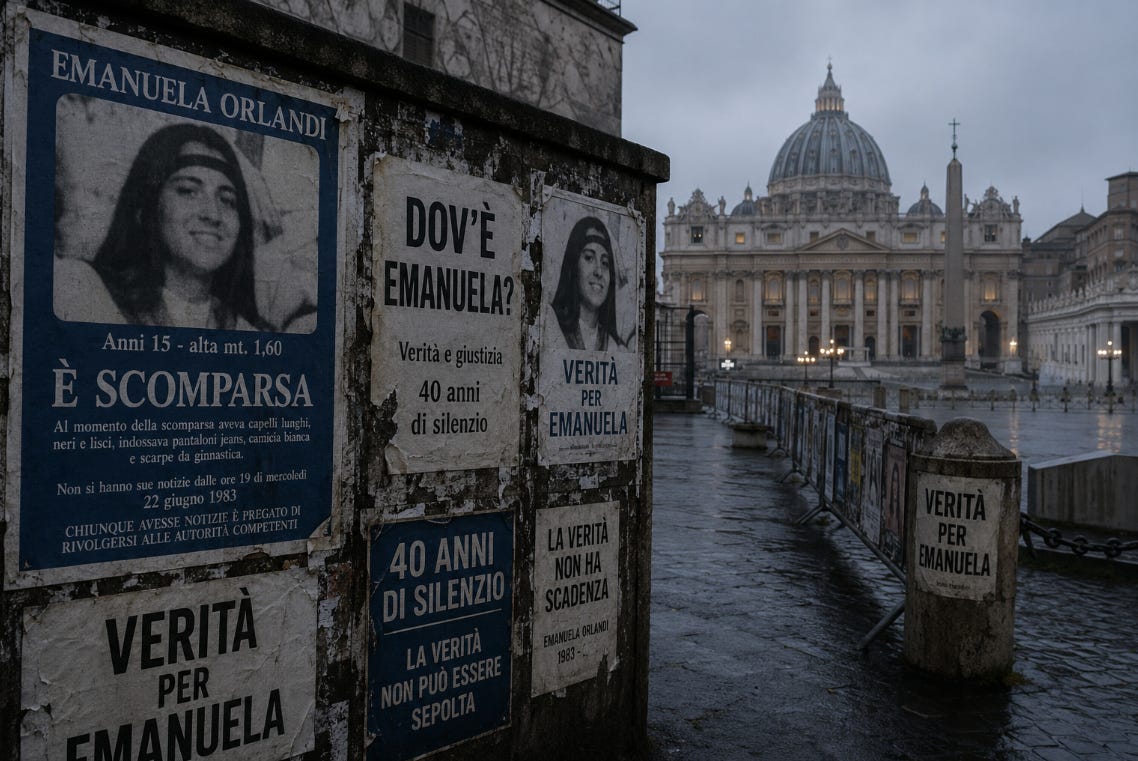
The disappearance of Emanuela Orlandi, a fifteen-year-old Vatican citizen who vanished in Rome in 1983, belongs directly inside this structure. The Vatican was not a distant observer of that case. It possessed institutional knowledge, controlled access, and for decades failed to provide the full truth demanded by her family and by the public record of suspicion surrounding the case. Whether Orlandi was murdered, sacrificed, trafficked, or used in some other protected arrangement has never been fully established in public. But the structural fact is already severe enough: a child connected to the Vatican disappeared, the institution withheld what it knew, and the demand for truth has remained physically posted outside the walls of sacred authority for forty years.
That pattern was examined more fully in Vatican Institutional Containment in the Catholic Abuse Crisis, which argued that repeated Catholic abuse scandals cannot be understood only as individual misconduct or episodic leadership failure. The relevant question is what the institution repeatedly did after abuse became visible. Across jurisdictions, the same operational features reappeared: allegations handled internally, accused clergy transferred or administratively managed, restricted records controlled inside the hierarchy, external accountability delayed, and reform occurring mainly after exposure. The prior essay matters here because it established the Vatican problem as a containment structure before the present question of exorcism, UFOs, and demonic discernment arises.
Those findings matter because the Catholic Church claims a uniquely sacred office. It does not present itself merely as a voluntary association, moral society, or local congregation. It claims apostolic succession, sacramental authority, confession, priesthood, spiritual jurisdiction, and the power to speak authoritatively about sin, evil, demons, exorcism, and salvation. The greater the sacred claim, the more severe the inversion when the sacred office becomes a shelter for desecration. Child rape inside sacramental authority is not simply crime inside religion. It is the inversion of priesthood itself: the shepherd becoming predator, the confessional becoming a trap, the sanctuary becoming a hunting ground, and the language of holiness becoming cover.
The natural-law issue is not denominational. It does not depend on accepting Catholic doctrine. The protection of children, the integrity of the body, the innocence of the vulnerable, and the duty of authority to protect rather than exploit are prior to institutional doctrine. Sacred authority intensifies that duty because it places the vulnerable under spiritual trust. When that trust is used to access, silence, or manage the vulnerable, the violation is not merely legal or administrative. It is a reversal of the natural order authority exists to serve.
The question is therefore not how evil entered the Church. Evil enters every human institution. The question is what the institution protected after evil was known. If sacred authority existed to defend the innocent, it would have broken hierarchy to save children. If it existed to name evil, it would have exposed evil without regard to institutional cost. If it existed to preserve holiness, it would have treated desecration inside the sanctuary as intolerable. But the repeated pattern was different. The structure protected itself. It managed disclosure. It moved offenders. It resisted external intervention. It narrowed accountability. It placed institutional continuity above violated innocence. That conduct reveals the object of protection.
This is where The Method of Structural Inquiry becomes necessary. Official explanations are evidence, not verdicts. An institution may describe itself through holiness, protection, doctrine, safeguarding, repentance, and reform. Those words may contain truth, but they do not settle the question. The question is whether the explanation accounts for the observable pattern: conduct, omission, incentive, consequence, and repetition. The method does not begin by accepting institutional self-description. It begins by asking what the structure actually does.
Corrupt institutions do not confess their corruption. Inverted institutions do not announce that their categories have been captured. They continue to speak in the language of their proper office while protecting the structure that contradicts it. Their condition is discerned through conduct: what they protect, what they punish, what they conceal, what they permit only under controlled conditions, and where they enforce boundaries. Institutional sin of this kind is not usually admitted. It is revealed by pattern.
From the perspective of Strategic Intent Analysis, stated purpose is never enough. Institutions must be read by repeated outcome, protected behavior, incentive structure, narrative management, and boundary enforcement. When an institution charged with protecting children repeatedly protects reputation instead, when an institution charged with naming evil repeatedly contains exposure instead, and when an institution charged with spiritual discernment disciplines discernment at the point where it becomes dangerous, the proper inference is not accidental failure. The pattern points to institutional inversion.
The removal of Monsignor Stephen Rossetti as an exorcist of the Archdiocese of Washington belongs in that pattern. Cardinal Robert McElroy removed Rossetti from his role and ended the archdiocese’s affiliation with the Saint Michael Center for Spiritual Renewal after Rossetti publicly linked UFO sightings to demonic activity. The stated objection was that Rossetti’s statements and the Center’s social-media use undermined Church teaching on the devil, demons, and exorcism. Rossetti had warned that many UFO sightings may be demonic in nature while also acknowledging that Catholics may believe in extraterrestrial life. After his removal, he expressed regret and reaffirmed obedience to Church authority.
The significance of that event is not that every UFO sighting must be demonic. The significance is jurisdictional. Rossetti did not deny demons. He did not deny exorcism. He did not reject Catholic teaching. He applied the demonic category to the central modern non-human intelligence question. That was the forbidden move. The category was not forbidden because it was false. It was forbidden because it escaped management.
Under Strategic Intent Analysis, Rossetti’s removal is probative because it occurred exactly where the thesis predicts enforcement would occur: at the boundary between controlled doctrine and uncontrolled public recognition. Demons remained permissible as theology. Exorcism remained permissible as controlled ministry. UFOs remained permissible as mystery, technology, aerospace, national security, or extraterrestrial speculation. What became impermissible was the public application of demonic discernment to UFOs by an official exorcist. That is not random. It is category enforcement.
In structural terms, Rossetti was fired for telling the truth in the wrong jurisdiction. He connected demons, deception, and UFOs in public. That connection is not strange. Many others had already reached the same conclusion. What made Rossetti dangerous was not novelty. It was office. He was not a podcaster, hobbyist, or marginal commentator. He was an exorcist. He spoke from inside the Church’s own category system.
That joining changes everything. The phenomenon moves from disclosure to discernment, from contact to deception, from aliens to demons, from technology to spiritual warfare, from curiosity to resistance. It removes the modern romance of the “visitor” and restores an older category: the deceiver. It says that the entities may not be explorers, neighbors, future humans, or neutral intelligences. They may be the old enemy operating through a modern mask.
That is why the present event belongs beside The Collins Elite and the Architecture of Deception. That essay argued that the UFO question is not primarily a question about technology, propulsion, recovered materials, or interstellar visitors. It is a question about how the phenomenon interacts with human belief, religion, power, perception, and the soul. The Collins-type concern is that the phenomenon may be deceptive, adversarial, and morally corrupting; that it may present itself through whatever mask a culture is prepared to accept; and that human attempts to obtain power, knowledge, or advantage from such intelligences may become forms of ritualized engagement rather than neutral investigation.
The Collins/Boeche material does not treat the UFO phenomenon as a neutral mystery. It treats it as deception involving non-human intelligences, ritual contact, demonic intrusion, and, in Boeche’s account, human sacrifice. Boeche’s sources described a program that had crossed from observation into ritualized engagement: occult or satanic methods to contact non-human intelligences, attempts to exploit that contact for military and psychotronic purposes, and the eventual conclusion that the humans involved were not controlling the entities. They had been allowed to believe they were in control.
That is the frame Rossetti publicly restored. He was not inventing a fringe association. He was naming the same category that government-linked religious inquiry had already encountered. The UFO-demonic thread was not unknown. It was not incoherent. It was not alien to the Collins material. It was central to it.
Ray Boeche’s role matters. Boeche was not simply a UFO researcher. He was religiously trained, had Catholic priestly background, later became an Anglican priest, and stood at the intersection of theology, anomalous investigation, and institutional inquiry. The public significance is not the private reason for his ecclesiastical path. The public significance is that defense-linked sources approached a religiously trained investigator rather than a purely technical aerospace figure. That fact is revealing. The problem they described was not merely technological. It required theological interpretation.
Within that framework, Rossetti’s statement was structurally precise. He placed the UFO question in the domain where the Collins material had already placed it: deception, spiritual intrusion, false appearance, and hostile non-human intelligence. His offense was category restoration. He applied an older religious category to a modern phenomenon that institutional authority is attempting to process through safer names.
The evidentiary foundation for that frame was developed in Deception and UFOs: The 1998 Collins Elite Report Reconstructed. That essay treated the alleged 1998 Collins Report not as a complete public document, because it is not one, but as a recoverable architecture of argument. The reported title itself matters: Deception and UFOs: What We Believe and Why. It did not frame the UFO problem as visitation, aerospace anomaly, or neutral mystery. It framed it as deception. The reconstructed chapter sequence moved from accepted wisdom, to the deception scenario, to the history of deception, to messengers, Trojans, contactees, missing time, infiltration, and future scenarios. The argument was not simply that strange things appear in the sky. The argument was that a real intelligence may be presenting itself through false explanatory frames.
That distinction is central. If the phenomenon is deceptive, then the extraterrestrial story may itself be part of the operation. The question is no longer where the entities claim to come from. The question is what the encounter does to human beings, institutions, belief, memory, authority, and consent. A deceptive intelligence does not need to announce itself accurately. It needs to supply a story that the target civilization is prepared to accept. In a technological age, that story is advanced visitors, superior science, hidden propulsion, genetic programs, space brothers, disclosure, and cosmic evolution. The mask changes because the audience changes. The function remains.
In that framework, the Vatican is not peripheral. It is central. The institution charged with guarding the boundary between human beings and demonic deception would be the highest-value target for inversion. A demonic order does not need to abolish the Church. It needs to weaken, manage, or neutralize the authority that should expose it. Once sacred authority is inverted, evil does not need people to stop believing in evil. It only needs the official interpreters of evil to control where the category may be applied.
The Fordham reference sharpens that point. In The Collins Elite and the Architecture of Deception, the Fordham material was treated as evidence of a likely study node, not as proof that the Collins Elite originated there. Jacques Vallee’s notes appear to refer to a conversation with a senior, unidentified person concerning the Collins Elite and a 1970s Fordham connection. The significance is institutional proximity. Fordham is a Jesuit university. A Fordham-linked study environment would place religious, academic, military, and intelligence interpretation in the same field of inquiry. The categories under examination were not merely aircraft, propulsion, or national-security secrecy. They appear to have included consciousness, demonology, altered states, ritual contact, and eschatology.
That means Catholic-adjacent institutional authority was not simply watching the UFO question from the outside. It was likely involved, at least at the level of study, interpretation, or advisory framing. Catholic intellectual and religious authority appears to have been close enough to the Collins-type inquiry to participate in the interpretive environment within which the phenomenon was studied, tested, or contained.
That matters because study nodes shape interpretation. Interpretation shapes institutional response. If religious actors helped interpret the phenomenon for intelligence or defense circles, then the Church’s role was not merely pastoral. It may have participated in the formation of categories through which the phenomenon could be understood. In that light, Rossetti’s removal becomes more revealing. He was not inventing an alien connection to demonology from nowhere. He was publicly restoring a category that appears to have existed inside earlier elite study environments but was not meant to become ordinary public discernment.
The category was permissible when contained. It became dangerous when spoken.
The abuse crisis then takes on darker significance inside the Collins framework. The public record establishes criminal predation, institutional concealment, and the protection of hierarchy. The Collins/Boeche material describes demonic deception, ritual contact, human sacrifice, and attempts to obtain power from non-human intelligences through transgression. Those two records do not need to be collapsed into a single documented compact for the structure to become visible. The connection is functional. Both involve desecration, secrecy, corrupted authority, and the treatment of human innocence as something that can be used, concealed, or sacrificed for power.
Clerical child abuse under sacred cover is therefore not merely an embarrassment to the Vatican problem. It is structurally legible as desecration occurring inside the office charged with opposing desecration. Priests violated children. The hierarchy protected the institution. The public language remained holiness. The operational function became containment. That is inversion.
This is why cover-up matters so much. Concealment is not secondary. Concealment is the behavioral signature of institutional alignment. When an institution repeatedly protects offenders, manages victims, limits disclosure, resists outside investigation, and preserves hierarchy, the question is not merely why it failed. The question is what its procedures and incentives were built to preserve. If the institution were aligned with holiness, exposure would be painful but necessary. If it were aligned with the protection of children, hierarchy would be expendable. If it were aligned with truth, judgment would be accepted as correction. But when the institution treats exposure as a threat greater than the harm exposed, concealment becomes part of the structure.
That is the captured guardhouse problem. The image follows from two established patterns: first, the abuse record, in which sacred authority repeatedly protected institutional continuity after innocence was violated; second, the Rossetti event, in which an exorcist was disciplined not for denying doctrine but for applying it to a protected modern category. Together, those patterns show how recognition can be controlled without the language of evil being abandoned.
The guardhouse does not need to fly the enemy’s flag. It can keep the old flag, retain the old language, recite the old prayers, and preserve the old offices. Its function changes more quietly. It controls recognition. It decides which evils may be named, which may be localized, which may be spiritualized safely, which may be bureaucratized, and which may never be connected to the larger structure. It can speak of demons in the abstract while disciplining the exorcist who applies demonic discernment to a protected phenomenon. It can preach protection of the innocent while preserving the system that concealed their violation. It can speak of repentance while avoiding institutional judgment.
Rossetti’s firing is therefore not an isolated personnel decision. It is an interpretive boundary event. He named the parasite in the wrong jurisdiction. He risked collapsing the separation between UFO disclosure and demonic deception. He risked connecting non-human intelligence, ritual, deception, spiritual warfare, institutional study, and religious concealment at the very moment modern authority is attempting to normalize the non-human category through science, government, intelligence, and carefully managed religious accommodation. In that context, he gave too much of the truth away.
The Vatican’s deepest danger is not that it abandoned the language of evil. It preserved that language. The danger is that it manages the language of evil so that evil may be named only where naming does not threaten the structure. That is the inversion of sacred authority. The institution charged with judging evil becomes the institution through which evil avoids judgment.
The Vatican case belongs to the wider architecture of institutional inversion because it shows the same pattern at the highest level of claimed authority: the language of the office remains while the function turns against the purpose the office exists to serve.
The religious inversion is the most serious because it concerns the highest claim. If sacred authority is inverted, the whole civilizational defense line is weakened. The institution that should expose the counterfeit becomes the institution that certifies the mask. The institution that should protect innocence becomes the institution that manages desecration. The institution that should discern spirits becomes the institution that disciplines discernment. The institution that should stand under judgment before God instead acts as though its hierarchy must be preserved from judgment.
The issue is not whether every Catholic is implicated. That would be false. The issue is not whether every priest is corrupt. That would be unjust. The issue is whether the Vatican power structure has become an inverted sacred form, preserving the outward signs of holiness while protecting arrangements that holiness exists to destroy. The greater the office, the greater the betrayal when the office is turned.
The adversarial non-human order does not need the Church to deny evil. It needs the Church to protect evil while claiming authority to name it. Different traditions have named such forces differently: fallen angels, demons, djinn, archons, watchers, deceivers, hostile spirits, or non-human intelligences. The names differ because traditions differ. The structure is the same: an intelligence outside ordinary human order offers power, knowledge, protection, influence, or access in exchange for transgression, secrecy, obedience, desecration, and consent. If sacred authority enters that exchange, or protects those who have entered it, the inversion is complete. The institution charged with resisting evil becomes the instrument through which evil is shielded.
The inversion breaks when recognition is no longer managed. Evil must be named where it operates, not merely where institutions permit it to be named. Sacred authority must be judged by the holiness it claims to serve. The protection of children must come before the protection of hierarchy. Discernment must apply to the powerful as well as the powerless. The non-human phenomenon must be examined not only by science, intelligence, and disclosure managers, but by the older language of deception, possession, ritual, and spiritual warfare.
That is why this moment matters. An exorcist was not removed because he denied evil. He was removed because he identified it in the protected jurisdiction. He applied the Church’s own category to a phenomenon modern authority wants interpreted through other names. In doing so, he exposed the deeper question: whether the institution charged with naming evil can still name it when evil appears inside the structures the institution has chosen to protect.
The Vatican and the management of evil are therefore not a side issue. They are central to the whole architecture. If the guardhouse is captured, the enemy does not need to storm the walls. It only needs the guards to keep speaking of protection while opening the gates.
The method, subjects, and selected essay index for Strategic Intent Analysis are organized at strategicintentanalysis.com.