

The rejection of creation has always rested on a false image. A human-shaped deity, external to the world, intervening from outside it, suspending rules at will. That image deserves rejection. But discarding it does not dissolve structure. It merely clears away a caricature so that something far more precise can be seen.
The world is not explained by personality. It is explained by form.
Consider ratio. The same proportions recur across entirely different domains. The relationship between parts and wholes repeats in shells, plants, human bodies, music, architecture, and art. The golden ratio is not a belief system. It is a constraint that appears wherever growth, balance, and coherence are preserved. No committee voted it into existence. Builders did not invent it. They discovered it because structures built against it fail, while those built with it endure.
Sacred geometry points to the same reality. The circle, the triangle, the square, the pentagon—these are not decorative choices. They are stable expressions of relationship. The so-called Platonic solids are not philosophical abstractions; they are the only ways form can close perfectly upon itself using identical faces. They are solutions, not inventions. Any realm without prior structure could not yield such constrained perfection.
This is why these forms appear again and again in ancient construction. Cathedrals, temples, stone circles, domes, labyrinths—none of these were arbitrary expressions of faith. They were attempts to mirror the structural logic of the world itself. Light was admitted at precise angles. Sound was shaped through vaulting and stone thickness. Proportion governed everything. The builders were not asking what they believed. They were asking what worked.
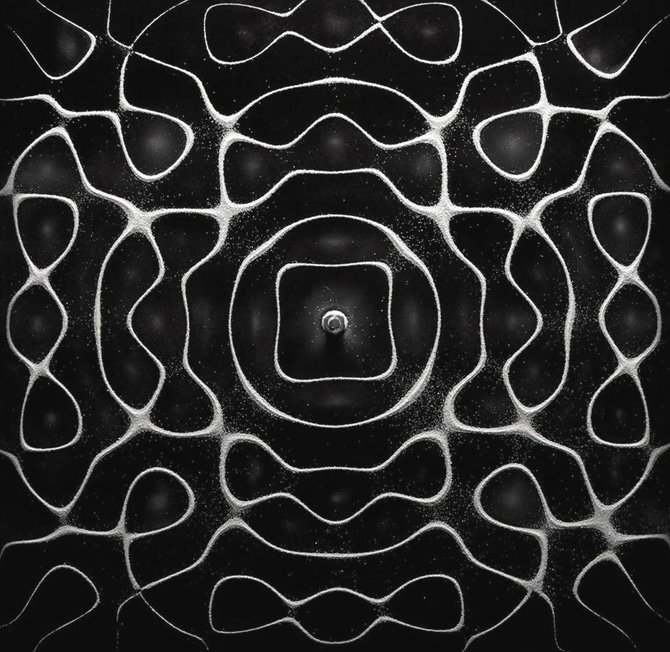
Cymatics offers another clue. When vibration passes through a medium, matter organizes itself into geometric patterns. Increase or decrease frequency, and the pattern changes—predictably. Chaos does not reign. Order emerges immediately. Form appears not because matter “wants” to organize, but because the field within which it exists enforces structure. Sound reveals geometry that was already latent.
The same is true of growth. Seeds do not grow randomly. They unfold according to embedded instructions that express proportion, symmetry, and repetition. Branching patterns repeat at different scales. Leaves distribute themselves to maximize exposure without overlap. Roots mirror branches. These are not poetic observations; they are mechanical facts. Growth follows law.
Even decay obeys rules. Materials fail along predictable lines. Loads distribute according to geometry. Stress reveals hidden structure. Nothing simply collapses into formlessness. Disorder itself proceeds along constrained pathways. There is no escape from form.
This is what it means to say the world is created. Not that it was assembled like a device, and not that it is governed by a humanlike ruler. Creation here means that the world is intelligible because it is shaped. That it has limits. That it resists certain actions and rewards others. That consequences are not moral opinions but structural outcomes.
Natural law follows directly from this. Actions that align with the grain of the world tend to sustain life and coherence. Actions that violate it generate fracture, instability, and collapse. This is not punishment. It is mechanics applied to behavior. A bridge does not fail because it is judged. It fails because its form is insufficient for its load. Societies are no different.
The old image of God failed because it externalized what is actually intrinsic. The order of the world does not hover above us; it surrounds us and runs through everything we touch. We live inside it. We cannot vote it away. We cannot redefine it by consensus. We can only learn it, respect it, or collide with it.
The world is structural. It is ordered. It is shaped by ratios, geometry, and law. Those facts alone are enough. One does not need mythology to see them, only attention. Creation is not a story about origins. It is a description of present reality.
We are not free from structure. We are free only in how we move within it.