

American lawyers are taught constitutional law, statutory interpretation, and federal jurisdiction. They are rarely taught treaty law as law. Treaties tend to appear only as historical background or as isolated doctrines in niche areas of practice. As a result, most discussions of Indigenous jurisdiction begin from an unexamined assumption: that the United States possesses general authority over Indigenous lands unless it has clearly relinquished it.
This essay argues the opposite. Properly understood, the United States never acquired general jurisdiction over Indigenous treaty lands in the first place. To assert such jurisdiction today requires a series of quiet but profound contradictions—contradictions with the Supremacy Clause, with the logic of treaties, and with the Supreme Court’s own reasoning in cases such as McGirt v. Oklahoma. This is not an argument about history or morality. It is an argument about constitutional structure.
The Constitution places treaties in an unusual and revealing position. Article VI declares that the Constitution, federal laws made pursuant to it, and treaties are the “supreme Law of the Land,” binding judges in every state. That sentence establishes hierarchy. It tells courts what must yield when laws conflict. Treaties are not placed beneath statutes, nor described as policy commitments. They are placed alongside the Constitution itself. This was deliberate.
Understanding why requires some explanation of how the Federalist Papers operate in U.S. jurisprudence. They are not law and they are not binding authority. Courts cite them because they are contemporaneous explanations of how the Constitution was understood by those who drafted and ratified it. When courts confront structural questions—how power is allocated, what limits exist, and which interpretations are even permissible—they routinely turn to the Federalist Papers as an interpretive guide. This is especially true where later doctrine appears to have drifted from first principles.
Treaty law is not peripheral in the Federalist Papers. It is addressed repeatedly and with unusual clarity. John Jay, in particular, is central. Jay was not merely a commentator. He was a principal author of the Federalist Papers, the primary negotiator of early U.S. treaties, and the first Chief Justice of the United States. When he explained treaty law, he was describing the system he was helping to construct.
In Federalist No. 64, Jay addressed an objection raised during ratification: that treaties should be repealable like ordinary legislation. His response was straightforward. A treaty, he explained, is a bargain between sovereigns. If one party can unilaterally alter or discard it, the bargain collapses. No rational nation would enter into agreements that bind them permanently while binding the United States only until Congress changes its mind. Jay’s point was not rhetorical. It was functional. Treaties only work if they bind both parties equally, and only mutual consent can alter them.
Alexander Hamilton reinforced this understanding in Federalist No. 75, describing treaties as contracts with foreign nations, binding in good faith and distinct from ordinary legislation. James Madison repeatedly described the treaty power as the mechanism by which the United States interacted with external sovereigns, not internal subjects. Taken together, the Federalist Papers make something clear that later doctrine often obscures: treaties were understood to constrain federal power, not merely to express it.
This leads to a critical implication that is often avoided. A government does not make treaties with entities it already governs. It regulates them. Treaties presuppose sovereignty on both sides. Between the late eighteenth century and 1871, the United States entered into hundreds of treaties with Indigenous nations. These treaties were negotiated, ratified, and enforced using the same constitutional machinery as treaties with European powers. The legal implication is unavoidable: Indigenous nations were treated as sovereign treaty partners capable of allocating jurisdiction.
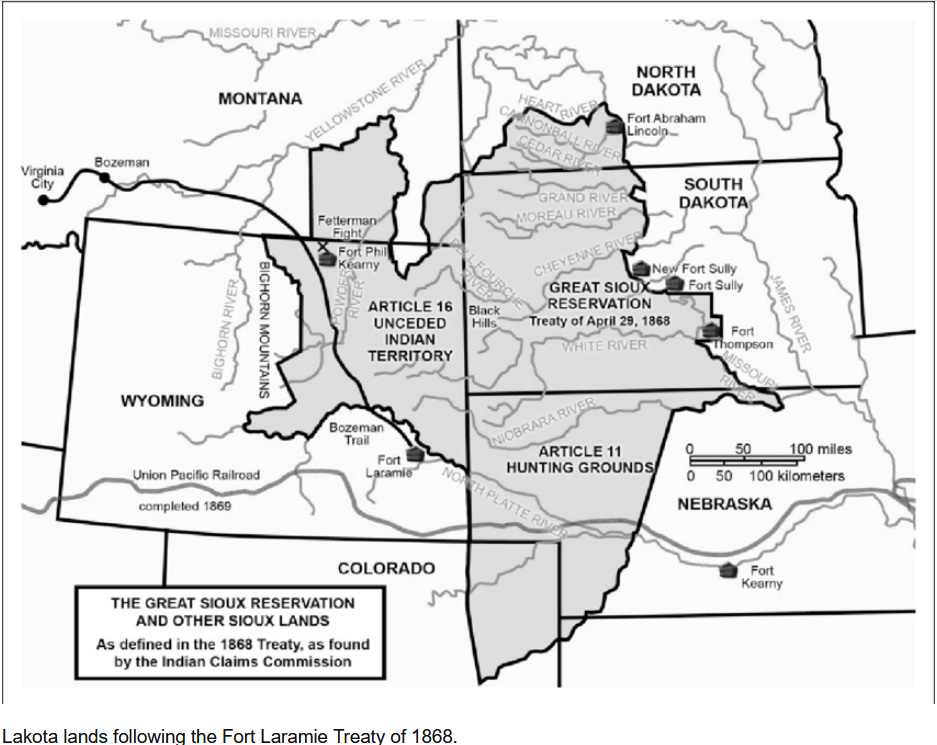
The Fort Laramie Treaty of 1868 illustrates this clearly. It set aside the Great Sioux Reservation “for the absolute and undisturbed use and occupation of the Indians herein named.” That language is not ceremonial. It is jurisdictional. “Absolute” means complete. “Undisturbed” means free from external sovereign interference. “Use and occupation” denotes territorial control. The treaty reflects a jurisdictional settlement in which the United States agreed that this land would not be governed by U.S. authority except where jurisdiction was expressly reserved.
The Supreme Court has repeatedly acknowledged this structure, even if later doctrine has struggled to live with it. In United States v. Sioux Nation of Indians (1980), the Court held that the United States unlawfully took the Black Hills in violation of the Fort Laramie Treaty. The Court treated the treaty as binding law and found the government in breach. That holding matters for a simple reason: a treaty that can be violated can also be enforced. Otherwise, the concept of violation has no legal meaning.
Early Supreme Court precedent aligns closely with this understanding. In Ware v. Hylton (1796), one of the Court’s first cases, the Court held that a treaty superseded a conflicting statute. The reasoning was direct: treaties are law, and inconsistent legislation must yield. This approach becomes difficult to reconcile only once one assumes, without analysis, that Congress must possess ultimate authority regardless of treaty commitments.
Despite this structure, modern doctrine often proceeds as if federal jurisdiction over Indigenous treaty lands is simply assumed. When pressed, the justification is rarely articulated clearly. Instead, it appears to rest on an unstated premise: that jurisdiction has arisen through long-standing federal practice. This premise is logically unsustainable.
Federal courts are courts of limited jurisdiction. As the Supreme Court emphasized in Kokkonen v. Guardian Life Insurance Co. (1994), they possess only the authority granted by the Constitution and statutes made in accordance with it. More fundamentally, unlawful conduct does not generate lawful authority. If it did, constitutional limits would erode through repetition. Governments would acquire power by ignoring restraints long enough.
The Supreme Court rejected this logic in McGirt v. Oklahoma (2020). There, the state argued that historical practice and reliance had effectively erased reservation boundaries. The Court refused, holding that jurisdiction depends on legal authority, not convenience, and that violations do not extinguish law. That reasoning does not stop at boundaries. It applies equally to jurisdiction itself.
McGirt also clarified the limits of federal authority. The Court held that Oklahoma lacked authority to prosecute an Indian for a crime committed on reservation land because Congress had never lawfully disestablished the reservation. Just as importantly, the Court emphasized that federal authority in Indian country is limited. Justice Gorsuch acknowledged that the Major Crimes Act represents an intrusion into tribal self-governance and may breach treaty promises—but only in narrowly enumerated cases.
Enumeration matters. If the United States possessed general jurisdiction over Indigenous treaty lands, enumeration would be unnecessary. The Major Crimes Act exists precisely because tribal jurisdiction would otherwise be exclusive, a point recognized long ago in Ex parte Crow Dog (1883) and reaffirmed in Keeble v. United States (1973).
Some later cases suggest that Congress may abrogate treaties by ordinary legislation. But those cases rarely confront the Supremacy Clause directly, and they rarely engage with the Federalist understanding of treaty law. John Jay warned explicitly against this outcome. If one party can unilaterally override treaties, treaties cease to function as law. They become revocable promises, binding only the weaker party.
Yet modern doctrine often assumes exactly that result, without acknowledging the contradiction.
When the Constitution’s structure is taken seriously, the conclusion follows inevitably. Treaties are supreme law. Treaties allocate jurisdiction between sovereigns. The Federalist Papers confirm this original understanding. Indigenous nations were treated as sovereign treaty partners. Treaty lands were set aside for exclusive Indigenous governance. Jurisdiction withheld by treaty cannot be reclaimed unilaterally, and it cannot arise from violation or habit.
Therefore, the United States has no general jurisdiction—criminal or civil—over Indigenous treaty lands. Any assertion of such jurisdiction requires subordinating treaties to statutes, elevating practice over law, and quietly reversing the Supremacy Clause.
This is not radical doctrine. It is simply the Constitution read as designed.