

Nikola Tesla’s life does not fit comfortably within the modern image of the inventor as an incremental improver, filing patents and refining the work of others. He belonged to a rarer category: the system-builder. Born in 1856 in what is now Croatia, educated in mathematics and engineering in Europe, Tesla arrived in the United States in 1884 with little money and a letter of introduction. Within a few years, his work would reshape the electrical foundations of modern civilization.
Tesla’s most consequential achievement was the development of alternating current systems: polyphase motors, transformers, and long-distance transmission. These were not abstract contributions. They solved concrete engineering problems that direct current could not. AC made large-scale electrification possible. Cities, factories, and modern infrastructure depend on it to this day. Tesla did not merely theorize; he built working systems that industry later adopted, often after first dismissing them.
He went on to pioneer radio-frequency technology, high-voltage experimentation, resonance, remote control, and wireless signaling. In 1899, at Colorado Springs, Tesla constructed enormous coils and conducted experiments that produced artificial lightning and demonstrated electrical effects transmitted through the ground and air. Lamps were lit without wires. Instruments registered electrical activity at distance. These demonstrations were witnessed, measured, and recorded. Tesla was not imagining outcomes; he was observing them.
A crucial aspect of Tesla’s work was how he invented. He repeatedly explained that his designs appeared fully formed in his mind, complete down to fine mechanical detail. He would mentally construct machines, operate them in imagination for extended periods, observe imbalance or failure, and correct flaws before ever building a physical model. Only when a device was perfected internally would he commit it to construction—and when he did, it typically functioned as envisioned. This method was widely remarked upon by contemporaries and stands in sharp contrast to the later portrayal of Tesla as speculative or impractical.
Tesla also situated himself consciously within an older tradition of natural philosophy. Long before industrial grids or power stations, electricity had been encountered as an ambient force rather than a manufactured commodity. In the eighteenth century, Benjamin Franklin demonstrated that atmospheric electricity could be drawn from the environment using a kite, a key, and a conductive line. Franklin did not generate electricity in the modern sense; he revealed its presence. Electrical force already existed and could be accessed through suitable means.
Tesla saw his own work as a continuation and maturation of this insight.
Underlying both Tesla’s experimental work and his inventive method was a firm conviction about the medium through which electrical phenomena occurred. He rejected the idea of empty space and consistently described electricity and radiation as disturbances propagated through a real, continuous medium—what he called the aether. In lectures and writings, Tesla emphasized vibration, resonance, and frequency as fundamental principles governing electrical behavior. He repeatedly framed electrical transmission not as the movement of discrete objects through nothingness, but as the excitation of a structured field capable of sympathetic response.
This perspective is captured in the line widely attributed to Tesla: “If you want to find the secrets of the universe, think in terms of energy, frequency, and vibration.” While the sentiment is entirely consistent with Tesla’s documented views, this specific sentence cannot be traced with certainty to a single primary Tesla publication. It is therefore best understood as a faithful condensation of his position rather than a verbatim quotation. The underlying idea—that resonance within a continuous medium governs electrical behavior—is unequivocally Tesla’s.
By the turn of the twentieth century, Tesla turned his attention to a far more ambitious problem: the wireless transmission of electricity at global scale. He believed the Earth itself could function as a conductive and resonant body, coupled to the surrounding energetic medium, allowing electrical power to be transmitted without wires, centralized grids, or physical distribution infrastructure. The practical expression of this work was Wardenclyffe.
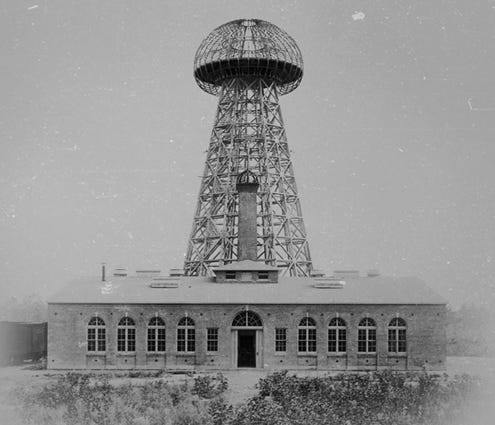
Wardenclyffe was not a metaphor or a thought experiment. It was a physical installation constructed on Long Island beginning in 1901. The site included a laboratory, power systems, massive transformers, and a 187-foot wooden tower capped with a metal dome. Tesla’s stated aim was to transmit electricity through resonance, using the conductive properties of the Earth and the surrounding medium to bypass conventional wiring altogether. In effect, Wardenclyffe was intended as a prototype for a fundamentally different electrical architecture—one that did not rely on centralized generation, transmission lines, or metered distribution.
Initial funding came from J.P. Morgan, who understood the commercial potential of wireless communication. Funding later ceased as Tesla’s ambitions expanded beyond communication toward power transmission. Whatever the proximate explanation, the economic problem is obvious: a system designed to transmit electricity without wires also dissolves the chokepoints on which centralized control depends.
In 1917, Wardenclyffe Tower was dismantled and sold for scrap, ostensibly to satisfy Tesla’s debts. Heavy equipment, transformers, and experimental apparatus were removed. What became of much of this equipment is poorly documented. By the time Tesla died decades later, the structure was gone, but the design knowledge—the principles, calculations, and refinements—remained in his papers.
Tesla died on January 7, 1943, alone in Room 3327 of the New Yorker Hotel in New York. Within hours of his death, before family members could secure his belongings, the U.S. government intervened. Tesla’s trunks, papers, and effects were seized and placed under federal control under the authority of the Office of Alien Property Custodian.
This was extraordinary. Tesla was not an enemy national. He was a naturalized U.S. citizen who had lived and worked in America for more than half a century. Yet his intellectual estate was treated as foreign. Alien-property authority was applied not because of nationality, but because power sought control of the property.
To evaluate the contents of Tesla’s papers, the government appointed John G. Trump, a respected electrical engineer and physicist at Massachusetts Institute of Technology and the uncle of Donald Trump. Trump reported that the materials contained no immediately realizable weapons or devices of military significance. That conclusion has been cited ever since as if it resolved the matter.
If it had, the papers would have been released.
They were not.
Some materials were returned to Tesla’s family years later. Others were not. No comprehensive public inventory was produced. No transparent chain-of-custody accounting has ever been made publicly available. The state retained discretion, and silence followed.
Tesla was not known for producing nonsense. His career was defined by working systems that others initially dismissed as impossible. His late-life work followed the same trajectory as his earlier achievements: resonance, field effects, transmission, and electrical power. The official narrative asks us to accept that this work was both insignificant and significant enough to justify extraordinary seizure and decades of institutional opacity. Under any coherent framework, those positions cannot coexist.
The deeper explanation emerges when Tesla’s aether-based model is taken seriously. A system grounded in resonance within a continuous medium undermines scarcity. It resists enclosure, metering, and centralized permission. Once institutional science and industrial power aligned around models that treated electricity as a discrete commodity produced at controlled points, Tesla’s framework became not merely unfashionable, but destabilizing.
Seen in this light, the containment of Tesla’s papers was not an anomaly. It was a structural response. Franklin revealed electricity as an ambient presence. Tesla sought to make that presence usable at scale. The former could be celebrated as history. The latter threatened the architecture of control.
That is why Wardenclyffe mattered.
That is why the equipment disappeared.
And that is why the papers remain contained.