

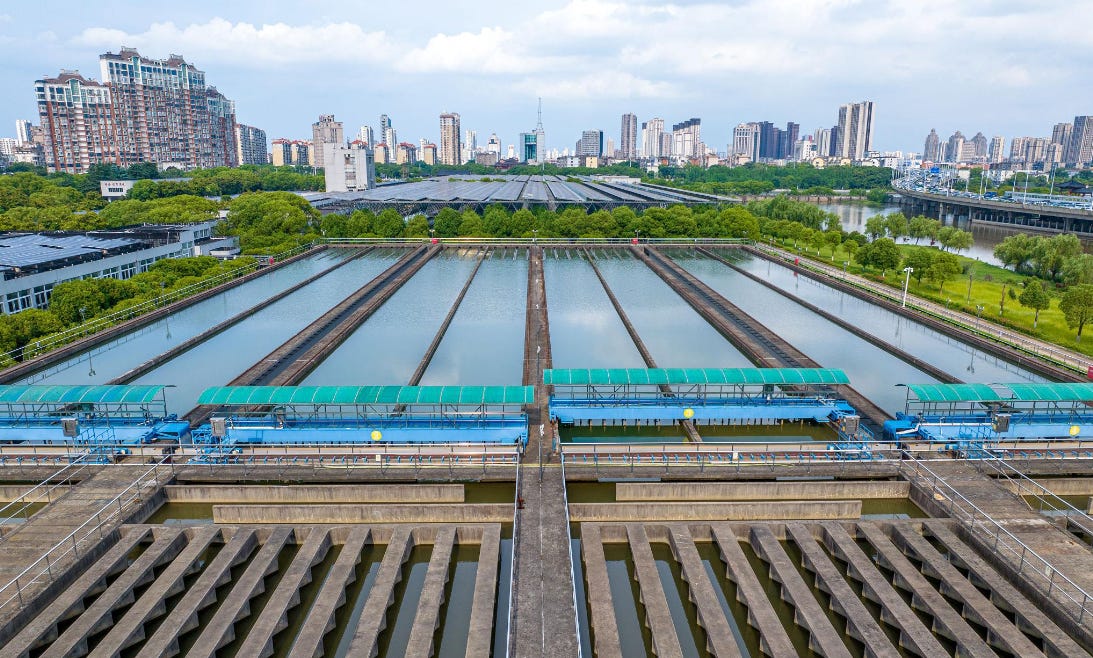
Modern cities depend on a hidden achievement so basic that it is rarely treated as strategic infrastructure at all. Water arrives under pressure, is treated to a standard safe enough for daily life, moves through homes, hospitals, schools, cooling systems, fire suppression networks, food preparation, and industry, and then disappears again into a wastewater structure that must also continue functioning without interruption. Because this works most of the time, urban water is often treated as a background utility rather than as one of the conditions that makes urban concentration possible. That is a mistake. Water infrastructure is not merely one service among others. It is one of the systems that makes dense urban life possible in the first place.
This matters because cities are not resilient simply because they are large, wealthy, or technologically advanced. In many cases they are less resilient precisely because they have become so concentrated, specialized, and dependent on uninterrupted flows. A city can absorb inconvenience in many forms. It can tolerate delayed deliveries, overloaded roads, higher prices, and even periods of electrical disruption. Water failure is different. When water systems begin to fail, the city loses something more fundamental than convenience. It loses pressure, sanitation, cooling, fire capacity, and confidence in ordinary routines. Water is not merely consumed within the city. It is embedded in the physical logic of the city itself.
The vulnerability becomes clearer when one considers how many systems depend on water continuity at the same time. Hospitals require sterile supply and waste removal. Apartment towers depend on pressure and pumping. Fire suppression depends on water availability at the moment of crisis rather than at the moment of planning. Food preparation, sanitation, transport hubs, commercial buildings, schools, and basic domestic life all assume that treated water will remain continuously available and that wastewater will continue to be removed without exposure or overflow. Once that assumption breaks, the effects propagate quickly across systems that were never designed to operate independently. What appears to be a utility problem becomes an urban stability problem.
Jackson, Mississippi showed this with unusual clarity. In 2022, failures at the O.B. Curtis water treatment plant left much of the city without reliable safe water, and the system eventually required federal intervention to stabilize operations. The significance of Jackson was not merely that a city suffered a water emergency. It was that the emergency revealed how thin the margin had become between ordinary metropolitan life and systemic breakdown. A city can appear normal for years while operating on stored reliability rather than maintained resilience. Once that reserve is exhausted, daily life begins to fail at the level of the most basic civic assumptions.
The 2021 Texas winter storm exposed another dimension of the same problem: cross-system dependence. As electricity systems failed, water systems also began to fail through frozen and burst mains, depleted storage, and loss of treatment and pumping capacity. What mattered was not only the scale of the water disruption, but the mechanism. Water continuity turned out to depend directly on power continuity. The systems were not independent. One failure propagated into the other. This is why water infrastructure belongs beside Energy Infrastructure Concentration and System Fragility. Both subjects reveal the same structural pattern: systems that appear stable under ordinary conditions can become highly vulnerable when concentration, interdependence, and loss of redundancy quietly increase the consequences of disruption.
The same logic is now visible at a more openly strategic level in the Gulf. The current Iran war has brought water vulnerability into view not as a municipal management problem, but as a matter of regional survival. Desalination plants across the Gulf have been openly identified as potential targets, and recent reporting indicates that attacks in Kuwait damaged infrastructure that included power and water facilities. In several Gulf states, desalination is not supplementary. It is the system that makes urban life possible at all. Where cities depend on a small number of large coastal plants, often closely tied to the power grid, water security becomes inseparable from military risk, energy continuity, and the physical protection of a handful of concentrated assets. Under those conditions, a strike on infrastructure is not merely an interruption. It is an assault on the viability of urban settlement itself, which is why this subject also touches the logic examined in Civilian Terror as State Policy, where threatened violence against civilian-dependent infrastructure becomes a means of coercion rather than a byproduct of battle.
That is why this essay sits naturally beside The Infrastructure Stack. The issue is not simply that water systems can fail. It is that cities are built as layered structures of interdependent systems whose continuity depends on the continuity of the others. Water is one of the clearest examples because it links immediately to sanitation, health, cooling, fire protection, domestic life, and the ordinary functioning of dense settlement. A water failure therefore reveals something larger than a utility problem. It reveals how much of modern urban order depends on a technical stack that remains mostly invisible until one layer begins to break.
The larger pattern is not unique to one city or one crisis. It is a recurring feature of modern systems built for efficiency, scale, and smooth performance under normal conditions while allowing resilience to erode quietly in the background. Redundancy is expensive. Spare capacity is politically unglamorous. Maintenance can be deferred. Capital replacement can be postponed because the visible consequences often arrive years after the decision that made them more likely. Then, when disruption comes, failure appears sudden even though fragility has been accumulating for a long time. Water infrastructure exposes that process with particular clarity because the loss of margin is felt immediately in the conditions of daily life.
Water infrastructure should therefore not be discussed only in the language of pipes, treatment plants, and utility budgets. It is a question of whether cities still possess the redundancy, maintenance discipline, local competence, and institutional seriousness required to sustain dense life under stress. A city is not robust merely because it functions on ordinary days. It is robust when it can absorb shock without forcing residents into emergency improvisation around the most basic conditions of life. Water is one of the clearest tests of that distinction.
When water systems begin to fail, the city does not simply become inconvenient. It becomes fragile. Residents lose confidence in what they can safely drink, whether schools and hospitals can function normally, whether sanitation can be trusted, whether firefighting capacity remains intact, and whether authorities understand the systems they are claiming to manage. The problem is not only technical. It is civilizational at the urban scale. Water is one of the conditions that makes urban order possible at all. When that condition weakens, the city discovers how much of its apparent stability was conditional from the beginning.