

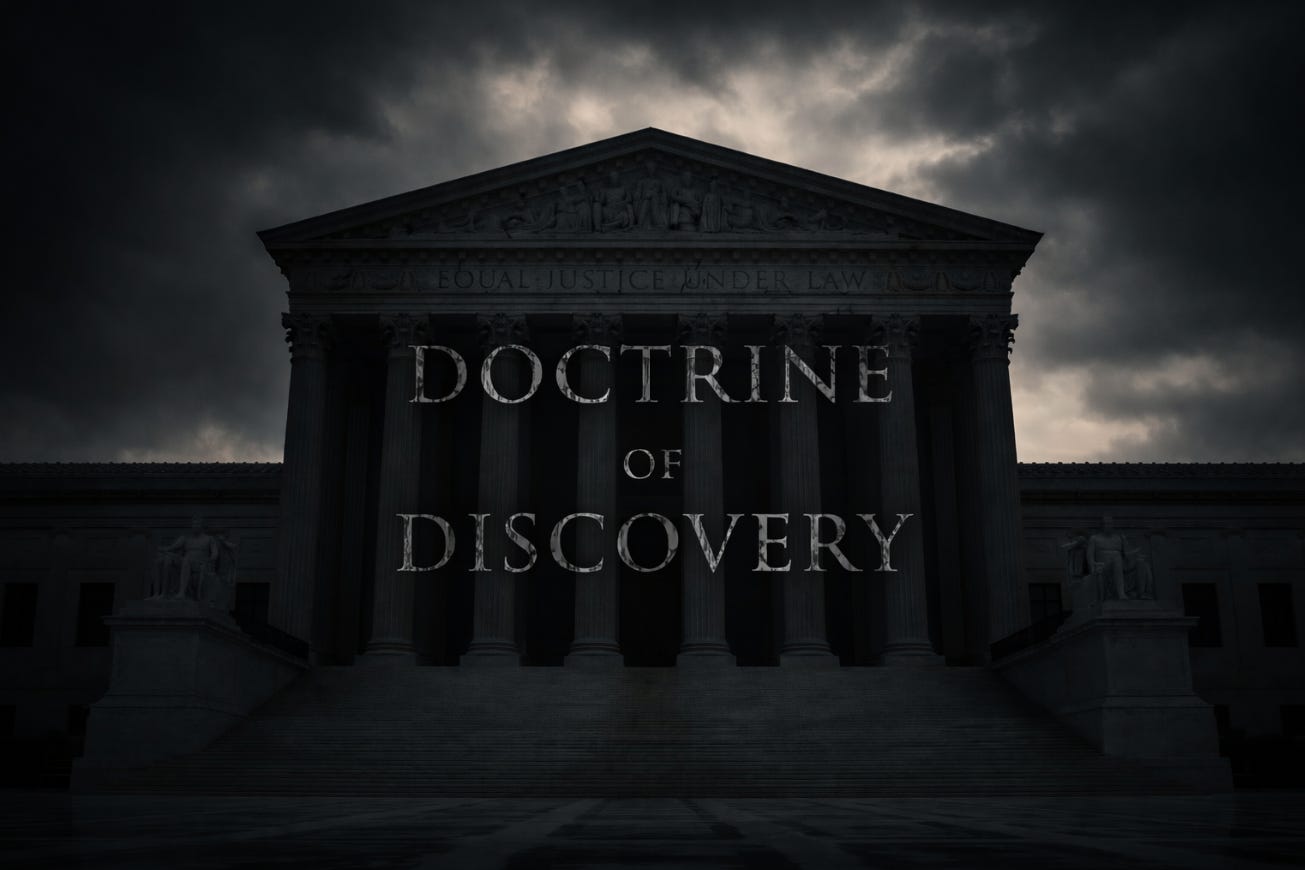
The most enduring form of racism is not found in slurs, attitudes, or even policy. It is found in structure: in the invisible rules that determine who may own land, who may govern themselves, and whose existence is legally complete. For Indigenous peoples in the United States, that structure rests on a doctrine so old, so normalized, that it rarely appears in public conversation at all. It is called the Doctrine of Discovery.
This doctrine did not originate in America. It was not debated by Congress. It was not voted on by the people. It was authored by the Vatican.
In the fifteenth century, the papacy issued a series of decrees—Dum Diversas (1452), Romanus Pontifex (1455), and Inter Caetera (1493)—that formally authorized Christian monarchs to invade, conquer, and claim lands inhabited by non-Christian peoples. These papal bulls did not recognize Indigenous peoples as equal human communities with inherent sovereignty. They defined them as legally and spiritually subordinate: “pagans,” “infidels,” and “barbarians” whose lands could be seized, whose political authority could be extinguished, and whose persons could be subjected to domination. Dum Diversas explicitly authorized Christian rulers to “subdue,” “conquer,” and even reduce non-Christians to perpetual servitude.
This was not metaphor. It was law.
Under these decrees, Indigenous peoples were not treated as nations. They were not treated as legal equals. They were not even treated as fully sovereign human communities. They were classified as populations without legitimate dominion—present on the land, but not entitled to it; human enough to be governed, but not human enough to govern themselves.
When European empires expanded, this theological hierarchy became imperial policy. When the United States emerged as a successor power, it did not abandon the structure. It translated it.
In 1823, the Supreme Court made the Doctrine of Discovery American law in Johnson v. M’Intosh. Chief Justice John Marshall ruled that Native nations did not hold full title to their lands. They possessed only a “right of occupancy.” The ultimate title belonged to the discovering European power and, by succession, to the United States. The religious language was stripped away. The hierarchy was not.
From that moment forward, Indigenous peoples were legally transformed from sovereign owners into permanent occupants of land that was no longer considered fully theirs.
This was not symbolic. It was structural. It redefined the entire legal relationship between Native nations and the state. Tribes could live on their land, but not own it in the same sense as European settlers. They could govern internally, but only at the pleasure of Congress. They could enter treaties, but only as wards of a superior authority. Their sovereignty became conditional. Their political existence became administratively managed.
This is what structural racism looks like when it is fully institutionalized. It does not announce itself. It simply assumes. It does not deny humanity explicitly. It denies equivalence quietly.
The doctrine embedded a hierarchy directly into property law: that European-derived authority was inherently superior to Indigenous presence, continuity, and stewardship. Land was no longer something held by those who lived on it, cared for it, and were bound to it across generations. It became something that could be claimed by proclamation, recorded by courts, and transferred through institutions that Indigenous peoples did not create and could not control.
From that single legal foundation flowed the architecture of federal Indian law. Reservations were not established as homelands freely chosen, but as reduced territories of permitted survival. Treaties were not agreements between equal nations, but instruments of managed dispossession negotiated within a framework where one side already claimed ultimate title. Tribal sovereignty was acknowledged rhetorically and constrained legally, producing the modern paradox in which Native nations are said to be sovereign yet are unable to exercise sovereignty over land, borders, or jurisdiction without federal approval.
Even today, Native land is held “in trust,” as though Indigenous nations are incapable of owning what they have inhabited since time immemorial. Congress retains the power to dissolve tribes. Federal and state authorities fragment jurisdiction over crimes, resources, and governance on reservations. Courts speak of “plenary power” over Indigenous peoples as though such authority were natural rather than inherited from a theology of conquest.
This is not merely a historical injustice. It is a living legal structure. The doctrine is still cited. It has never been overturned. Every modern case that affirms tribal rights does so within a framework that already assumes the United States holds ultimate dominion. Rights are recognized as grants within a system whose foundation remains unchanged.
This is why the Doctrine of Discovery cannot be dismissed as a relic of the past. Structurally racist decisions in American law have been confronted before—and, in some cases, formally repudiated.
In Korematsu v. United States (1944), the Supreme Court upheld the federal government’s mass incarceration of Japanese Americans during World War II. Entire families—citizens included—were forcibly removed from their homes and placed in internment camps based solely on ancestry, justified by claims of military necessity. It was one of the most explicit racial exclusions ever endorsed by the Court. Decades later, the ruling was publicly disavowed. In Trump v. Hawaii (2018), the Court declared that Korematsu was “gravely wrong the day it was decided” and “has no place in law under the Constitution.”
The Doctrine of Discovery has never received that reckoning.
Korematsu was eventually recognized as a structural injustice—an admission that race-based confinement violated the most basic principles of constitutional equality. But the doctrine that reduced Indigenous nations to mere occupants on their own land, that subordinated sovereignty itself to conquest, remains fully embedded in American jurisprudence. It is still cited. It still structures federal Indian law. It still defines the legal reality in which Native nations exist.
The difference is not moral. It is foundational.
Korematsu was an aberration within the system.
The Doctrine of Discovery is part of the system.
One involved the suspension of rights during a crisis.
The other defines who is understood to possess rights in the first place.
Removing Korematsu corrected a decision.
Overturning the Doctrine of Discovery would challenge the legal basis of ownership, jurisdiction, and territorial authority itself.
Which is why one could be repudiated—and the other remains quietly untouched.
The racism of this structure lies not in personal prejudice, but in the original premise: that Indigenous peoples were never fully sovereign to begin with. That their relationship to land was something less than ownership. That their nations were something less than nations. This is not equality before the law. It is hierarchy written into law.
From a natural law perspective, the inversion is obvious. Authority is not derived from presence, continuity, or stewardship, but from declaration by an external power that arrived later and claimed superiority by doctrine. The land itself did not consent. The people who belonged to it were never asked whether their sovereignty was real. It was simply redefined.
What changed was not who lived there. What changed was the story that the law chose to believe.
And once the story was accepted, everything else followed.
This is why the Doctrine of Discovery is not a footnote. It is the root. It explains why Indigenous peoples in the United States are still required to justify rights that others take for granted. It explains why dispossession can be acknowledged as tragic while its legal mechanism remains intact. It explains how a racial hierarchy can persist without being named as such.
Structural racism does not always announce itself in violence or insult. Sometimes it lives quietly in doctrines that no longer need to defend themselves, because they have become the grammar of law itself.