

The Museo del Oro in Bogotá does not present gold as a commodity. It presents gold before commodity thinking took possession of it.
The objects are immediately recognizable as gold, but their use is not modern. They are not arranged as wealth in storage. They are not treated as inert value. They are worn on faces, ears, chests, and noses. They are shaped into birds, jaguars, cats, snakes, human-animal figures, vessels, masks, and rafts. They are made for ceremony, status, offering, transformation, and display. They belong to a world in which gold was not simply owned. It was used.
The first thing the museum makes difficult to miss is the relationship between gold and the sun. Circular forms, radiating patterns, polished surfaces, and objects made to catch light appear again and again. Gold does not merely shine. It holds light and gives it back. A pectoral moves with the chest. An earring turns beside the face. A nose ornament sits at the place of breath. These are not neutral placements. They put gold where the body becomes visible.
This was not unique to Colombia. Across many ancient cultures, gold was drawn toward the sun, divinity, permanence, and ritual authority. Silver was drawn toward the moon, reflection, purity, and cooler light. Copper, darker and redder, changing more visibly through oxidation and contact with earth, carried a more embodied quality. These correspondences were not random decoration. They arose from how the metals behave. Gold is luminous and incorruptible. Silver reflects. Copper changes.
A prior essay, The World Is Structural and Created, examined how ancient forms often mirrored the logic of the world rather than functioning as ornament. The gold objects in Bogotá belong to that same family of perception. They suggest a world in which material, light, animal, body, and ritual were understood together, not separated into modern categories.
The nose ornaments are especially striking. There are hundreds of them. They cross the nostrils and alter the face itself. They sit close to breath, speech, smell, and identity. A person wearing such an object would not merely possess gold. He would appear through gold. The face would be changed by it. The breath would pass beneath it. The body would become part of the object’s meaning.
The same is true of the earrings, pectorals, masks, and crowns. These objects were not casual adornment. They marked chiefs, shamans, and ritual specialists. Gold made authority visible. It did not simply announce wealth. It announced role. The wearer stood before others as someone permitted to act within ceremony, someone whose body had been made legible through a material associated with light, permanence, and power.
The animal forms deepen the pattern. Birds, jaguars, cats, snakes, and double-headed serpents recur throughout the collection. Human figures appear with wings, animal heads, extended limbs, and hybrid bodies. The repetition is too consistent to treat as decorative preference. It is a visual grammar of transformation and mediation. The ritual figure is not cut off from the animal world. He is joined to it, borrowing its movement, force, sight, or danger.
That recurrence matters. Truth Has a Coherent Structure argued that true descriptions hold across contexts because they inherit stability from the structure being described. The museum shows that kind of coherence in material form: sun, gold, animal, face, breath, status, offering, water, transformation. One object may be ambiguous. A whole collection begins to speak.
The Colombian record supports this. Gold in the ancient Americas was treated as sacred material, not merely as prestige metal. Offerings were connected with seeds, fertility, water, renewal, and the continuity of life. Some accounts describe gold and gilded copper ornaments being placed in sunlight before ritual use, as if light restored or intensified their force. The details cannot all be reconstructed with certainty. The larger point is clear enough. Gold was not only displayed. It was put to work.
That does not require a crude claim that gold operated like a machine. The stronger hypothesis is subtler. Gold made ritual more coherent. It concentrated attention. It marked the person authorized to act. It linked the body of the ritual specialist with solar light. It survived burial, water, handling, and time. It could be worn, offered, submerged, hidden, and recovered without losing itself.
In a harmonic and ordered world, those properties would matter. Ritual depends on alignment: material, gesture, place, witness, belief, and authority. Gold supplied a material that visibly aligned with the sun, permanence, sacred offering, and high status. If ritual works partly through perception, expectation, embodied action, and shared meaning, then the metal is not incidental. The material strengthens the act because it makes the act more complete.
Some vessels in the museum make this point quietly. They are sealed, with only small holes at the top. They do not open like ordinary containers. They are not made for access. They are made for controlled release. Whatever passed through them did so deliberately, drop by drop or stream by stream. The design points away from storage and toward offering.
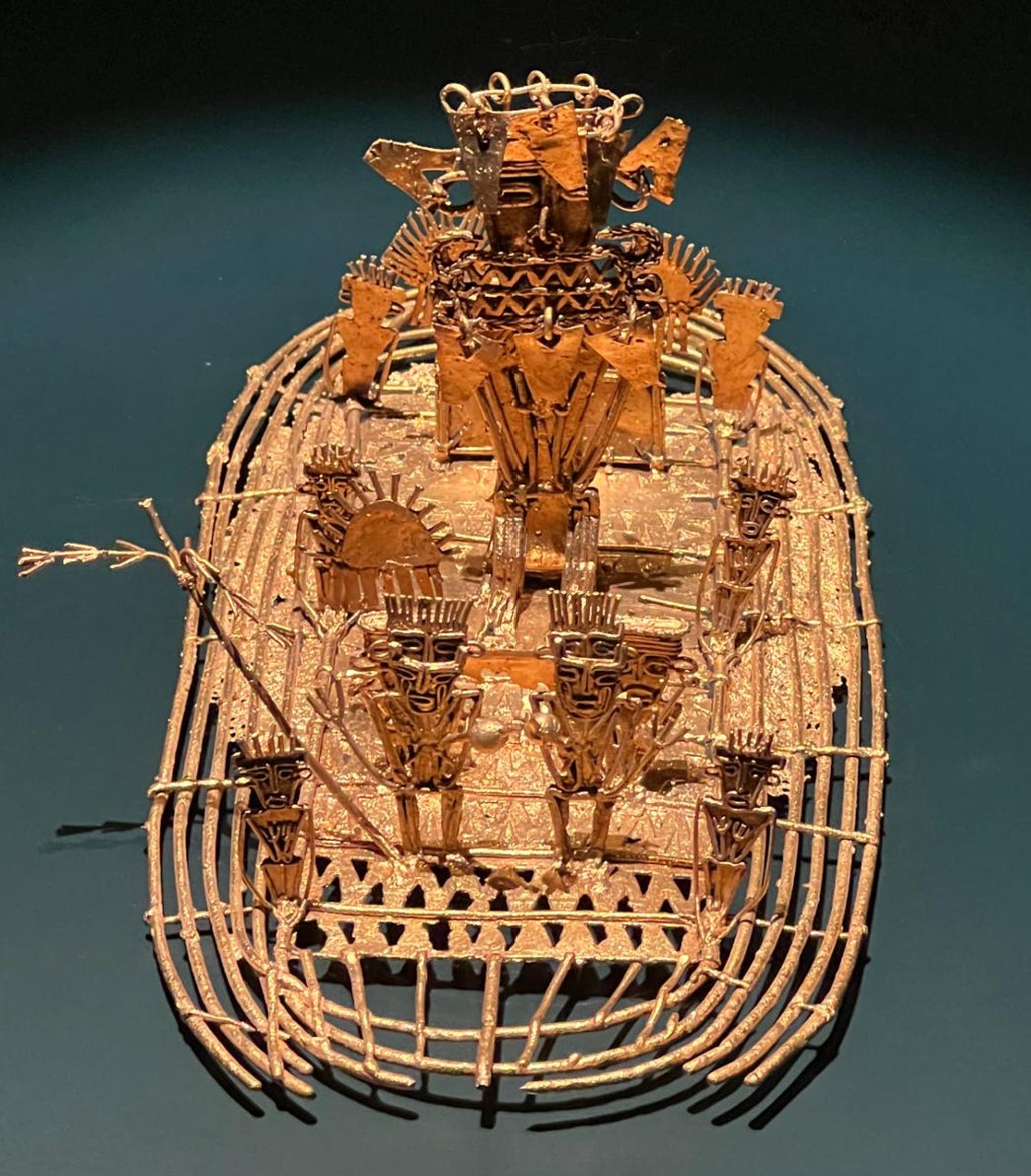
The raft figures bring the system together. A central figure stands elevated, surrounded by attendants, in a bounded ceremonial scene associated with water. The modern imagination turned El Dorado into a story about hidden wealth. The object suggests something else. It shows hierarchy, ceremony, gold, water, and offering. The Europeans searched for a city of gold. What they encountered was a ritual world in which gold could be deliberately given away.
This is where the modern relationship to gold begins to look narrow. Gold and Monetary Permanence examined why gold has remained valuable across civilizations and monetary systems: its durability, incorruptibility, divisibility, and independence from institutional promises. The objects in Bogotá point to an older layer of the same recognition. Before gold became money, it had already become meaning.
The difference is not that ancient people were irrational and modern people are practical. The difference is that ancient ritual systems saw more of the material at once. Modern finance isolates gold’s permanence and turns it into monetary function. The older world recognized permanence, but did not separate it from light, body, breath, animal power, authority, water, offering, and the sun.
At some point, the dominant use changed. Gold became something to be held rather than enacted, counted rather than offered, secured rather than released. The metal did not change. The surrounding world did. A material once used to make relationship visible became a material used to preserve value when relationship fails.
The objects in the Museo del Oro preserve more than craftsmanship. They preserve an older understanding of matter. Gold was not important only because it was rare. It was stable, luminous, workable, durable, and difficult to corrupt. It could carry sunlight into ceremony. It could mark the person authorized to act. It could survive water, burial, and time. It could be given without disappearing.
That may be what these peoples understood more clearly than we do. Gold mattered because it behaved like permanence made visible. It belonged in ritual because ritual required materials capable of carrying meaning without collapsing under time. The modern world still trusts gold when systems fail, but often forgets why trust attached to gold in the first place.
Gold was not always money. Before it was money, it was order in material form.