

There is a familiar moment that precedes modern conflict, and it rarely begins with bombs. It begins with markets.
Before speeches harden into ultimatums, before headlines learn the word “inevitable,” before analysts argue about motives, oil moves. Not dramatically at first, but decisively. Insurance premiums adjust. Shipping routes quietly reprice. Gold lifts, not in panic, but in anticipation. These are not emotional reactions. They are institutional ones.
This week’s surge in Brent crude above $70 is being described as a response to rhetoric surrounding Iran. That framing is incomplete. Markets do not move on rhetoric alone. They move on permission structures. When naval assets reposition, when language shifts from deterrence to inevitability, and when escalation is framed as conditional rather than optional, markets understand that probability has changed—even if events have not yet occurred.
To understand why Iran remains such a persistent focal point for these dynamics, it is necessary to recall how its current political order came into being. In 1953, Iran’s democratically elected prime minister, Mohammad Mossadegh, was overthrown in a coup engineered by the United States and the United Kingdom after he moved to nationalize Iran’s oil industry. That intervention dismantled a functioning democratic system and reinstalled the Shah, whose rule endured until the 1979 Islamic Revolution. The regime that governs Iran today is not an ancient or organic political inheritance; it is the downstream consequence of that earlier destruction of Iranian democracy. The deep mistrust of external power, the central role of security institutions, and the fusion of sovereignty with resistance are not incidental features of the modern Iranian state—they are structural outcomes of how it was formed.
This is the first signal to watch: price movement before causation. When energy, shipping, and metals move ahead of any kinetic action, it suggests foreknowledge embedded within the system, not surprise.
The second signal is timing. Internal unrest in a target state is rarely fabricated wholesale; grievances are often real. Economic stress, youth disaffection, inflation, repression—these forces arise independently of external pressure. But history shows just as clearly that external money, NGOs, training networks, and media amplification frequently shape the scale, durability, and direction of that unrest. What matters is not authenticity, but activation. When internal instability intensifies in lockstep with external diplomatic, legal, and military escalation, unrest has ceased to be merely domestic. It has become strategically aligned.
This is how pressure campaigns mature. Protest does not need to be created; it needs to be activated and sustained at the right moment. Crackdowns then become predictable, and predictability becomes leverage. Once that leverage is secured, the protest itself no longer needs to persist.
The third signal is moral pre-framing. Long before any strike, the ethical architecture is assembled. Language shifts from policy disagreement to moral necessity. The regime is no longer wrong; it is dangerous. No longer repressive; it is illegitimate. No longer a negotiating partner; it is a threat. Once this framing stabilizes, escalation can be presented not as a choice, but as a response already implied by prior declarations.
Sequence matters. When condemnation precedes provocation, intent is already visible.
A fourth signal appears at the institutional level: the European Union’s formal designation of Iran’s Islamic Revolutionary Guard Corps as a terrorist organization. This is not symbolic. Such designations harden legal posture, foreclose diplomatic flexibility, and pre-authorize financial, intelligence, and security cooperation measures that would otherwise require fresh justification.
Once this threshold is crossed, the space for de-escalation narrows sharply. Legal architecture aligns with moral framing, and escalation becomes easier to justify, faster to execute, and harder to reverse. Political cover is created upstream, responsibility is distributed across allies, and unilateral action is reframed as collective necessity.
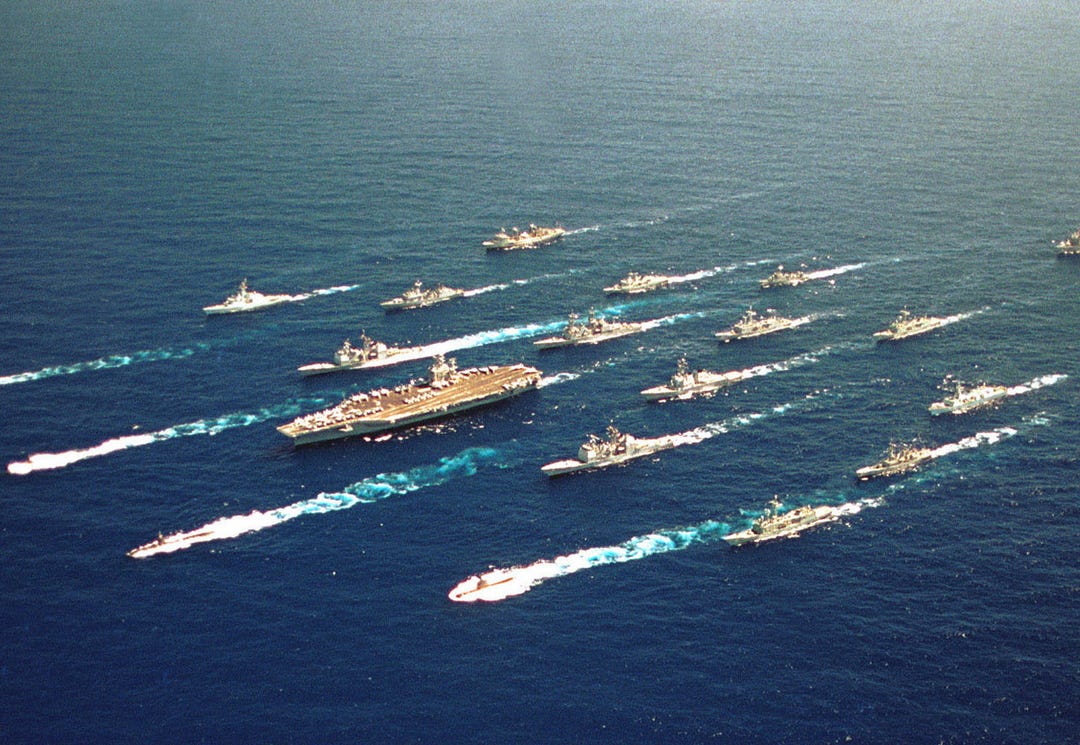
The fifth signal is asset movement without commitment. Deployments that are large enough to be unmistakable, but ambiguous enough to preserve deniability. Fleets that arrive “to deter,” forces that posture “just in case,” exercises that resemble readiness more than rehearsal. These moves constrain the target’s options while acclimating domestic and allied audiences to the presence of force. Whether violence follows or not, the pressure is real and sustained.
Ambiguity here is functional. It preserves optionality while shaping expectation.
A sixth, often overlooked signal appears not in military briefings but in aviation notices: when commercial airlines begin quietly rerouting or avoiding airspace around the Gulf. Airlines do not respond to political speeches. They respond to insurer guidance, regulatory advisories, and classified risk assessments circulating through civil aviation channels. When flight paths lengthen, fuel costs rise, and airspace is treated as contingently unsafe, it indicates that escalation risk has crossed an internal threshold—well before governments acknowledge it publicly.
Airlines move when probabilities shift, not when wars are announced.
Finally, there is the signal that rarely makes headlines but consistently reveals intent: who benefits from prolonged tension even in the absence of war. Elevated energy prices reallocate capital. Financial stress consolidates into preferred jurisdictions. Defense postures justify expanded authority and budgets. Alliances are disciplined, rivals are tested, and markets learn which instabilities are tolerated and which are protected.
War is not always the objective. Often, managed instability is.
The question, then, is not whether escalation with Iran will occur. The question is whether the conditions for escalation are being systematically normalized. Oil moving first suggests they are. Moral framing hardening suggests they are. Formal legal designation of core state military organs suggests they are. Asset positioning without resolution suggests they are. Airlines quietly avoiding airspace suggests they are.
The real signals are not found in statements or denials. They are found in sequencing.
When markets move before events, when rhetoric outruns diplomacy, when unrest is activated in alignment with external pressure, when legal posture hardens in advance, and when force is positioned before necessity is exhausted, history suggests we are not watching a crisis unfold.
We are watching one being prepared.