

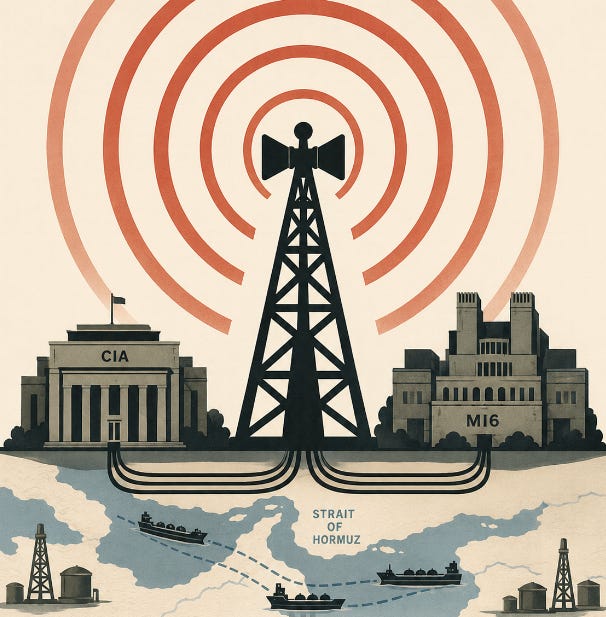
Alastair Crooke’s article, Former MI6 Spy Alastair Crooke: Iran Takes Its Chances With War, is useful because it reveals the frame now being prepared. It is also dishonest because it assigns agency in the wrong place.
Crooke is not merely a retired diplomat offering detached analysis of the Middle East. He is a former British intelligence figure operating in public media as a permitted interpreter of events. That distinction matters. The modern intelligence-linked analyst does not appear only as an official spokesman. He appears as a former diplomat, regional expert, peace-process insider, or dissident commentator. The surface role is independence. The deeper function is managed disclosure.
This is the modern Mockingbird problem.
In After Mockingbird: What the WaPo–ZeroHedge Conflict Reveals, the central point was not that intelligence influence over media belongs only to the past. The point was that the architecture changed. Scarcity once allowed narrative authority to be centralized through a small number of institutions. As that scarcity disappeared, influence migrated into a wider information environment, operating through access, amplification, marginalization, reputational signaling, platform visibility, and boundary management. What replaced direct control was not independence. It was containment.
Crooke belongs to that later structure. He does not need to publish inside a legacy newspaper. He does not need to deny every fact that matters. His value lies elsewhere. He carries enough institutional memory, intelligence proximity, and dissident credibility to function as a permitted interpreter for readers who no longer trust ordinary official voices.
Operation Mockingbird is usually treated as a historical scandal: intelligence influence over journalists, editors, media institutions, and public interpretation. But the more important lesson is structural. Intelligence influence over media does not require crude propaganda or constant fabrication. It requires trusted voices who can arrange partial truth into an authorized frame. The modern Mockingbird does not need to lie about everything. He only needs to tell selected truths in the order required by power.
Crooke’s article performs precisely that function.
His role is not proven by confession. It is shown by boundary. He may criticize the West, but only within limits the Western security system can survive. He may describe escalation, but not the design that makes escalation useful. He may name Hormuz, but not the strategic purpose of driving conflict toward the energy valve. He may warn of the energy cliff, but not identify the actors who benefit from pushing society toward it. This is not honest dissent. It is permitted dissent, and permitted dissent is one of the oldest forms of narrative control.
The problem is not that Crooke says nothing true. That would make him useless. The problem is that he tells enough truth to preserve credibility while withholding the truth that would change the frame. He allows readers to see danger, but not authorship; escalation, but not design; Iranian leverage, but not Western use of that leverage as a blame mechanism.
Alastair Crooke is not dangerous because he deceives without truth. He is dangerous because he uses truth to protect the deception.
The headline claim is that Iran is “taking its chances with war.” That phrase does the essential work. It tells the reader where responsibility is supposed to land before the next phase of escalation unfolds. Iran is presented as the actor accepting war, choosing war, or gambling with war. The West appears in the background as a force reacting to circumstances, managing risk, restraining Israel, asserting naval pressure, or responding to Iranian decisions.
But the war did not begin with Iran taking its chances. It began with the United States and Israel attacking Iran. Iran’s later actions occurred inside a war the United States and Israel initiated. That is the central fact Crooke’s frame must soften.
If Iran had unilaterally attacked the United States, no Western analyst would describe the American response as Washington “taking its chances with war.” The initiating act would define the moral and legal structure. Iran would be named as the aggressor, and American retaliation would be described as self-defense. Yet when the United States and Israel initiate war against Iran, Crooke reverses the frame. Iran’s response becomes the story. The initiating attack becomes background.
That inversion is not analysis. It is narrative protection.
The Western security system is not an observer of this conflict. It is a combatant in it. It began the war. It can escalate the war. It can de-escalate the war. It knows where further escalation leads. When a former British intelligence figure describes the next phase as Iran taking its chances, the phrase should be read as blame assignment.
This is Crooke’s dishonesty. It is not that every fact in the article is false. The opposite is closer to the truth. The article is revealing because it identifies real things. It names Hormuz. It names limited war. It names Gulf infrastructure. It names Lebanon as a trigger. It names the approaching energy cliff. It tells the attentive reader that escalation is likely and that energy is central.
But it places those real facts inside a false structure of agency.
Crooke tells the reader where the war is going, but not who is driving it there.
A war around Iran does not automatically become a global energy crisis. It becomes one when conflict is pushed toward the Strait of Hormuz, when shipping is made vulnerable, when naval pressure is used as policy, when retaliation is made predictable, and when the world’s energy valve is converted into a battlefield. Iran does not have to be innocent for this structure to be visible. Iran is a state, with interests, coercive instruments, and strategic calculations of its own. The issue is simpler. Why did the United States and Israel begin a war architecture in which Iran’s predictable response could be used to produce a wider energy crisis?
That is the inversion Crooke conceals.
This is also why Strategic Intent Analysis: Inferring Direction Through Structural Convergence matters. The governing point of that essay was that direction often does not appear in stated objectives. It becomes visible through preparation, selection among alternatives, repeated reinforcement, narrowing of options, and foreseeable consequence. Institutions rarely confess their real purpose. They reveal direction through what they repeatedly produce.
Applied here, the method is straightforward. The public explanation is not enough. One must ask what the system selected, what it reinforced, what alternatives it foreclosed, and what consequence it predictably produced. The United States and Israel selected war. They selected conflict with a state whose most obvious deterrent lies near Hormuz. They selected a path in which retaliation would naturally move toward shipping, Gulf infrastructure, energy pricing, and regional escalation. Then voices such as Crooke describe the next phase as if Iran were choosing war rather than responding inside a war initiated by others.
Strategic Intent Analysis does not require confession. It requires observation of trajectory.
The trajectory here is clear.
The public explanations for the war do not withstand scrutiny. The war does not resolve the nuclear question. It does not produce regional stability. It does not make shipping permanently secure. It does not lower the risk of escalation. It does not create a realistic path by which Iran can accept terms without surrendering sovereignty. It does not produce peace.
Judged by its public purposes, the war is pointless.
Judged by its structural effects, it is not pointless at all.
Its first true function is to create an energy crisis. Hormuz is not a symbol. It is one of the world’s central energy chokepoints. Conflict there turns missiles into oil prices, naval friction into shipping costs, insurance risk into inflation, and regional war into domestic hardship. A war near Hormuz does not remain a war over Iran. It becomes a war over diesel, food transport, fertilizer, heating, manufacturing, air travel, and household survival.
This is the energy logic developed in Energy Scarcity and Strategic Control. Nord Stream, Venezuela, and Iran should not be read as separate crises. Read in sequence, they reveal a pattern: remove Europe’s cheaper Eurasian energy option, pull substitute supply through U.S.-approved channels, and then intensify scarcity and route insecurity in the Gulf. The result is not merely market volatility. It is the restructuring of dependency. Energy scarcity becomes a tool of strategic control.
Iran is the most dangerous stage of that sequence because Hormuz is not peripheral. It is systemic. A conflict there does not simply pressure Iran. It pressures Europe, Asia, shipping, insurance, fertilizer, diesel, food systems, and industrial continuity. It raises the cost of dependence inside the very energy order into which Europe has already been pushed.
The second function of the war is to blame Iran for scarcity. If Western escalation pushes conflict into the world’s energy valve, and Iran then uses its natural deterrent at that valve, the public can be told that Iran caused the energy shock. The sequence disappears. The initiating attack disappears. The design disappears. What remains is the comic-book enemy: Iran threatening the world economy.
That is why Crooke’s wording matters. “Iran takes its chances with war” is not a casual phrase. It is the narrative assignment of blame before the next phase unfolds. It begins after the initiating act. It treats the response as the origin. It converts the consequences of a U.S.-Israeli war into evidence of Iranian danger.
The third function is to preserve the enemy in usable form. The West does not need its designated enemies defeated in any final sense. It needs them preserved in usable form: simplified, permanent, menacing, and always available for the next emergency. Russia performs this function in Europe, where it sustains NATO expansion, rearmament, sanctions policy, and European dependency on U.S.-aligned security structures. Iran performs it in the Middle East, where it justifies Gulf militarization, Israeli security primacy, sanctions, oil-route anxiety, and emergency energy politics. China performs it industrially and technologically, giving the system a permanent explanation for supply-chain control, semiconductor policy, military buildup, and the policing of technological dependency. Terrorism performs it internally, preserving surveillance, intelligence budgets, border authorities, emergency powers, and the treatment of domestic life as a security problem. The specific enemy changes; the structural function remains. The enemy must be dangerous enough to justify power, but not resolved so completely that the justification disappears.
This is the logic examined in The War Machine: Strategic Intent and the Persistence of Conflict. Modern war is usually described as a failure of diplomacy, deterrence, or leadership. At the structural level, conflict may stabilize the institutions built around it. Capability requires justification. Industry requires throughput. Politics rewards precaution. Narrative sustains legitimacy. Institutions resist contraction. Where those forces align, war no longer appears merely as policy failure. It becomes system maintenance.
The Iran war fits that pattern. It does not need to achieve a clean military victory. It needs to preserve the conditions under which military-industrial, intelligence, energy, and emergency-governance structures can expand. It needs a continuing threat, a continuing enemy, a continuing explanation for scarcity, and a continuing reason for authority to grow.
Crooke’s article becomes dishonest at precisely this point: he names the energy cliff but refuses to name what the cliff is for.
Once Hormuz becomes the trigger, the energy crisis performs several forms of work at once. It gives the public a foreign explanation for scarcity. It expands emergency authority through budgets, military deployments, infrastructure protection, surveillance of critical systems, subsidy regimes, rationing discussions, censorship of alleged misinformation, and intensified public-private coordination. It transfers cost downward onto households, farmers, truckers, small businesses, and industrial workers while rewarding those closest to the control points: energy majors, commodity desks, shipping insurers, defense contractors, infrastructure firms, financial intermediaries, and politically connected actors positioned to profit from volatility. It disciplines allies, especially Europe, which has already been pushed away from cheap Eurasian energy and into a more expensive Atlantic replacement order. It justifies military expansion by creating a continuing case for naval buildup, missile defense, Gulf basing, arms transfers, intelligence operations, and critical-infrastructure security. At the human level, the result is not abstract. It is higher fuel, higher food, higher transport cost, lower resilience, and greater dependency.
This is the downstream utility Crooke’s frame conceals. He allows the reader to see Hormuz as danger, but not as instrument. He allows the reader to see energy crisis as risk, but not as use.
He does not need to tell readers that the West wants an energy crisis. He only needs to tell them that Iran is taking the risk of one. He does not need to say that Western escalation is designed to make Iran usable as the face of scarcity. He only needs to describe the coming escalation in terms that make Iranian agency appear primary. He does not need to deny that Hormuz is the energy trigger. He names it. That is the controlled disclosure. The concealment lies in the assignment of responsibility.
This is the characteristic method of the intelligence-linked media voice. It does not conceal everything. Complete concealment would make the analysis useless to informed readers. Instead, it reveals enough of the structure to prepare the audience while preserving the false moral arrangement required by the system.
The reader is allowed to know that escalation is coming.
The reader is allowed to know that Hormuz is central.
The reader is allowed to know that the energy cliff is approaching.
The reader is not allowed to see that the Western war design makes those consequences useful.
That is why Crooke is a modern Mockingbird. His function is not silence. His function is controlled disclosure arranged to misassign blame.
The phrase “Iran takes its chances with war” should therefore be inverted. Iran is not taking its chances with war. Iran is being positioned to absorb blame for the next phase of a war the United States and Israel began. The West initiates or escalates the conflict, pushes it toward the energy chokepoint, anticipates Iran’s response, and then presents that response as the cause of the crisis.
This is not peace failing.
It is narrative preparation succeeding.
The paper-deal phase, if it ever existed in substantive form, appears to have served the normal purpose of paper diplomacy in managed conflict. It stabilized public expectations, gave political leaders the appearance of restraint, allowed markets and allies to be managed, and created the later claim that diplomacy had been tried. When escalation resumes, the failure can be assigned to the target.
They delayed.
They refused.
They escalated.
They chose war.
But if the United States and Israel began the war, and if the underlying demands were never designed to be acceptable, then the failure of diplomacy is not a failure at all. It is a stage in the operation.
The deeper question is not whether Iran will use Hormuz. Of course Iran will use the leverage available to it if attacked, blockaded, or threatened with strategic destruction. The deeper question is why the West chose a war path that makes Hormuz central. No serious security system fails to understand the consequences of escalation there. The energy result is not obscure. It is the obvious result of the battlefield selected.
Crooke sees this clearly enough to name the “energy cliff.” That is what makes the article revealing. He identifies the mechanism but protects the frame. He tells the reader that the cliff is approaching, but not that the road has been chosen.
This is the purpose of the permitted mouthpiece. He is close enough to know what is unfolding, distant enough to preserve plausible independence, and useful enough to translate security-state expectation into public analysis. His authority comes from the world whose role he does not fully name. He is permitted to disclose the coming shape of events so long as he preserves the essential deception about agency.
The modern Mockingbird problem is not merely media bias. It is the use of intelligence-linked credibility to prepare public consciousness before responsibility can be assigned. The public is not simply told what happened after the fact. It is trained in advance to interpret what is about to happen.
That is what Crooke’s article does. It tells the informed reader that the war is moving into a new phase. It tells the market-facing reader that energy risk is central. It tells the security reader that Hormuz is the lever. It tells the political reader that diplomacy is no longer the operative structure. And it tells the general reader that Iran is taking its chances with war.
That last message is the lie that organizes the rest.
The West does not appear to be trying to end the Iran conflict. It appears to be trying to make the Iran conflict useful: as a trigger for energy scarcity, a justification for military expansion, a reason for domestic emergency authority, a mechanism for disciplining allies, a means of preserving Israeli regional dominance, and a way to transfer the costs of decline onto ordinary populations while blaming a foreign enemy.
That is why the war’s stated irrationality should not distract from its structural rationality. If the objective were peace, the war would make little sense. If the objective were scarcity, pressure, dependency, and control, it makes much more sense.
Crooke’s role is to make that structure harder to see. He does not do so by denying the facts. He does so by arranging them.
The coming energy crisis, if it unfolds through Hormuz, should not be read as an accident caused by Iranian recklessness. It should be read through the sequence that produced it. Who began the war? Who moved the conflict toward the energy valve? Who benefits from scarcity? Who gains authority when prices rise? Who profits from instability? Who needed Iran to remain a permanent enemy? Who required the public to believe that the hardship was caused elsewhere?
Those questions expose the structure Crooke’s frame conceals. Iran is to be blamed for the energy crisis. The Western role in producing it is to disappear.
That is the modern Mockingbird problem.