

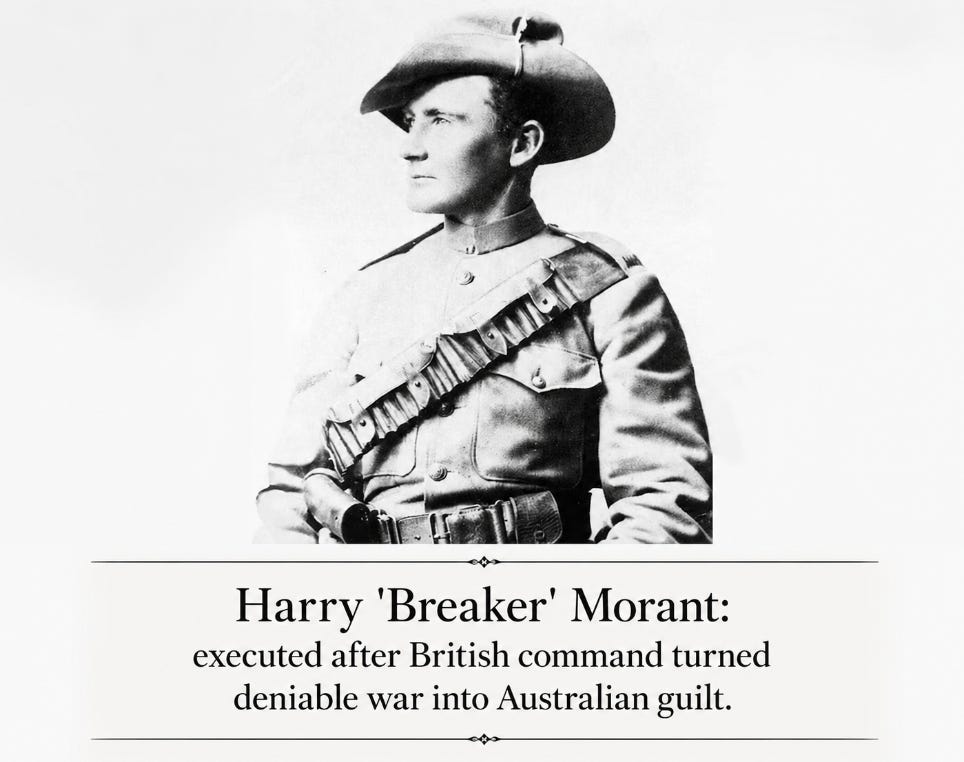
The injustice in Breaker Morant is not hard to feel. The difficulty begins when the case is confined to the courtroom, as if the Boer War had not already shaped the conditions in which the alleged crimes occurred. Charges were laid. Evidence was heard. Findings were entered. Harry “Breaker” Morant and Peter Handcock were shot. George Witton was imprisoned. The formal architecture of law was present. That is not the same thing as justice.
The Boer War had already become an immoral war against farmers, families, farms, and civilian endurance. It was fought through scorched earth, concentration camps, irregular pursuit, reprisal, and the hardening logic of counter-guerrilla command. Prisoner executions were not an isolated shock suddenly discovered at Fort Edward. They belonged to the wider degradation of the war. The system had dirtied the field before it selected the men who would pay for the dirt.
This is why the case cannot be understood as a small colonial murder trial. It was a war-machine case before it was a court-martial case. The wider pattern examined in The War Machine: Strategic Intent and the Persistence of Conflict applies directly here: war systems acquire incentives, methods, reputations, and a need for continuity. The Boer War had developed its own machinery. Farms were burned. Civilians were caged. Irregular units were formed because ordinary methods were no longer considered sufficient. Once war becomes a system, conduct that would otherwise appear exceptional becomes operationally useful. The real moral question is whether the men punished at the end were the authors of the policy or the expendable residue of it.
Kitchener must therefore remain at the center. He was not a remote clerk confirming paperwork. He commanded the war. He presided over the late stage of a conflict that had moved into guerrilla conditions, irregular pursuit, farm destruction, camps, and reprisal. He knew why units like the Bushveldt Carbineers existed. They were not raised for parade-ground warfare. They were irregular mounted men placed into a hard district to do hard work. Their usefulness lay partly in their distance from clean official language. A written order leaves a signature. A field understanding leaves a result.
Morant’s defence rested there. He did not merely say he was angry after the death and alleged mutilation of Captain Hunt. He said he believed he was acting under orders, or under a settled command understanding: prisoners were not to be brought in. That is the point the imperial frame cannot safely admit. If the war had produced a working rule that prisoners were not to be taken, the men in the field were not operating outside the system. They were operating inside the system as it actually functioned.
The British method was to cut the field act away from the command environment that produced it. Ambiguity served command while action was needed. It was denied when review became dangerous. The instruction was clear enough to be obeyed and vague enough to be disowned. It travelled downward as expectation, instruction, and military culture. It travelled upward as deniability.
This was risk without owners in imperial form. As developed in Risk Without Owners: How Modern Systems Distribute Consequences, decision authority may remain concentrated while exposure is pushed outward. Kitchener’s command worked that way. The men directing the war did not stand where the consequences landed. Risk moved to irregulars, colonial soldiers, and men in the bush who could be isolated after the fact. The decision center remained protected. Command kept authority without reciprocal exposure.
That is why “following orders” cannot be dismissed with the ordinary legal formula. Yes, an unlawful order is not cleansed merely because it comes from a superior. But that principle becomes evasive when applied only downward. It permits command to say the soldier should have recognized illegality while leaving untouched the authority that created the unit, shaped the district, tolerated the practice, and made prisoner-taking operationally inconvenient. The subordinate is expected to possess a legal clarity that headquarters deliberately avoided recording.
If the court-martial was truly an inquiry into the morality of killing prisoners during irregular war, why were Kitchener and his staff not on trial?
Morant, Handcock, and Witton could answer for what they did at Fort Edward. They could not answer for the war policy that formed the Bushveldt Carbineers, transmitted deniable expectations, rewarded severity, and preserved official innocence above the field. A proceeding that tries the hand while excluding the head is not an inquiry into responsibility. It is a barrier against responsibility rising.
The contrast with Captain Alfred Taylor makes the selection visible. Taylor was not peripheral. He was the British intelligence officer in the district, close to irregular command, close to information flow, and far better positioned than the Australians to know how orders, permissions, and field understandings moved between headquarters and the Spelonken. If the proceeding was truly concerned with prisoner killing, Taylor should have been central. Instead, the charges against him were dismissed. Morant and Handcock were executed. Witton was imprisoned.
That distinction cuts through the fog. Taylor pointed upward. The Australians could carry guilt downward. The British intelligence officer who knew too much about the command environment walked away. The Australians, treated as colonial instruments rather than protected imperial insiders, absorbed the moral cost of the war.
This is the logic of controlled accountability. As argued in The Sacrificial Prince: Institutional Survival Through Controlled Accountability, institutions under legitimacy pressure do not always suppress accountability. Sometimes they select it. They allow a controlled loss large enough to restore moral appearance and small enough to protect the surrounding architecture. Morant and Handcock were not sacrificed because the Empire had suddenly discovered moral law. They were sacrificed because the war’s real law had become too visible. Their deaths made the loss appear serious while keeping the command structure intact.
The court’s own recommendation to mercy makes Kitchener’s act harder to soften. Witton reproduces court documents showing that mercy was recommended for Morant in the Visser case and for Morant, Handcock, and Witton in the Eight Boers case. Kitchener rejected mercy for Morant and Handcock while commuting Witton’s sentence to life imprisonment. On 25 February 1902, Kitchener confirmed death. On 26 February, the sentence was promulgated. On 27 February, Morant and Handcock were shot in Pretoria.
That is the evidentiary core. Kitchener’s private thoughts do not need to be guessed. The court heard the case and recommended mercy. Kitchener chose death. Within roughly forty-eight hours of his confirmation, two Australians were dead.
The conflict of interest is obvious. The defence had placed orders, field practice, irregular warfare, and command environment at issue. The final gatekeeper of mercy was the commander whose system was implicated. Kitchener was deciding not only whether two men would live, but whether the question of command responsibility would remain alive. Mercy would have preserved the problem. Execution closed it.
Then came the detail that should never be treated as minor. When reprieve was sought, Kitchener was said to be away on trek. Witton records that Morant’s petition received the answer that Kitchener was unavailable, that no hope of reprieve could be held out, and that the sentence was irrevocable. Handcock’s letter was returned without acknowledgment. The man available to confirm death was unavailable when death was challenged.
That is not meaningful review. It is finality dressed as process. Kitchener could condemn. He could not be reached to reconsider. The court could recommend mercy. It could not grant it. Major Thomas could seek time. Time was not given. If appeal existed in theory, it was killed by speed.
The due process failures were not decorative flaws. They were the mechanism. The defence rested on orders and command practice, yet the implicated commander controlled mercy. The men had no meaningful interval for review before execution. The proceeding had barely begun in the Eight Boers case when the prosecutor and two members of the court were replaced, with no settled explanation in the surviving accounts. In a capital court-martial involving irregular war, alleged orders, and command responsibility, unexplained changes in the personnel judging and prosecuting the case should not be waved away as administrative noise.
The Australian War Memorial’s account captures the central injury. It accepts that the officers on the courts-martial appear to have acted honestly and fairly, even if their findings remain debatable. The deeper problem sat above the court: Kitchener ignored the mercy recommendations, confirmed the death sentences, and then found it necessary to lie and mislead the Australian Government and people about the affair.
That distinction matters. The court was not necessarily the deepest source of the injustice. The deeper injustice was the command authority that rejected mercy, controlled finality, and managed the political explanation after the executions.
Kitchener was brave with other men’s lives. That is the sentence his reputation cannot easily survive. He commanded a war that required irregular methods, permitted deniable practice to operate in the field, and then confirmed death sentences against men accused of carrying out that war’s logic. The court recommended mercy. Kitchener chose death. The legal form does not cleanse the moral fact.
The trial record should be treated with the same severity. It is often said that the records were lost. That word is too passive. If the proceedings were sent home to England, then the record entered imperial custody. It did not disappear from a battlefield tent. It entered the archival body of the state. The essential fact is custody followed by unavailability. Britain held the record and later could not, or would not, produce the record needed to test the convictions. A state cannot execute men, control the record by which the executions could be reviewed, fail to produce that record, and then treat the absence of the record as a reason not to revisit the case.
The later refusal to correct the case continues the same pattern. Britain controlled the trial, the mercy decision, the executions, the record, and the later terms of correction. That is not historical finality. It is institutional evasion sustained across time.
Australia should not have accepted it.
Morant, Handcock, and Witton were Australians serving under British imperial command. They were not merely imperial personnel absorbed into a British administrative file. They were Australian soldiers placed inside a British command structure, tried under that structure, and punished after a process in which British command responsibility never became the central issue.
If Kitchener ignored mercy recommendations and misled the Australian Government and people, then the case is not only British legal history. It is an unresolved Australian injury. Australia was entitled to the truth then. It remains entitled to the truth now.
Australia may not hold the formal power to erase an imperial court-martial conviction entered under British authority in 1902. But Australia does not need British permission to judge what happened to its own soldiers. It can conduct an independent legal review, make findings on procedural fairness, command responsibility, missing records, Taylor’s acquittal, and the denial of meaningful appeal, and then require Britain to answer. Britain made them scapegoats. Australia should not have left them there.
George Witton’s title, Scapegoats of the Empire, remains the cleanest description. A scapegoat is not necessarily absent from the event. A scapegoat carries a burden that belongs to the institution selecting him. He is marked, isolated, and expelled so the larger body can remain clean. That is what Morant and Handcock did for Kitchener’s war. Their deaths converted imperial violence into individual crime.
This does not require sentimental treatment of Morant. The point is not that he was gentle, flawless, or incapable of harsh action. That defence would weaken the case. The point is that the proceeding was morally incomplete because it isolated the act from the command system that made the act intelligible. Morant was not executed because Kitchener stood outside the violence of the Boer War. He was executed because Kitchener stood above it, benefited from it, and then required others to die where command responsibility should have stood.
The pattern did not end in South Africa. Institutions under pressure still do this. They create environments where boundary violations become useful. They preserve formal language that denies those violations as policy. When exposure arrives, they isolate the lowest actor capable of absorbing public blame. The correction is visible. The architecture survives.
Kitchener’s defenders need him to remain abstract: the organizer, the hard strategist, the necessary imperial man. Morant and Handcock return him to the concrete. They show what Kitchener’s command meant when translated into human terms: men sent into deniable conditions, judged by the authority that created those conditions, and killed when mercy would have kept the question of orders alive.
Breaker Morant remains powerful because it shows law being used as imperial purification. The executions did not cleanse the war. They concealed it. They allowed the Empire to appear lawful by killing men who had acted according to the Empire’s unspoken law.
The final injustice is not only that Morant and Handcock died. It is that they died in place of the truth. Their execution allowed Kitchener and the imperial command structure to remain above the field they had created. It turned deniable orders into private guilt. It allowed irregular war to be remembered as individual excess rather than command policy.
Morant and Handcock were not executed because they misunderstood the Empire. They were executed because they understood it too well. They acted within the real logic of a deniable war, and Kitchener sacrificed them so that the logic itself would not have to stand trial.