

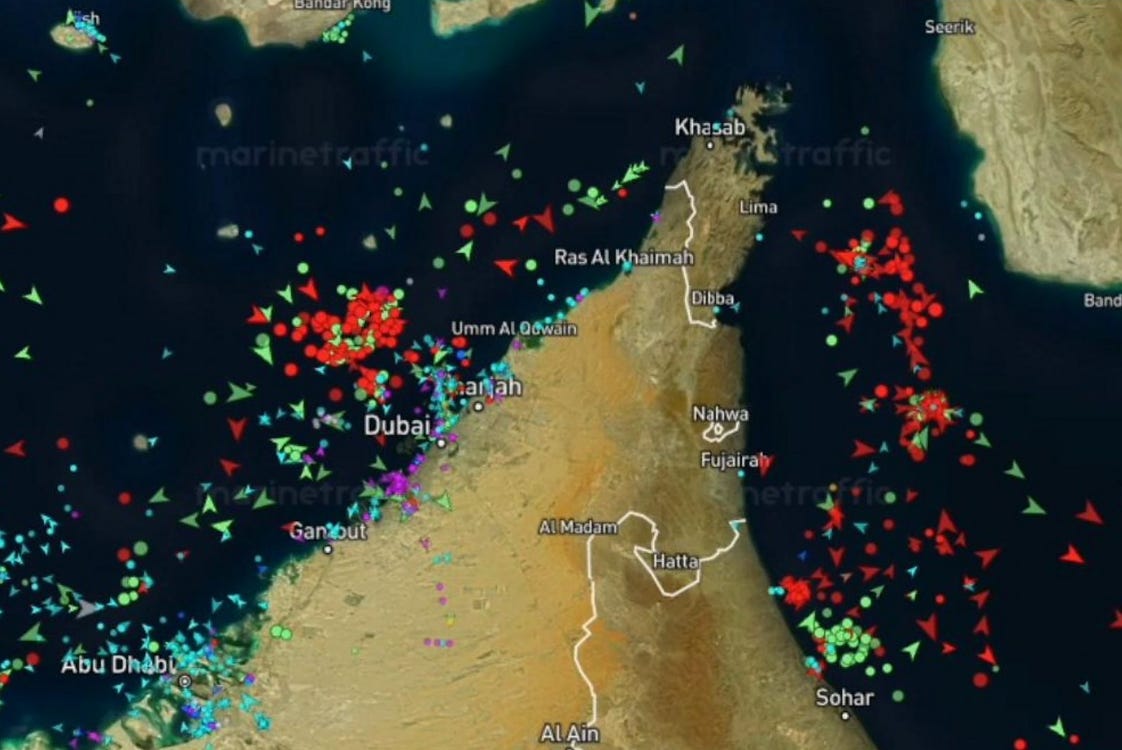
Modern energy systems appear global and diversified, but their physical infrastructure is concentrated in a small number of critical chokepoints. Beneath the language of markets, resilience, and supply flexibility lies a set of narrow physical corridors through which a large share of the world’s energy must pass. Few locations illustrate this dependence more clearly than the Strait of Hormuz.
The Strait of Hormuz is a narrow maritime passage connecting the Persian Gulf to the Gulf of Oman and the wider Indian Ocean. At its narrowest navigable point the shipping lanes are only a few miles wide. Through this confined corridor flows roughly twenty million barrels of oil each day, along with a large portion of the world’s liquefied natural gas exports. No other maritime passage carries a comparable share of global oil supply. A substantial share of modern industrial activity therefore depends on uninterrupted transit through a passage that can be crossed in a matter of hours.
This concentration exists because geography offers few alternatives. The largest oil and gas exporters of the Persian Gulf—Saudi Arabia, Iraq, Kuwait, Qatar, the United Arab Emirates, and Iran—export primarily from terminals located inside the Gulf basin. Tankers carrying those exports must pass through the Strait of Hormuz before reaching open ocean routes. Pipelines that bypass the corridor exist, but their capacity remains small compared with the volumes that transit the strait daily.
The result is a structural vulnerability. A global industrial system depends on a narrow maritime channel whose disruption would remove a significant share of daily energy supply from world markets. Even partial interference with tanker traffic would be enough to produce substantial effects. Energy markets react not only to actual shortages but to credible risk of interruption. Insurance premiums rise, shipping slows, and prices respond long before physical supply disappears.
For this reason the Strait of Hormuz is often described as the most sensitive location in the global energy system. Its importance is not merely commercial. It is systemic. When a large portion of energy supply passes through a corridor only a few miles wide, instability in that corridor carries consequences that extend far beyond the immediate region.
This reality becomes particularly important when military conflict is proposed in the vicinity of the strait. Public discussions of war typically focus on stated political objectives—deterrence, punishment, regime change, or enforcement of international norms. Those objectives dominate the early framing of the conflict.
Yet historical experience suggests that large states with internal security depth, extensive regional networks, and hardened infrastructure are rarely transformed quickly through external intervention. Political outcomes such as regime change are uncertain and difficult to sustain even when initial military operations succeed. Other consequences, however, are far more predictable.
War in the vicinity of the Strait of Hormuz would immediately place global energy flows under threat. Tanker traffic would face elevated risk. Shipping insurers could withdraw coverage or sharply increase premiums. Commercial operators might delay transit until conditions stabilized. Even intermittent disruption could remove substantial volumes of oil from global markets.
The resulting economic effects would propagate rapidly. Oil price spikes increase transportation costs, raise manufacturing expenses, and affect electricity generation and agricultural inputs. Energy shocks historically precede broader economic instability because energy remains a foundational input across industrial systems.
In this sense, geography converts a regional conflict into a global economic event. The narrowness of the corridor ensures that instability interacts directly with energy flows. A conflict framed around political objectives may therefore generate consequences that arise primarily from the physical structure of the system itself.
Understanding that structure requires looking beyond official descriptions of events and examining the pattern of outcomes that follows them. When institutional responses consistently reinforce a particular trajectory—through policy alignment, incentive shifts, and long-term commitments—the resulting direction becomes visible through the structure of the response rather than through the language used to describe it. The analytical method for examining that pattern is described in Strategic Intent Analysis: Inferring Direction Through Structural Convergence.
The persistence of conflict despite uncertain political outcomes is examined further in The War Machine: Strategic Intent and the Persistence of Conflict, which explores how institutional incentives can sustain wars long after their stated objectives become implausible.
Energy systems themselves provide the deeper structural context. As explained in Energy Sovereignty: The Precondition for Freedom, control over energy supply is often the foundation of political autonomy. States that cannot reliably secure energy flows operate under external constraint regardless of their formal sovereignty.
Infrastructure disruptions reveal the same principle. The destruction of Nord Stream demonstrated how energy systems can be altered in ways that permanently reshape geopolitical relationships, a pattern explored in Nord Stream and the Discipline of Reality.
The Strait of Hormuz represents the most concentrated expression of these dynamics. A narrow maritime corridor carries a large share of the world’s energy supply. The global economy depends on uninterrupted passage through that corridor, yet it lies adjacent to one of the most politically volatile regions in the international system.
This combination of geographic concentration and geopolitical tension creates a permanent structural risk. The strait functions not merely as a shipping route but as a pressure point within the architecture of global energy.
Understanding that structure clarifies the stakes of instability in the region. The significance of the Strait of Hormuz does not lie only in the ships that pass through it, but in the fact that modern industrial civilization depends on them continuing to do so without interruption.