

This essay is part of William J. Teesdale’s Strategic Intent Analysis archive at strategicintentanalysis.com. The method is simple: begin with what is observable, then test the story against the structure beneath it.
Europe remains sovereign in law. Its states retain constitutions, parliaments, elections, courts and governments possessing every formal attribute of independence. Yet sovereignty is measured by something more consequential than institutional form: whether a state can make important decisions contrary to the wishes of another power and endure the consequences. Across war, energy, finance, military command and increasingly technology, the range of decisions Europe can make independently has steadily narrowed. The resulting structure is becoming difficult to describe as an alliance of sovereign equals. It is better understood as a modern feudal order.
Feudal systems do not require the superior power to administer subordinate territories directly. Their defining feature is hierarchy. The superior power provides protection, access and membership within a larger order. Lesser powers govern themselves internally but owe strategic allegiance and material contribution in return. Their independence remains substantial until they attempt to exercise it against an important interest of the superior power. At that point the hierarchy reveals itself.
That increasingly describes the relationship between the United States and Europe. Washington supplies the dominant Western military architecture, nuclear protection, strategic intelligence, financial access and critical military technologies. European obligations appear not as oaths of fealty but as defense expenditures, basing rights, sanctions compliance, weapons procurement, intelligence integration and alignment with American strategic priorities.
NATO provides the clearest institutional expression of the relationship. The Supreme Allied Commander Europe is traditionally an American officer who simultaneously commands United States European Command. The military organization established to defend Europe therefore operates under an American commander as a permanent structural feature. The arrangement originated under the exceptional conditions following the Second World War, when Western Europe was exhausted and American military power indispensable. What began as protection gradually became structure. European governments allowed strategic capacities to become embedded inside an Atlantic architecture because Washington supplied capabilities Europe otherwise would have had to maintain independently.
Dependence then became self-reinforcing. Europe required American protection because it lacked independent strategic capacity, while American protection reduced the apparent need to develop that capacity.
The material obligation has become increasingly explicit. NATO members have committed themselves to spending 5 percent of GDP annually on defense and defense-related requirements by 2035. European governments are reorganizing national budgets around a security architecture whose highest operational military command remains American. The modern vassal does not supply horses and grain. It increases military expenditure, hosts forces and purchases weapons from the strategic system from which protection is received.
The hierarchy becomes clearest when a subordinate state refuses. During the American war with Iran in 2026, several European allies denied Washington basing or overflight rights connected with the conflict. Washington publicly criticized those states and reconsidered aspects of the American military presence in Europe. The states retained the legal power to say no, but the exercise of sovereignty carried consequences imposed by the power supposedly providing protection.
Finance produces the same hierarchy without military force. American secondary sanctions can impose severe consequences upon foreign companies and financial institutions for transactions conducted outside the United States between actors who may be acting lawfully within their own jurisdictions. Practical enforcement comes through American influence over banking access, dollar clearing, correspondent accounts, property and markets. A European government may legally permit an activity while companies under its jurisdiction decline to undertake it because another sovereign controls infrastructure upon which international commerce depends.
This is economic suzerainty. Europe may declare an independent foreign policy, but practical behavior can still be determined elsewhere. Sovereignty remains visible in law while obedience is produced through dependency.
Energy exposes the problem at its foundation. As Energy Sovereignty: The Precondition for Freedom argued, almost everything of economic significance depends upon energy. Production requires energy applied to matter; logistics requires energy to move it. Industrial capacity depends upon supply that is abundant, reliable and predictably priced. A state unable to secure those conditions eventually loses the material ability to withstand external pressure even while its formal constitutional authority remains intact.
Energy therefore sits beneath political sovereignty rather than beside it. Once control over energy is externalized, industry becomes vulnerable, trade becomes conditional and political choices acquire costs determined by whoever controls the available alternatives.
For decades Germany and continental Europe obtained enormous quantities of inexpensive Russian pipeline gas. The relationship was geographically natural and economically complementary. Russia possessed energy; Europe possessed capital and industrial capacity. Nord Stream strengthened that relationship by connecting Russia directly with Germany beneath the Baltic Sea and preserving an economic connection between Europe’s industrial center and the Russian resource economy.
That arrangement reduced American leverage. A Germany obtaining inexpensive Russian energy possessed a powerful material interest in stable relations with Moscow, while Russia had a corresponding interest in economic integration with Western Europe. Nord Stream represented more than gas infrastructure. It preserved strategic optionality: a physical mechanism through which two major parts of Europe could maintain a relationship that did not require Washington’s permission.
Nord Stream and the Discipline of Reality developed precisely this point. As long as the infrastructure existed, Europe retained an alternative future. Governments could impose sanctions or suspend flows, but political change, negotiation or economic necessity could restore the relationship. The pipeline itself constrained escalation because it made reversal physically possible.
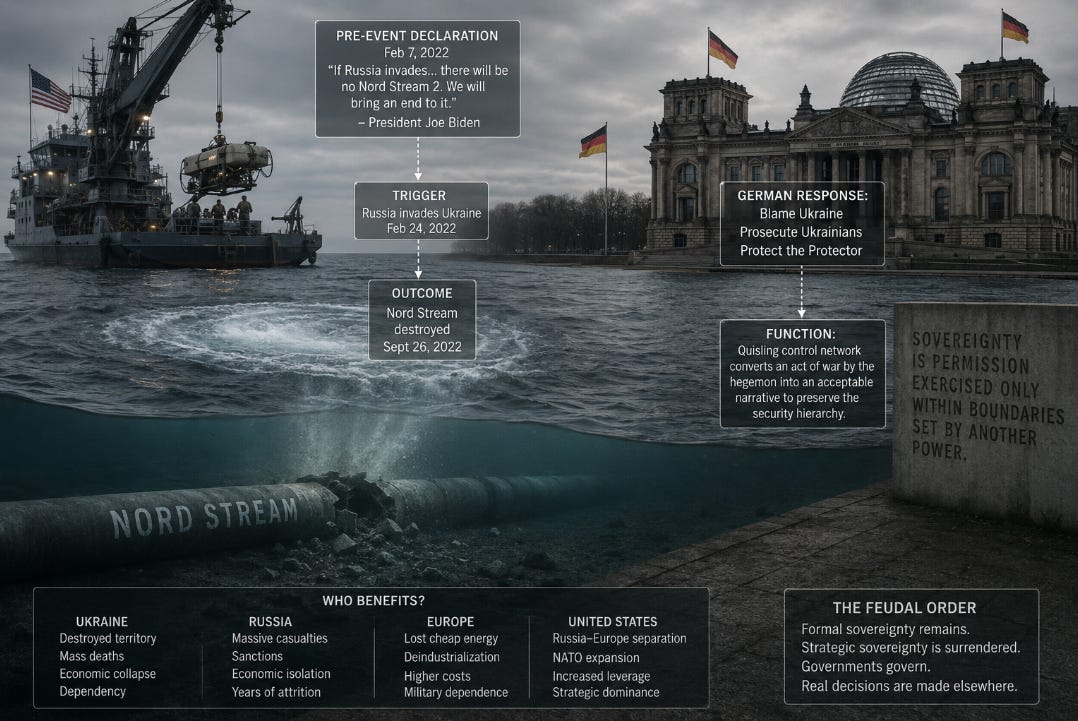
The United States opposed Nord Stream for years. On February 7, 2022, President Joe Biden stood beside German Chancellor Olaf Scholz and announced that if Russia invaded Ukraine there would no longer be a Nord Stream 2 and that “we” would bring it to an end. When challenged that Germany controlled the project, Biden did not retreat into diplomatic qualification. He expressed complete confidence that the United States possessed the means to accomplish the outcome he had just described.
That statement is central because it preceded the event. Biden identified the triggering condition, the intended result, the actor speaking in the first-person plural and confidence in the means available to achieve it. Russia subsequently invaded Ukraine, and Nord Stream was then physically destroyed.
The United States destroyed Nord Stream.
Seymour Hersh’s reporting did not create that conclusion. It supplied operational detail to a strategic attribution already visible from pre-event intent, longstanding motive, capability, access and the outcome eventually produced. His account described an American state operation using specialist naval capability, allied assistance, explosives placed during a military exercise and subsequent remote detonation. It explained how the announced result could have been physically accomplished.
Hersh’s reporting also served another function. It allowed responsibility for the operation to become knowable without requiring official acknowledgment. A detailed account could circulate widely enough that governments, intelligence services and serious observers understood what had occurred while Washington retained formal deniability. Capability was demonstrated, a boundary was enforced and a warning was delivered without the diplomatic consequences an official admission would have produced.
The reported Truss communication after the destruction fits the same pattern as supporting evidence, although the attribution does not depend upon it. The decisive convergence was already visible: Washington had sought the elimination of Nord Stream, the American president publicly announced that it would disappear if Russia invaded, he stated that Washington possessed the means to ensure that result, and the triggering condition was followed by the promised physical outcome.
The later German attempt to attribute the operation to Ukraine does not explain any of this.
The sequence is particularly revealing. The Ukrainian-yacht narrative appeared publicly after Hersh attributed the destruction to the United States. Hersh then explicitly identified the emerging story as a U.S.-German intelligence cover operation intended to divert responsibility from Washington. German prosecutors subsequently spent years converting substantially that narrative into warrants, arrests and indictment.
Under Strategic Intent Analysis, the resulting prosecution cannot simply be treated as an independent evidentiary chain validating the very narrative whose origin and institutional function are in question. The German state is part of the system being analyzed. Its prosecutorial output must therefore be assessed in relation to the incentives and structural constraints operating upon that state.
The German account still cannot explain Biden’s pre-event declaration. It cannot explain years of American opposition to Nord Stream, why the President of the United States publicly promised its termination, or why its destruction produced precisely the irreversible strategic result Washington had sought. Names, passports, boats and alleged Ukrainian participants do not answer those questions.
The German story is deliberate disinformation, and the prosecutorial process is the institutional mechanism through which that disinformation becomes respectable.
This is precisely the function of the Quisling network examined later in this essay. The subordinate governing apparatus translates the requirements of the hegemonic system into forms that can be processed domestically without challenging the hierarchy itself. German prosecutors do not solve the Nord Stream problem; they make the real problem institutionally disappear. The German state can acknowledge sabotage while avoiding Washington, investigate an attack while preserving the security relationship with the attacker, and prosecute Ukrainians while leaving the Atlantic structure untouched.
The prosecutorial apparatus is therefore not external to the feudal system. It is one of the ways the system reproduces itself.
The destruction of Nord Stream was an act of war against Germany because explosives were used to destroy strategic civilian infrastructure serving Europe’s largest industrial economy. The attack removed Germany’s ability to restore the direct Russian energy relationship upon which important parts of its industrial model had depended. Had Russia secretly destroyed comparable infrastructure carrying Norwegian or American energy into Germany in order to force Berlin toward an economic relationship preferred by Moscow, the act would immediately have been treated as aggression.
Germany’s predicament is that the attacker was also its protector. A sovereign state attacked in such a manner would identify the responsible power, demand accountability and reconsider the relationship. Germany instead required an attribution that allowed the Atlantic structure to survive.
The Ukrainian narrative performs that function perfectly. Berlin can prosecute alleged Ukrainian participants while continuing to host American forces and remain inside an American-led military system. The destruction of strategic national infrastructure is reduced to a criminal proceeding involving individual operatives, and the strategic author disappears from the permissible field of inquiry.
That is the feudal relationship operating through law. Germany suffered an act that profoundly damaged its economic sovereignty and then used its own institutional machinery to protect its relationship with the power responsible for it. Procedure replaced strategic accountability because genuine accountability would have required Germany to behave as an independent state.
The economic consequences followed the principle established in Energy Sovereignty: The Precondition for Freedom. Once the material alternative disappeared, adaptation replaced resistance. Europe lost much of its former cheap-energy advantage. Energy-intensive industry became less competitive, German industrial employment declined and production contracted or moved elsewhere. Europe became more exposed to global LNG markets and seaborne supply while the United States retained abundant domestic energy and gained a structurally more dependent European customer.
Russia simultaneously lost its principal Western European economic relationship. A durable continental accommodation between Russian resources and German industrial capacity became much harder to restore. Washington gained a Europe less capable of reconciling independently with Moscow and more dependent upon the Atlantic system. Strategic optionality disappeared first; practical sovereignty narrowed afterward.
The Ukraine war joins security dependence, energy separation, human destruction and strategic subordination in a single event.
Washington knew the Russian red line. In February 2008 William Burns, then United States ambassador to Moscow and later director of the CIA, sent Washington the cable Nyet Means Nyet: Russia’s NATO Enlargement Redlines. Burns reported that opposition to Ukrainian NATO membership extended widely across the Russian political establishment and warned that the issue could divide Ukraine, produce violence or civil war and confront Russia with a decision over intervention.
Two months later NATO declared at Bucharest that Ukraine and Georgia would become members. Washington therefore possessed unusually precise advance knowledge of the escalation mechanism and continued advancing into it.
For the next fourteen years Ukraine moved progressively toward the Western political and military system while remaining outside the Article 5 protection that actual NATO membership would have supplied. Russia repeatedly identified Ukrainian NATO integration as a security red line. By late 2021 Moscow placed the matter directly before Washington and NATO and demanded that Ukraine remain outside the alliance’s military structure. Washington refused.
Russia invaded in February 2022 after Washington had knowingly sustained precisely the policy its own diplomatic apparatus had warned could produce Russian intervention. Under SIA, that is provocation. Burns established knowledge of the mechanism; Bucharest established persistence; fourteen years of continuing integration established direction; Russia’s final demands supplied explicit warning; Washington’s refusal established choice.
Ukraine occupied the most dangerous possible position inside that strategy. It acquired the risks associated with movement toward NATO without receiving NATO’s collective-defense guarantee. Washington pushed the geopolitical frontier toward Russia while Ukrainians remained physically exposed upon that frontier. When the predictable confrontation became war, Ukraine supplied the battlefield and much of the human material through which the larger contest was fought.
The persistence of the conflict also belongs within the framework developed in The War Machine: Strategic Intent and the Persistence of Conflict. Modern military systems do not require individual officials consciously to desire permanent war. Capability requires justification, industrial capacity requires continuing procurement, political institutions reward preparation and security bureaucracies resist contraction. Once those incentives converge, prolonged conflict strengthens the structures organized around responding to it.
Ukraine demonstrates that mechanism brutally. Each additional year of warfare produced greater military expenditure, expanded procurement, European rearmament, enlarged NATO commitments and deeper institutional investment in confrontation with Russia. Human catastrophe did not result in structural contraction. It produced further mobilization. As security deteriorated, the institutions embedded in the policy that produced the deterioration became more indispensable.
The resulting mortality cannot be understood merely through the remarkably low public figures repeatedly circulated throughout the war. Colonel Douglas Macgregor, a former senior Pentagon adviser with longstanding military and NATO relationships, stated in August 2025 that he had been reliably informed that approximately 1.7 to 1.8 million Ukrainians had been killed on the eastern battlefield.
The wording matters. Macgregor was reporting information reaching him through his network, not presenting a calculation derived from public casualty databases. His professional history gave him access to Pentagon, NATO and military relationships capable of providing information unavailable to the public. SIA evaluates such reporting according to access, specificity, consistency and correspondence with observable conditions rather than treating anonymous sourcing as an automatic reason for dismissal.
The observable demographic conditions deserve considerable weight. Ukraine has spent years confronting severe military manpower shortages while employing increasingly coercive mobilization practices to locate eligible men. At the same time, the civilian economy faces a shortage of working-age labor measured in the millions. Emigration, displacement, injury and mobilization all contribute to that depletion, but collectively they describe a country suffering an immense disappearance of available human capacity. The demographic picture is not remotely consistent with treating the war’s human cost as marginal.
Macgregor’s estimate was already approximately a year old by August 2026. If it is substantially correct, Russian military deaths place combined battlefield mortality above two million even before Ukrainian civilians are counted.
Russian losses belong in exactly the same moral accounting. Russians are Europeans. Political exclusion from the Atlantic system does not change Russia’s geography, history or civilization, and Russian soldiers do not become less human because they wore the opposing uniform. Independent demographic work has placed Russian military deaths in the hundreds of thousands, with additional deaths continuing to enter the record.
Civilian mortality adds another layer that verified public counts cannot fully capture across occupied, destroyed or inaccessible territory. Yuriy Belousov, head of the war-crimes department in Ukraine’s Prosecutor General’s Office, was already estimating in early 2023 that Ukrainian civilian deaths could have reached approximately 100,000, when publicly verified totals remained only a fraction of that number. Years of warfare followed.
Whatever the final accounting, the demographic destruction is already visible. Ukrainians have been killed, wounded and displaced on an enormous scale; the country’s population has scattered and its birth rate has collapsed. Russia has buried hundreds of thousands of men and suffered corresponding damage to families and communities. The dead on either side belong to the same moral category.
The war is a European civilizational rupture rather than merely a conflict geographically located in Europe. Russians and Ukrainians are peoples connected by history, language, religion, geography, kinship and trade. They became the human material consumed by a geopolitical confrontation whose dominant external architect remained geographically insulated from the battlefield.
The governing SIA question is straightforward: who obtained the strategic result?
Ukraine received devastated territory, catastrophic mortality, emigration, demographic collapse, debt and an economy dependent upon continuing external support. Russia suffered enormous military casualties, sanctions, economic separation from Western Europe and years of attritional warfare. Europe lost inexpensive Russian energy, weakened its industrial position, accepted immense new military expenditures and became more dependent upon American security and weapons.
Washington received something different. Russia and Western Europe were separated. Nord Stream disappeared. NATO was revitalized and expanded. European military expenditure surged, dependence upon American military systems increased and the possibility of a durable German-Russian economic accommodation was physically disrupted. Russia was consumed by attritional warfare while Europe increasingly assumed the financial burden of sustaining Ukraine.
Europe therefore finances a war in which Europeans kill Europeans while sacrificing an economic relationship with Russia that materially benefited Europe itself. It spends more on defense because the resulting confrontation makes it feel less secure and then interprets its greater dependence upon American protection as evidence of the alliance’s necessity.
Ukraine has functioned as something close to human tribute within this system. Its population absorbed extraordinary losses, Russian men were consumed alongside them, and European governments supplied money and matériel. The United States supplied the dominant strategic architecture while remaining largely insulated from the destruction occurring on the European continent. A genuine alliance distributes risks and benefits among partners. A hierarchy distributes them according to rank.
The same architecture becomes visible beyond Europe. Energy Scarcity and Strategic Control examined Nord Stream, Venezuela and Iran as sequential elements within an emerging strategy of energy control rather than unrelated geopolitical episodes.
Nord Stream removed the Eurasian energy option connecting Germany and Russia. Venezuela then moved under much greater American influence after Washington removed Nicolás Maduro and assumed a commanding role in the country’s transition. Venezuela possesses immense petroleum resources and had important economic relationships with China, Russia and Iran. Another major energy state was therefore pulled toward the American strategic perimeter.
The following month the United States and Israel initiated war against Iran. American operations were followed by a naval blockade and sustained pressure upon Iranian petroleum exports. Iran mattered not only as a regional adversary but as a major supplier to China. Pressure upon Iranian production and transportation therefore struck an important Chinese energy relationship while sanctions followed the trade through tankers, refiners and financial institutions.
The sequence has consequently become clearer. The Eurasian energy relationship between Russia and Europe was broken. Europe became more dependent upon an Atlantic replacement system. Venezuelan resources moved toward channels Washington could shape. Iranian energy moving toward China came under direct military and financial pressure. The result is increasing American leverage over the energy relationships available both to Europe and to Washington’s principal global competitor.
China gives that structure its larger significance. The United States is constructing a competing system encompassing energy, semiconductors, artificial intelligence, critical minerals, finance and aligned states while attempting to reduce the resources and partners available to the Chinese system.
Pax Silica makes the technological side unusually explicit. It reaches across critical minerals, semiconductor production, advanced manufacturing, compute infrastructure and artificial intelligence. Washington is increasingly requiring participating states to choose between the American and Chinese technological systems rather than participate freely in both.
That requirement is the modern economic equivalent of fealty. Membership provides access to technologies, investment, infrastructure and trusted markets; the price is strategic alignment. A country may remain sovereign in constitutional theory while losing practical freedom to maintain equivalent relationships with competing systems.
China therefore threatens American primacy for a deeper reason than the size of its economy. It is constructing another center of manufacturing, finance, technology, infrastructure and political power. An alternative system gives subordinate states somewhere else to go, and that possibility reduces the leverage created by dependency.
Nord Stream represented optionality in energy. China represents optionality across technology, manufacturing and finance. Independent relationships with Russia, Iran and other resource states create additional room for maneuver. Each alternative reduces the power of the hegemonic center, giving that center a structural interest in limiting them.
The progressive separation of Europe from Russia and simultaneous pressure upon European economic and technological relationships with China therefore belong within the same pattern. The objective is larger than containment of individual adversaries. The emerging system constrains Europe’s capacity to acquire strategic independence from Washington itself.
European populations increasingly perceive the relationship differently from the governments representing them. The governing institutions remain deeply embedded within the Atlantic structure because the reward system operates inside it.
European political and military careers develop through NATO commands, Brussels institutions, Washington relationships, security conferences, policy organizations, consultancies and defense industries. Former officials move into international appointments and private institutions connected with the same architecture. The rewards include money, but the more durable incentives are status, legitimacy, access, prestige and continued membership in the governing class.
An official who translates American strategic requirements into European obligations is treated as responsible and internationally serious. An official who seeks genuine strategic independence must challenge military command, intelligence dependency, sanctions architecture, defense procurement and energy policy simultaneously. One path reinforces the institutions through which elite careers advance; the other threatens them.
This produces a modern Quisling function without requiring an explicit act of treason. The administrator internalizes the assumption that the interests of the Atlantic system and those of his own country are identical. American strategic requirements become European responsibilities, sanctions become allied obligations, weapons purchases become burden sharing and restrictions upon independent economic relationships become collective security.
The German Nord Stream prosecution demonstrates the mechanism in unusually pure form. German prosecutors operate inside the same state structure that cannot acknowledge an American attack without destabilizing Germany’s security relationship with Washington. Their function is therefore not simply to determine who committed a crime in the abstract. The institutional outcome they produce resolves the contradiction confronting the German state: an American act of war against German infrastructure becomes a Ukrainian criminal case.
That is what a Quisling control network is designed to accomplish. It does not require every participant to receive instructions from Washington. The structure selects, rewards and legitimizes outputs compatible with continued subordination while marginalizing outcomes that would threaten the hierarchy. The intermediary institutions then reproduce the preferred order through ordinary administrative, political and legal processes.
The remarkable result is that compliance can present itself as institutional independence. A German prosecutor pursuing Ukrainians appears to demonstrate the vigor of German law while performing an attribution that protects Germany from confronting the power that actually violated German sovereignty. The machinery of the subordinate state becomes the mechanism by which subordination is concealed.
Ordinary Europeans inhabit a different incentive system. They do not receive NATO appointments when defense expenditure rises or gain Washington access when Russian energy disappears. They experience the consequences through higher costs, industrial decline, larger military budgets, reduced fiscal space and greater exposure to war. This difference helps explain the widening gap between European public opinion and strategic policy: populations judge the structure by what it produces, while governing elites experience it from inside the institutions distributing power and legitimacy.
The superior power does not need to administer Europe directly. National governments retain extensive domestic authority while strategic choices operate within boundaries established above them. Elections therefore change parties more readily than they change the underlying architecture. Governments rise and fall while NATO command remains American, foreign bases remain, sanctions structures persist and military dependence deepens.
Germany can suffer the destruction of critical national infrastructure by the state upon which it depends for protection and remain institutionally incapable of confronting that state. That fact reveals the difference between formal sovereignty and strategic sovereignty more clearly than constitutional language ever could.
The arrangement is self-sealing. Genuine European independence would require independent military command, deterrence, intelligence, energy security, financial infrastructure, industrial capacity and technological access. Yet American provision of many of those functions makes independent European alternatives appear unnecessary. Europe relies upon Washington because it lacks autonomy, while continued reliance upon Washington prevents the development of autonomy.
Washington’s behavior within this structure is coherent. A hegemonic power preserves favorable hierarchy by controlling strategic resources where possible, rewarding alignment, imposing costs upon defection and constraining relationships capable of reducing dependence upon the center. The American system is particularly powerful because military protection is reinforced by finance, intelligence, sanctions, technology, energy relationships and market access.
The deeper institutional failure is European. A continent containing hundreds of millions of people, extraordinary wealth, advanced technology and immense industrial capability has retained the ceremonies of sovereignty while surrendering important parts of its practical substance. Europe possesses national governments but limited independent grand strategy, militaries nested inside an American-led command system, companies constrained by foreign sanctions and energy relationships reshaped by strategic objectives formed elsewhere.
The Ukraine war makes the transformation impossible to obscure. Washington knowingly pressed into a declared Russian security red line. Ukraine became the battlefield. Ukrainians and Russians died in enormous numbers while Europe financed continued attrition and severed itself from the inexpensive Russian energy upon which much of its industrial competitiveness had depended. The United States destroyed Nord Stream when that infrastructure preserved Germany’s ability to reverse the separation. Germany then answered an act of war by its protector through a prosecutorial narrative that transferred responsibility to Ukraine. NATO expanded, European military expenditure surged and American strategic leverage over Europe increased.
The same principle now extends into technology, where access to the American system increasingly requires exclusion from the Chinese alternative. Protection requires alignment, access increasingly requires conformity, and defection carries escalating costs. The subordinate state remains formally sovereign until it attempts to exercise sovereignty against an important interest of the superior power.
Europe has therefore lost sovereignty through dependency rather than conquest. The process occurred gradually enough that every individual concession could be described as cooperation, collective security, economic necessity or technological coordination. No single decision abolished independence. Their cumulative architecture did.
A sovereign state determines which wars it supports, whom it trades with, where its energy comes from and how its national resources are used. When another state destroys its critical infrastructure, it identifies and confronts the attacker. A vassal operates within strategic boundaries established elsewhere and, when the superior power attacks it, searches for someone else to blame.
That is the feudalization of Europe: national governments surviving after strategic sovereignty has migrated upward, democratic institutions operating within a hierarchy they cannot readily alter, and sovereignty transformed from an inherent power into permission whose practical value lasts only while its exercise does not conflict with the interests of the hegemon.