

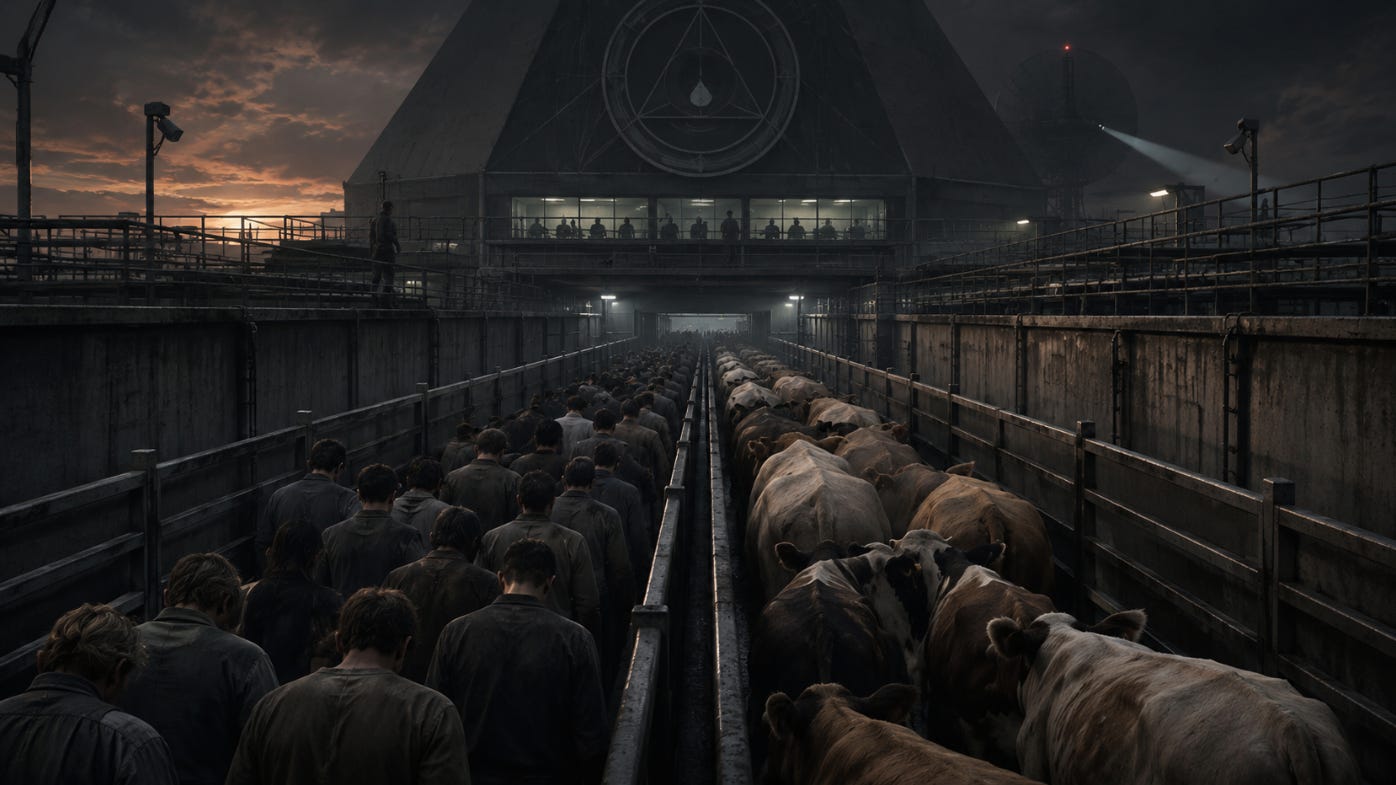
The UFO record contains a biological problem that has never been adequately integrated with the technological one. Human beings do not appear only as witnesses to anomalous craft. Across decades of reports they are abducted, examined, sampled, mutilated, disappeared, or described as biological material. Blood, reproductive organs, tissue, glands, eyes, tongues and internal organs recur. In some accounts, human body parts are sorted and stored. In others, bodies bearing the same distinctive morphology long associated with animal mutilations appear in circumstances difficult to reconcile with ordinary movement to the recovery site.
The usual UFO discussion separates these subjects. Roswell belongs to crash retrieval. Abductions belong to experiencer research. Cattle mutilations belong to ranchers and veterinarians. Missing persons belong to law enforcement. Human mutilations remain at the margins because almost nobody wants to discuss them. Secret agreements belong to another literature again.
Placed beside one another, however, these categories begin to describe something more coherent.
In Deception and UFOs: The 1998 Collins Elite Report Reconstructed, I examined fragments of the reported Collins Report, Deception and UFOs: What We Believe and Why. Its architecture treats the visible phenomenon as presentation rather than identity. One of its central chapters was reportedly titled “The New Mexico Crashes: Trojans.” Other material connects Jack Parsons, L. Ron Hubbard, the Babalon Working, aerospace culture and the New Mexico events of 1947 through titles including Parsons, von Karman and Goddard: A Door Unlocked and New Mexico Origins: Parsons, Hubbard and Babalon Working.
The implication is not that Parsons happened to be an occultist who also built rockets. The Collins interpretation treats his ritual work as potentially connected to an opening or entry point followed by the modern UFO wave. Roswell then becomes an early major manifestation of that wave rather than simply a mechanical accident involving an independently arriving craft. Aztec belongs to the broader New Mexico crash-retrieval sequence that followed, although the surviving Collins material makes the Parsons connection specifically to the 1947 New Mexico events rather than expressly to Aztec.
The conceptual model remains clear. The phenomenon entered the technological world through material events that invited a technological explanation. The military recovered matter, encountered biological material, classified what it found and began treating the phenomenon as an engineering and national-security problem. In the Collins reading, that may have been precisely the intended response. New Mexico became an entry operation. Recovered material functioned as a Trojan by drawing the state toward aerospace secrecy, technological exploitation and the assumption that the visible craft and occupants disclosed the true nature of the intelligence behind them.
As examined in The Collins Elite and the Architecture of Deception, that apparent identity may itself be part of the deception. The Collins framework places modern UFO encounters inside a much older history of attempted contact with non-human intelligence through invocation, altered states and ritual. John Dee called the intelligences angelic. Crowley used ceremonial and Enochian structures. Parsons pursued Babalon within the emerging aerospace world. Modern defense programs use the vocabulary of UAP, consciousness, biological entities and advanced technology. The terminology changes while the underlying act remains recognizable: human beings seek contact with an intelligence they do not control in order to acquire knowledge or power.
That history gives the alleged secret treaty a different meaning. It would not necessarily represent diplomacy with the beings physically presented to human officials. It may instead represent the point at which elements of the national-security state attempted to formalize a relationship with an intelligence that had already entered through a deceptive frame.
The treaty literature varies over dates and names, but its central bargain is remarkably consistent. The arrangement is generally described as the Greada or Grenada Treaty, although the formal name of any actual instrument remains uncertain. The important feature is the exchange attributed to it: advanced technology in return for tolerance of human abductions subject to limits, including periodic lists of abductees and their return without lasting memory of what occurred.
The agreement record is broader than any single 1980s or 1990s UFO network. Gerald Light’s 1954 account concerning Muroc, later Edwards Air Force Base, belongs to an earlier stream of claims involving high-level official confrontation with the phenomenon. The later Lear, Cooper, Bennewitz and related accounts overlap and should not be counted as wholly independent confirmations merely because several names repeat similar information. But the agreement question extends both before and after that network, culminating in modern whistleblower allegations concerning classified agreements, treaty-like executive instruments and restraints operating outside ordinary congressional control.
The purpose here is not to establish the exact date, title or wording of one specific treaty. That is a separate inquiry. The question is what follows if the recurring agreement tradition is substantially correct and biological access to human beings formed part of the bargain.
John Lear’s 1987 account is unusually explicit on that point. Lear wrote that government representatives entered a deal in which technology would be provided while officials ignored an ongoing abduction program. The government supposedly required lists identifying the people being taken. He then described the arrangement deteriorating: many more people were allegedly being abducted than appeared on the official lists, the activity extended beyond simple monitoring, and some missing children were said to have been used for secretions and other biological material. Lear also preserved Paul Bennewitz’s conclusion that those who made the agreement had applied human logic to something operating by another logic and had thereby walked into a trap.
The alleged sequence supplies a functional structure against which the wider record can be examined. Human officials believe they have negotiated limited access. They receive technology. The other party gains access to people. Lists are required and limits imposed. The limits are then violated, more people are taken than acknowledged, and biological extraction appears inside the same narrative. By the early 1980s, according to Lear’s version, those responsible understood that the relationship had gone badly wrong.
The human-mutilation record becomes difficult to separate from that sequence.
One of the earliest and most direct cases attributed to the phenomenon is the 1956 Jonathan Lovette incident at White Sands. According to Bill English’s account of material he associated with a classified Grudge/Blue Book report, Major William Cunningham saw Air Force Sergeant Jonathan Lovette being pulled toward a disk-shaped object while the two men were working at the missile range. Lovette disappeared. His body was subsequently recovered mutilated: eyes removed, tongue missing, anus and genitalia excised with apparent surgical precision, and the body reportedly drained of blood.
English later described something still more disturbing from his own Vietnam-era service. In 1970, he said, his Army team was sent to locate a B-52 that had gone down in Laos or Cambodia. The aircraft appeared unusually intact. Inside, the crew remained strapped into their seats with injuries resembling the later human-mutilation pattern: eyes and ears missing, tissue stripped from the jaw, and rectal excision. English said photographs were taken. Years later, while working as an NSA data analyst at RAF Chicksands, he claimed to have encountered those same photographs inside Grudge/Blue Book material along with other human-mutilation cases.
Leonard Stringfield supplies one of the most important accounts in the field. Stringfield described information given to him by a high-ranking Army officer whom he had known for years. The officer claimed that during a Special Operations mission in Cambodia his unit encountered non-human beings engaged in something far more specific than merely standing near dead humans: they were sorting human body parts and sealing them into large containers. A firefight followed. According to the officer, the soldiers were later detained and interrogated under hypnosis, with substitute memories imposed upon them.
The progression is significant. Lovette describes abduction followed by mutilation. English describes multiple military personnel displaying comparable injuries. Stringfield describes collection, sorting and storage. The activity begins to resemble biological acquisition rather than indiscriminate violence.
The Guarapiranga case in Brazil provides a different evidentiary form because the corpse, police photographs and autopsy findings existed outside an alleged classified military report. A man’s body was recovered near the reservoir in 1988. Extensive tissue had been removed from the face, head and neck; the eyes, ears, tongue and muscles were missing; uniform openings appeared in the arms and torso; internal organs had apparently been extracted through relatively small apertures; genital and rectal tissue had been removed; and remarkably little blood appeared around the wounds. The injuries closely resembled the established animal-mutilation morphology.
That morphology matters more than any single theory about who caused it. The same body regions repeatedly appear in animal cases: eyes, tongue, jaw tissue, reproductive organs, anus, blood, glands and internal organs. Human cases attributed to this field repeatedly display closely comparable removals.
The 1979 Idaho case described by Don Ecker involved a nearly naked man found in remote terrain with sexual organs and lips removed. His bare feet showed no indication that he had crossed the rugged ground, no tracks explained his arrival, and his possessions were found miles away. The surrounding area had a history of both anomalous aerial reports and cattle mutilations. Three decades later, seventeen-year-old Lisandra Hartz Bento was found in Brazil with eyes and lips removed, little blood around the body or clothing, deep rounded punctures around the armpit and pelvic region, and apparent extraction of muscle through one of those openings.
Across cases separated by geography and time, the same biological signature recurs: removal rather than ordinary trauma, repeated selection of particular tissues, remarkably limited blood at the recovery site, and in some cases circumstances suggesting that the body was moved or returned after the biological activity occurred. The question becomes why the same types of biological material appear to be selected repeatedly.
The older treaty literature supplies one possible answer. Lear described abductions involving genetic crossbreeding and later alleged that missing children had been used for secretions and other biological material. Lieutenant Colonel Philip Corso’s material moved in the same direction. Corso described human fluid and tissue sampling, animal mutilations, interference with human and animal genetics and abduction as part of the activity confronting the military. He characterized the relationship itself as something close to a negotiated surrender in which the other side dictated terms because the United States could not effectively oppose it.
Technology, abduction, tissue, genetics and inability to enforce limits all appear inside the same structure. The term harvest begins to describe a function rather than a metaphor.
The possibility that the familiar Grey is manufactured does not originate with the anonymous 2023 EBO microbiologist account. Versions of the idea have circulated for decades, although the sources supporting them differ sharply in evidentiary value. Jacques Vallée provides an important conceptual antecedent rather than a direct biological claim: by 1990 he was arguing that the reported humanoid occupants did not fit the conventional explanation and should not simply be assumed to disclose the origin or nature of the phenomenon. John Lear was much more explicit. In a May 1990 public briefing he described the Greys as cybernetic organisms rather than an independent species, said they worked for someone else, and said they operated under higher direction.
Other material belongs to weaker tiers and should be treated accordingly. Valdamar Valerian’s Matrix II was a self-published, pseudonymous compilation drawing heavily upon the interconnected UFO literature of its period; it is useful here because it preserves an early form of the claim, not because it constitutes independent confirmation. It described smaller Greys as cloned operational workers involved in abduction, examination and biological activity while control remained elsewhere. Nigel Kerner later developed the biological-robot interpretation as a sustained published thesis, while Garry Nolan, a named academic speaking publicly decades later, has discussed the possibility that the beings reported in encounters are biological intermediaries or avatars through which another intelligence operates. These sources are plainly not equivalent, but together they establish that the manufactured-intermediary proposition existed long before the 2023 EBO account.
That changes the significance of the 2023 microbiologist account. The post remains anonymous and cannot establish the proposition by itself. Its importance is narrower and more interesting: it supplies an unusually detailed alleged biological description that fits a much older model. The writer claimed that the recovered Grey-type organisms were engineered constructs with highly specialized physiology and a chimeric genome containing terrestrial genetic material. Cultured cells were also said to respond to fetal bovine serum and bovine growth factors.
The important question is therefore no longer simply whether the Grey is manufactured. It is what follows if it is.
A manufactured Grey would not adequately explain the intelligence behind the phenomenon. It would instead be an instrument: a biological interface capable of operating physically around human beings while leaving its designer, controller or originating intelligence concealed. The body seen by the witness would then be no more definitive of the underlying intelligence than a remotely operated vehicle is definitive of the person controlling it.
That model also provides a possible function for the recurring biological harvest. Older accounts associated with cloned or manufactured Greys already connected their operation with human genetic material, animal tissue, blood, reproductive material and biological collection. The EBO account adds a later alleged biological architecture compatible with those earlier claims. Taken together, the pattern raises the possibility that at least some of the material removed from humans and animals is not incidental to the phenomenon but is used in the manufacture, adaptation, nourishment or maintenance of the organisms through which the hidden intelligence operates.
The precise function cannot presently be determined. Genetic construction, tissue compatibility, nutrition, developmental substrate and reproductive work are all possible models. What matters structurally is that the same record repeatedly places biological acquisition beside beings that may themselves be biologically manufactured.
This has a direct bearing on the Collins interpretation. If the phenomenon manages perception through controlled presentation, the Grey may be one of those presentations. A physical organism gives human investigators something they can examine, classify and understand as an apparently independent being. Its body directs attention toward biology while diverting attention from the more important question of agency: what made it, what directs it, and why does that intelligence not appear directly?
The result is a two-level structure. At the visible level are craft, biological organisms, abductions, recoveries and physical interaction. Behind that level may be an intelligence whose identity remains obscured even from the institutions attempting to study or negotiate with it. The Grey would then function not merely as a worker but as a screen between human beings and the actual principal.
That possibility fundamentally changes the meaning of the alleged treaty. Human officials may have believed they were negotiating with the beings physically presented to them. But if those beings were manufactured intermediaries, the visible counterparty was not necessarily the intelligence controlling the relationship. The officials making the bargain may never have known who—or what—stood behind it.
The alleged failure of the agreement becomes easier to understand in that light. Human institutions applied diplomatic concepts—limits, lists, permissions, reporting requirements and negotiated access—to a relationship whose actual structure they may not have understood. They believed they were defining the terms because they were communicating with a recognizable intermediary. But an intermediary does not have to be the sovereign party. It may simply transmit instructions, conduct operations and preserve distance between the principal and those being managed.
The deepest concealment may therefore concern neither the craft nor the Grey. It may concern the intelligence that deliberately placed both between itself and us.
The missing-person question then becomes more difficult to ignore. The enormous annual number of Americans reported missing is not itself useful because most reports are resolved. The meaningful category is the unresolved residue and, more specifically, the repeated allegation that some victims never re-enter the ordinary civilian death-investigation system.
Lear’s claim concerning missing children is one strand. Another appears in the testimony attributed to an unidentified former Army member associated with a claimed U.S.-led NATO recovery team known as Group 58 Security. He told researchers that he had encountered numerous mutilated human bodies during his service, that a second group known as “The Collectors” removed remains for analysis, and that recovered individuals continued to remain on missing-person lists because local authorities were not informed. He also claimed to have seen human body parts inside a landed craft. A separate British stream associated with Tony Dodd contains the same disturbing allegation: mutilated bodies recovered covertly while the victims remained administratively missing.
These accounts do not establish how many unresolved disappearances, if any, belong to this phenomenon. They identify a possible mechanism by which a real death could remain publicly classified as a disappearance. A serious future inquiry would therefore need to focus not on the headline number of missing-person reports, but on unresolved disappearances whose circumstances intersect with anomalous activity, unusual biological injury, military recovery or known mutilation areas.
Paul Bennewitz sits at an especially revealing junction in this history.
Bennewitz was already investigating unusual activity around Kirtland Air Force Base before Myrna Hansen entered the picture, so Hansen did not create the government’s interest in him. But her May 1980 experience appears to have changed the significance of what he was assembling. Under hypnosis Hansen described an abduction, a cow being taken, an underground facility and human body parts floating in vats.
Hypnotically elicited memory is unreliable as stand-alone evidence; suggestion, reconstruction and confabulation can alter what a subject reports. Hansen’s significance lies somewhere else. Details arising from her account reportedly corresponded closely enough with features of the real Manzano Weapons Storage Complex to attract direct Air Force attention. She was subsequently questioned under hypnosis with an Air Force psychologist, and Richard Doty later remarked upon the specificity of her knowledge, including the appearance of an elevator.
That chronology makes the extraordinary interference with Bennewitz far more intelligible. Air Force counterintelligence did not merely issue a denial or ask him to stop. Fabricated UFO information was deliberately fed into his investigation while his psychological condition deteriorated.
The question is why Bennewitz required that degree of intervention. He had begun with anomalous activity near Kirtland. Hansen then brought him an account linking abduction, cattle, human body parts and an underground facility. Her description unexpectedly intersected with an actual highly classified underground military complex. Bennewitz was therefore no longer merely pursuing lights in the sky. He was moving toward an integrated model connecting the phenomenon’s military, underground and biological dimensions.
My assessment is that Hansen was likely an escalation point in the operation against him. The objective may not simply have been to hide whatever classified technology Bennewitz was observing around Kirtland. The greater danger was that he was beginning to connect categories that depended upon remaining separate. If that is right, the method used against him makes strategic sense: do not merely deny the investigator’s evidence; contaminate the entire field around him until nobody can distinguish discovery from fabrication.
The Collins material is often reduced to the proposition that a religious faction inside the Pentagon decided UFOs were demons. That misses its operational significance. The deeper Collins conclusion was that human actors had attempted contact, sought power from the interaction, believed they were controlling it and eventually concluded that they had been allowed to believe they were in control. Ray Boeche’s sources described efforts to contact and utilize non-human intelligences through methods crossing directly into occult ritual, producing psychotronic effects, weapons research and deaths. Their conclusion was not merely that the intelligence was hostile. It was that the apparent bargain had been a trap.
Within that frame, the secret treaty becomes the institutional version of the same ancient transaction. Ritual contact seeks knowledge or power by opening a relationship with an intelligence beyond ordinary human control. A national-security system does the same thing through classified programs, technical language and negotiated access. One is called invocation; the other is called contact, liaison, treaty or technology transfer. The institutional clothing changes. The underlying exchange may not.
That is why Parsons matters so much. If his work helped open or intensify a channel, and the post-1947 wave followed from it, Roswell did more than announce the presence of something anomalous. It gave the emerging national-security state a technological object around which to organize its response. The question shifted from what had been contacted to what could be obtained from it.
The strategic temptation would have been enormous. A state that believed another intelligence possessed propulsion, energy systems, materials science and biological knowledge far beyond contemporary capability would seek access. The Cold War intensified the pressure: if the United States refused, another power might not. Under those conditions, a bargain allowing a limited number of biological examinations could have been rationalized internally as an ugly but manageable concession.
The defect in that reasoning is obvious from outside the institution making the bargain. The people being abducted did not consent. The officials making the calculation did not bear the biological cost. The technology accrued to hidden state programs while the risk was imposed upon individuals who knew nothing of the transaction.
More fundamentally, the people who supposedly made the agreement may never have possessed the power they imagined they were exercising. The Collins material repeatedly emphasizes asymmetric interaction. The phenomenon presents itself in forms its audience is prepared to accept, supplies narratives about itself, and draws human institutions into relationships whose meaning those institutions misunderstand. The identity suggested by the visible occupants may be one such narrative. The Grey may be another. “Advanced technology in return for limited access” may be another still.
If the counterparty exceeded the agreed number of abductions, failed to provide accurate lists, caused disappearances and engaged in biological activity never contemplated by the human side, then the agreement did more than fail. It revealed who actually controlled the relationship. An agreement is meaningful only when both sides can enforce its limits. A party that receives technology but cannot prevent the other party from taking additional human beings has not negotiated sovereignty. It has accepted dependency.
The state may therefore have mistaken permission for control.
That possibility also explains why the biological side of the UFO issue would require deeper secrecy than the technological side. The United States could survive disclosure that it recovered anomalous craft. It could survive learning that extraordinary propulsion or energy systems had been hidden inside contractors. It could survive exposure of illegal classification, misappropriated funding and decades of deception, although the institutional consequences would be substantial.
Proof that officials knowingly permitted a non-human intelligence access to human beings in return for technology would be categorically different. Secrecy would then be protecting not simply what the government recovered, but what someone agreed to give away.
That is the constitutional and Natural Law problem developed in Agreements with NHI and the Case for Treason. No state owns its people. No President, military service, intelligence agency, classified program or defense contractor possesses lawful title to another human being’s body. Government cannot transfer rights it does not own, and no technological advantage, however transformative, creates authority to convert citizens into consideration.
The people supposedly subjected to the bargain were not collateral belonging to the state. They could not be secretly pledged. If an agreement authorized abduction, biological exploitation or human access without consent, the agreement would be unlawful at its inception because the thing supposedly granted was never government property.
The modern whistleblower record makes the older allegations harder to leave sealed inside historical UFO literature. David Grusch placed recovered non-human biologics, concealed programs and allegations of human harm into congressional proceedings. He was later asked by Ross Coulthart about an internal document referring to agreements that risk putting our future in jeopardy. Coulthart framed those as agreements between the United States and non-human intelligence. Grusch did not reject the premise; he said national leadership needed to get to the bottom of it.
More recently, Grusch has urged openness to a much wider range of possibilities concerning the nature of the phenomenon, specifically including Judeo-Christian theology. He has also suggested that a substantial portion of what is occurring may not fit the conventional assumptions applied to it. That observation is important because it moves the same question raised by the Collins material into the modern whistleblower record: the beings and craft presented to human observers may not disclose the nature or identity of the intelligence responsible for them.
Matthew Brown has separately alleged classified executive orders and agreements, sometimes described as treaties, established without ordinary congressional knowledge and capable of restraining presidential action. These modern claims do not prove the exact terms attributed to older treaty narratives, but they make it difficult to dismiss the entire agreement question as an artifact of one self-referential period of UFO research.
The recurring mutilation record suggests that biological activity is not incidental to the phenomenon. The treaty literature alleges that access to humans formed part of the exchange. Lear explicitly connects excessive abductions, missing children, secretions and body parts. Corso describes fluid and tissue sampling, genetics and mutilation as operational concerns. Lovette presents an alleged abduction followed by precise mutilation. English describes a military crew with comparable injuries. Stringfield describes beings sorting human body parts into containers. Guarapiranga supplies a physical morphology strikingly similar to animal mutilation. Bennewitz and Hansen connect the biological pattern to a classified underground military environment. Decades of accounts and analysis concerning manufactured Greys, followed by the more detailed EBO account, supply a model under which the familiar Grey could itself be constructed from biological inputs rather than representing the intelligence behind the phenomenon. The Collins material supplies the larger interpretive framework in which both technological and biological presentation may conceal the nature of the originating intelligence.
The resulting sequence is larger than a collection of grisly cases. A channel is opened; anomalous manifestations intensify; technological material draws the military into a framework of recovery and exploitation; biological intermediaries encourage the assumption that the visible occupants are the principal intelligence; hidden institutions attempt engagement; technology creates the incentive for a bargain; human access becomes part of the alleged consideration; the supposed limits fail; biological extraction continues; and secrecy protects both the relationship and the identity of the intelligence behind it.
Seen in that sequence, the harvest becomes evidence of what the bargain may have cost, while the existence of the bargain helps explain why the technological Trojan mattered: it drew human institutions into a relationship they believed they could exploit and control.
The UFO question has spent decades asking what technology was recovered, who possesses it and what it can do. Those questions examine only one side of the transaction. If a secret agreement existed, the more important inquiry is what moved in the other direction.
If access to human beings was part of the exchange, then the deepest secret is not simply that government made contact with non-human intelligence. It is that some part of government believed it possessed authority to bargain with human life. And if the Grey was itself an engineered intermediary, those officials may not even have known the identity of the intelligence with which they were bargaining.