

This essay is part of William J. Teesdale’s Strategic Intent Analysis archive at strategicintentanalysis.com. The method is simple: begin with what is observable, then test the story against the structure beneath it.
The recovered-craft question is no longer the interesting part of the UFO problem.
Roswell and the wider retrieval record—including the Wilson-Davis notes, Eric Davis, Admiral Wilson, David Grusch’s sworn testimony concerning specific retrievals and reverse-engineering programs, Robert Bigelow’s claimed personal knowledge of contractor custody, and Lue Elizondo’s refusal to deny involvement in a legacy program—all point in the same direction. The record is larger than any one witness and far larger than the limited examples considered here.
Strategic Intent Analysis does not require the institutions accused of concealing a program to confess before a conclusion can be reached. It examines conduct, capability, institutional architecture, incentive, continuity, selective disclosure, and the repeated direction of outcomes. On that test, the conclusion is analytically clear: the United States has recovered non-human craft or material and placed it inside deeply classified military and corporate programs. Other major powers either possess comparable material or have organized extensive efforts to acquire it.
The conclusion rests on the retrieval record and the institutional architecture built around it, not on whether its custodians choose to acknowledge it.
This essay begins after that conclusion.
The consequential issue is the energy and propulsion system behind the craft, what decades of classified work may already have learned about it, and whether comparable technology could ever be removed from the military and corporate structures that now control it.
A craft capable of extreme acceleration, sustained operation without visible fuel, abrupt directional change, low thermal output, and movement through air and water without recognizable lift or reaction propulsion cannot be understood merely as an unusual vehicle. Its visible performance implies an underlying energy architecture: an extraordinary source of power, an unfamiliar conversion process, a different relationship between matter and fields, or some combination of the three.
The propulsion system and the energy system may ultimately be inseparable. Even if they are technically distinct, the physics that makes one possible may transform the other.
That is why the UFO issue is potentially more important than the confirmation of non-human intelligence. Confirmation would alter humanity’s understanding of itself. Access to the underlying energy technology could alter the material organization of civilization.
It could change electricity generation, transportation, industrial heat, water treatment, agriculture, construction, resource extraction, and access to space. It could weaken dependence on oil fields, gas pipelines, shipping lanes, fuel depots, power stations, and centralized electrical grids. It could make energy available where it is needed rather than where geology, infrastructure, and political permission allow it to be delivered.
It could also produce weapons, surveillance systems, strategic mobility, and forms of military power against which existing defenses would be largely irrelevant.
The technology would therefore enter two systems with overwhelming incentives to control it.
The first is the military-industrial system. Its institutional purpose is to convert technical advantage into strategic superiority. A recovered propulsion principle would be studied first for speed, weapons delivery, concealment, surveillance, logistics, space access, and denial to rivals. Civilian application would be postponed until officials believed military advantage had been secured—or withheld indefinitely if civilian release threatened that advantage.
The second is the incumbent energy system. It consists of producers, utilities, pipeline operators, commodity traders, banks, sovereign states, infrastructure owners, and governments whose revenue and authority depend upon the controlled production and distribution of energy.
These institutions do not need to meet in one room or sign one agreement. Their interests already converge.
A utility has invested billions in centralized generation and transmission. An oil company values reserves according to future demand. A government depends on fuel taxes or hydrocarbon revenue. A bank holds debt secured by energy assets. A pipeline operator requires continued throughput. A commodity trader profits from scarcity, volatility, and geographic imbalance. A military alliance derives leverage from protecting—or threatening—energy routes.
Abundant local energy would destabilize every part of that architecture.
Oil and gas reserves would lose value. Pipelines, refineries, power stations, and transmission networks could become stranded assets. Entire sovereign budgets would be impaired. Banks would confront damaged collateral. Commodity markets built around predictable fuel demand would contract. Industrial geography would change as factories ceased to depend upon existing energy corridors and politically determined energy prices.
The resulting resistance would not require a centrally directed conspiracy. Each institution could act independently according to its own interests and still help produce suppression.
A regulator could require years of testing under rules written for conventional energy systems. A utility could insist that the device connect through infrastructure it was designed to replace. A bank could refuse financing because deployment would undermine assets already securing its loans. An energy company could purchase exclusive development rights and proceed slowly. A defense agency could classify the underlying principle. A contractor could argue that propulsion implications made civilian release a national-security threat.
Different motives would lead toward the same destination: containment.
The military and energy systems also overlap. Energy policy is treated as national security. Defense contractors possess the secure laboratories, materials expertise, clearances, and government relationships needed to receive recovered hardware. Energy corporations intersect with intelligence services, banks, sovereign funds, political institutions, and strategic planning. The organizations most capable of developing a breakthrough are also the organizations most threatened by uncontrolled distribution.
The Intelligence State and the UFO Problem examined what happens when anomalous evidence enters this environment. It ceases to be approached primarily as evidence. It becomes a security object, a technological prize, a foreign-acquisition risk, a classification problem, a witness-management problem, and a source of institutional liability.
A physicist asks what the object reveals about nature. An intelligence organization asks who else possesses it, what military capability can be extracted, which adversaries are working on the same problem, what programs would be exposed, and what historical consequences would follow if the public learned that the material had been held for decades.
The intelligence system manages implications before it explains reality.
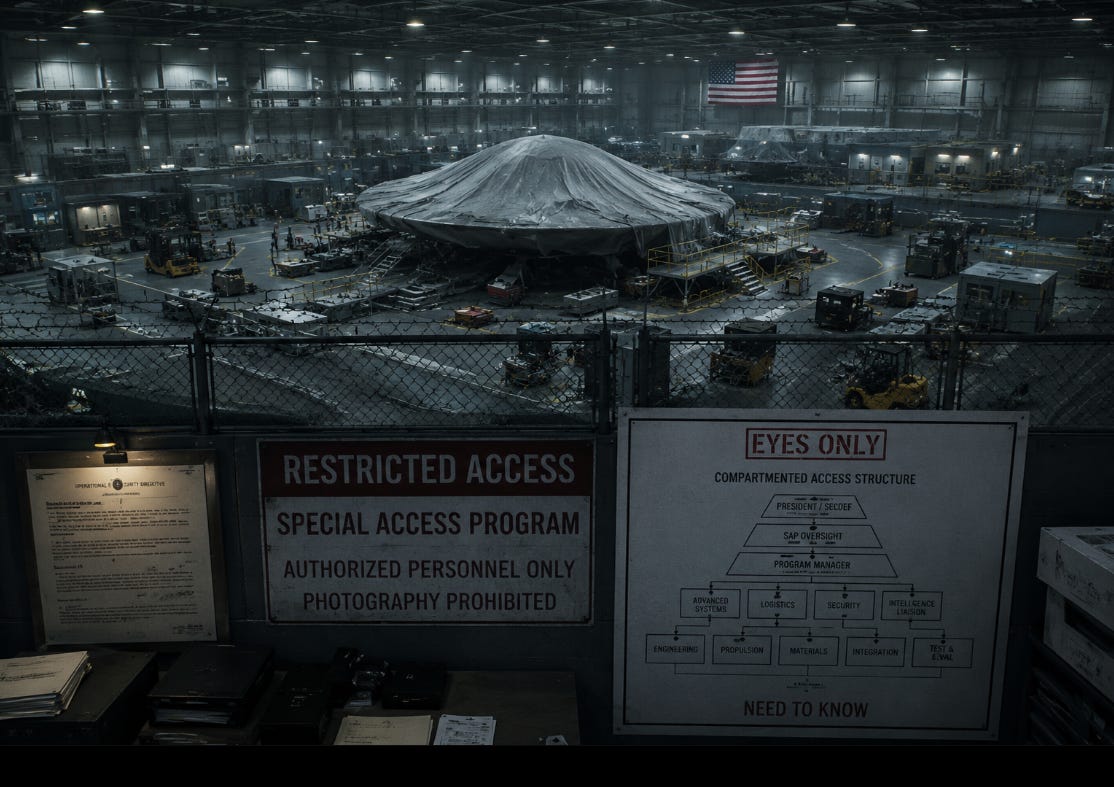
The first institutional capture has therefore already occurred. Recovered material appears to have been transferred into special-access programs, military laboratories, private aerospace facilities, restricted funding channels, and contractor environments designed to prevent ordinary visibility.
That structure is not merely secret. It is fragmented.
As explained in Compartmentalization and the Structure of Classified Power, confidentiality and compartmentalization serve different functions. Confidentiality prevents outsiders from seeing information while allowing the responsible institution to understand the whole. Compartmentalization divides the whole inside the institution itself.
One group studies a material. Another examines an electromagnetic effect. A third works on power conversion. A contractor holds the physical object. A government office manages access. A security team controls personnel. A congressional committee receives a sanitized briefing. Each participant sees enough to perform a task and too little to judge the entire program.
The Manhattan Project demonstrated that an enterprise of enormous scale could operate while most participants understood only their immediate function. Special-access programs refined the model. Clearance no longer guarantees knowledge. Rank does not guarantee access. Constitutional authority does not guarantee visibility.
A president, cabinet secretary, military commander, inspector general, or member of Congress may have formal authority over institutions while remaining outside the compartments where substantive knowledge is held. The decisive hierarchy becomes access rather than office.
A narrow continuity structure can then operate inside the visible state. Its membership is determined by admission to programs, contractor relationships, and inherited access rather than public responsibility. Elected officials arrive and depart. Contractors, security officers, scientists, and program custodians may remain for decades.
Fragmentation also protects individuals from understanding the moral character of the whole.
A scientist tested a sample. A manager administered a contract. A security officer enforced an access list. A lawyer approved a narrow procedure. A contracting officer authorized a payment. Each account may be accurate. None establishes that the integrated program was lawful.
People may suspect wrongdoing while lacking the information needed to name it. Reviewers can approve individual pieces without seeing cumulative consequence. Procedure continues functioning while informed judgment becomes impossible.
This is how oversight becomes ceremonial. Budgets exist. Legal opinions exist. Committees exist. Reporting requirements exist. The paperwork is complete. Almost no one authorized to review it can assemble the whole.
The modern disclosure process has not dismantled that structure. It has adjusted the public narrative around it.
Before 2017, ridicule carried much of the burden. Pilots, military personnel, scientists, and journalists understood that serious attention to UFOs could damage a career. Reports could still be collected internally while the witness absorbed the reputational cost of making them public.
Once military videos, congressional attention, and whistleblower testimony made blanket ridicule unsustainable, the system changed methods. The subject returned to respectable discourse through controlled channels. Hearings were held. Offices were created. Senior officials adopted careful language. UFO became UAP. The public was permitted to know that something serious existed.
The custody structure remained closed.
Disclosure Without Resolution: The UFO Issue as Institutional Containment described this transition from mockery to managed acknowledgment. Disclosure has expanded the permissible discussion without producing an integrated account of recovered material, contractor possession, reverse engineering, historical deception, human injury, funding, or legal authority.
The public story moves while the material structure remains fixed.
This becomes clearer when disclosure is divided into five separate thresholds.
The first is ontological acknowledgment: an admission that non-human intelligence or non-human craft exist.
The second is disclosure of custody: identification of what was recovered, where it went, and which public and private entities held it.
The third is technical disclosure: an account of what was learned about materials, energy, propulsion, biology, or field effects.
The fourth is historical and legal accountability: who concealed the programs, who obstructed oversight, who benefited, who was harmed, and what laws were broken.
The fifth is public access: whether any useful technology is allowed to leave the classified estate and benefit humanity.
A government could cross the first threshold while refusing the remaining four. A president could announce that humanity is not alone while contractor vaults remained closed, the technical data stayed classified, the dead remained unexplained, and not one household received a cheaper unit of energy.
The public could be given metaphysics and denied mechanics.
That would not be disclosure in any meaningful civilizational sense. It would be an admission designed to preserve custody.
Robert Bigelow’s recent intervention illustrates the problem. His claimed knowledge is unusually direct. He says he knows which aerospace companies possess craft and what they hold. He says foreign powers already understand that the United States has retrieval, reverse-engineering, and biological programs. He also proposed amnesty for the institutions and people involved in maintaining the concealment.
Bigelow is not a detached observer. His aerospace interests, government relationships, classified-program proximity, and long involvement in the subject place him inside the institutional field he is describing. His amnesty proposal would likely benefit people or entities within that field and may benefit Bigelow himself.
That does not make his knowledge irrelevant. It makes his proposed remedy self-interested.
Amnesty cannot be the price of disclosure before the public knows what conduct would be forgiven.
Possession of recovered material does not itself establish treason. A contractor may have accepted custody under government direction. Engineers may have performed narrowly compartmented work without knowing the program’s origin or legal status. Officials may have believed secrecy was necessary to prevent foreign acquisition or uncontrolled military use.
But custody begins the inquiry. It does not end it.
The public still does not know who owned the recovered material, whether Congress was informed, whether funds were misappropriated, whether public property became private intellectual property, whether inspectors general were obstructed, whether witnesses were threatened, or whether people were injured or killed.
Grusch placed allegations of human harm and possible murder before Congress. Those allegations make blanket institutional immunity impossible to justify.
Agreements with NHI and the Case for Treason established the necessary distinction between possession and agreement. A recovered craft creates questions of custody, ownership, classification, funding, and oversight. An agreement creates parties, terms, obligations, exchange, enforcement, and authority.
A contractor holding material for the government has not necessarily committed treason. A contractor that knowingly concealed murder, obstructed Congress, suppressed witnesses, or participated in an agreement permitting human harm occupies a different legal category.
The facts must determine the category.
Witness protection and limited immunity may be necessary. An engineer who surrenders records, identifies facilities, and provides truthful evidence may deserve protection. A participant trapped by threats and classification may deserve leniency. A senior official may receive consideration when complete cooperation is necessary to expose the larger program.
That process follows disclosure and investigation. It does not precede them.
Blanket amnesty would allow the custodians to negotiate immunity while they still controlled the evidence. They could reveal selected facts, preserve their technical position, retain patents and personnel, and obtain protection before anyone determined whether the concealed conduct involved lawful custody, theft, obstruction, retaliation, homicide, or agreements affecting human sovereignty.
The institutions that controlled the secret would also control the settlement.
The same capture problem would confront any independent discovery of comparable energy or propulsion technology.
An inventor who approaches the government risks classification. An inventor who approaches a defense contractor risks absorption. An inventor who files a patent may trigger national-security review. An inventor who seeks conventional venture capital will usually be required to consolidate intellectual property, grant board control, and promise investors a defensible monopoly.
The founder may remain the public face of the company while steadily losing the legal power to determine where the technology goes.
The first investor demands equity. The next demands a board seat. The manufacturer demands exclusivity. The insurer demands approved testing. Regulators apply rules designed for older technologies. Government officials invoke national security. A major corporation proposes acquisition. By the time the device has been proved, every agreement surrounding it may already point toward control.
Capture would occur through the development process itself.
The historical record shows the failure modes. The design question is how a second pathway could avoid them.
The answer cannot be immediate publication. A transformative energy device could be dangerous, misunderstood, difficult to manufacture, or inseparable from military propulsion. Releasing incomplete plans would not produce safe abundance. It would produce confusion, fraud, failed replication, and possibly uncontrolled weapons capability.
Nor can the answer be prolonged secrecy inside one laboratory or company. A single inventor can be pressured. A single company can be bought. A single facility can be raided. A single patent portfolio can be classified or acquired. A single jurisdiction can be coerced.
The project would need temporary protection followed by deliberate redundancy.
The first requirement would be independent verification. More than one qualified person would need to establish that the effect was genuine, repeatable, and not the result of measurement error, concealed energy input, or experimental artifact.
The next requirement would be replication outside the originating laboratory. Separate teams, facilities, and equipment would reduce scientific uncertainty while preventing one employer, investor, or government from controlling every working embodiment.
Technical records, test data, material specifications, and manufacturing knowledge would then need protected custody in several jurisdictions. Legal ownership should also be divided so that no single acquisition, court order, classification decision, or physical seizure could extinguish every lawful claim to the technology.
Limited civilian deployment could follow in applications where performance and failure were measurable: stationary power, industrial heat, isolated infrastructure, water production, or other settings that did not immediately distribute the most dangerous propulsion capability.
Public disclosure should occur only after suppression had become impractical. The announcement should describe a technology already replicated, legally protected, and physically embodied in multiple independent nodes—not reveal a solitary prototype waiting to be captured.
This approach creates a path from secrecy to distribution without confusing secrecy with permanent ownership.
The distinction between civilian energy and advanced propulsion may determine the entire architecture.
A stationary power source could benefit households and industry while a related propulsion system might allow objects to move at extraordinary speed, bypass borders, or deliver weapons without interception. Where the two functions can be separated, civilian energy should be distributed far more broadly than militarily sensitive propulsion.
They may instead share a common physical principle while requiring different field geometries, materials, control systems, or components. Civilian manufacturers could then receive the energy application without acquiring every element required for strategic mobility.
The hardest case arises if one compact device inherently enables both. A machine capable of powering a town might also propel a small craft across continents. In that event, neither ordinary commercial licensing nor unrestricted publication would be adequate. Multiple jurisdictions and independent technical custodians would have to prevent any single state from reserving the capability for itself while controlling the pace of civilian deployment.
The choices are therefore wider than total secrecy or total release. Different layers of knowledge can be distributed according to consequence while the underlying energy benefit is moved steadily beyond monopoly control.
A central technical organization would still be necessary. Someone must preserve design integrity, coordinate safety standards, investigate failures, certify manufacturing, and continue development. Without a common technical center, incompatible versions and fraudulent devices would proliferate.
But the center cannot own the future.
Its authority must be divided and legally constrained. No founder, investor, corporation, or government should possess the unilateral power to sell the entire system, close licensing, suppress future deployment, or transfer exclusive control to a military authority. Succession cannot depend upon one person. Essential records and rights cannot sit in one jurisdiction.
The central body would be a custodian of continued development rather than the permanent sovereign of the technology.
A distributed licensing network offers one practical model. Qualified manufacturers in several countries could produce civilian applications while receiving continuing improvements from the common technical center. Their rights would depend upon compliance with safety requirements, honest reporting, non-suppression, nonexclusive distribution, and restrictions on offensive military use.
A participant that attempted to monopolize the system or divert it toward prohibited use would lose future designs, technical assistance, certification, and cooperation from compliant manufacturers.
This becomes meaningful if the technology continues to evolve.
A static invention can be stolen, bought, classified, or frozen. An evolving platform gives the network continuing value. Test results from one manufacturer improve devices across the system. New materials reduce cost. Field experience exposes failures. Later generations become safer and more capable.
A defecting company or state may retain one version. It loses access to the collective intelligence producing the next.
This is a stronger form of enforcement than litigation alone. A court case may take years and may have little effect on a sovereign state. Exclusion from an active technical network has immediate practical consequences.
The central organization must itself remain subject to the same anti-capture principles. It cannot manufacture every component, own every patent, control every laboratory, and collect every payment. Otherwise it becomes the monopoly it was designed to prevent.
Research, manufacturing, legal custody, and commercial deployment should remain distributed. Coordination is necessary. Dominion is not.
Capital will still be required on an enormous scale.
Transformative energy cannot move from a laboratory bench into civilization through good intentions or internet publication. It will require materials research, precision manufacturing, metrology, long-duration testing, safety engineering, certification, security, supply chains, trained technicians, and factories.
Investors and industrial partners must receive substantial returns. They may receive early manufacturing rights, defined commercial fields, royalties, preferential access, and continuing technical advantages. The first organizations willing to assume extraordinary risk should be rewarded accordingly.
Their reward cannot include permanent authority to stop additional licensing or suppress the technology.
The legal architecture must separate economic return from ultimate control. Investment may purchase participation and priority without purchasing ownership of humanity’s energy future.
The distinction matters because abundance threatens systems larger than the energy industry itself.
Modern states govern partly through physical dependence. Fuel supplies, pipelines, shipping lanes, grids, sanctions, and industrial prices determine which countries can act independently. A state that imports the energy required to heat homes, make fertilizer, operate factories, and transport goods remains vulnerable regardless of its formal constitutional status.
Families live inside the same structure at a smaller scale. Electricity and heat arrive through networks they cannot replace. Access is metered. Prices are imposed. Disconnection is possible. Legal ownership of a home does not produce material independence when the systems required to inhabit it remain externally controlled.
Factories close when energy becomes too expensive. Chemical production migrates. Fertilizer plants shut down. Metal production declines. Industrial towns decay because the physical price of production has been moved beyond what the productive economy can bear.
Energy scarcity is therefore more than a market condition. It is a method of governance.
Distributed abundance could weaken that control. It could lower the cost of water, food, transportation, and manufacturing. It could restore productive capacity in countries made dependent upon external fuel. It could reduce the strategic power of pipelines, shipping routes, sanctions, and energy cartels. Communities might regain a level of material autonomy that centralized systems have steadily removed.
Abundance would also disrupt employment, public revenue, pensions, debt, and existing industrial assets. A responsible transition would need to protect people whose lives depend upon incumbent industries without preserving the institutions that manufacture scarcity.
The goal is liberation from extraction, not indiscriminate destruction of those trapped inside it.
No technology guarantees that result. Cheap and abundant power could support local autonomy, or it could power a denser system of surveillance, computation, drones, and automated enforcement. A breakthrough released through military secrecy would strengthen military hierarchy. One controlled by energy incumbents would be metered and rationed. One distributed without safety or governance could produce chaos.
The device does not contain its moral destination within its engineering.
That destination is established by the structure built around it.
The first pathway appears to have placed recovered technology into classified military and corporate custody. It produced compartmentalization, contractor control, managed disclosure, disputed oversight, and allegations of grave human harm.
A second pathway must be built to prevent those institutions from taking it again.
The technology would need to be verified before it was announced, replicated before it became dependent upon one institution, and distributed across enough technical, legal, and geographic nodes that suppression was no longer possible. Capital would need to receive exceptional returns without receiving the power to impose permanent scarcity. Civilian energy would need the widest lawful distribution compatible with preventing catastrophic military use. Secrecy would require a purpose, a boundary, and an end.
No confession from the current custodians is required to understand the problem. Their conduct has already revealed the architecture.
The remaining question is whether transformative energy and propulsion can escape it.
Without an anti-capture structure established before the breakthrough becomes visible, the technology will not overturn the system of military dominance and artificial scarcity.
It will become that system’s most powerful possession.