

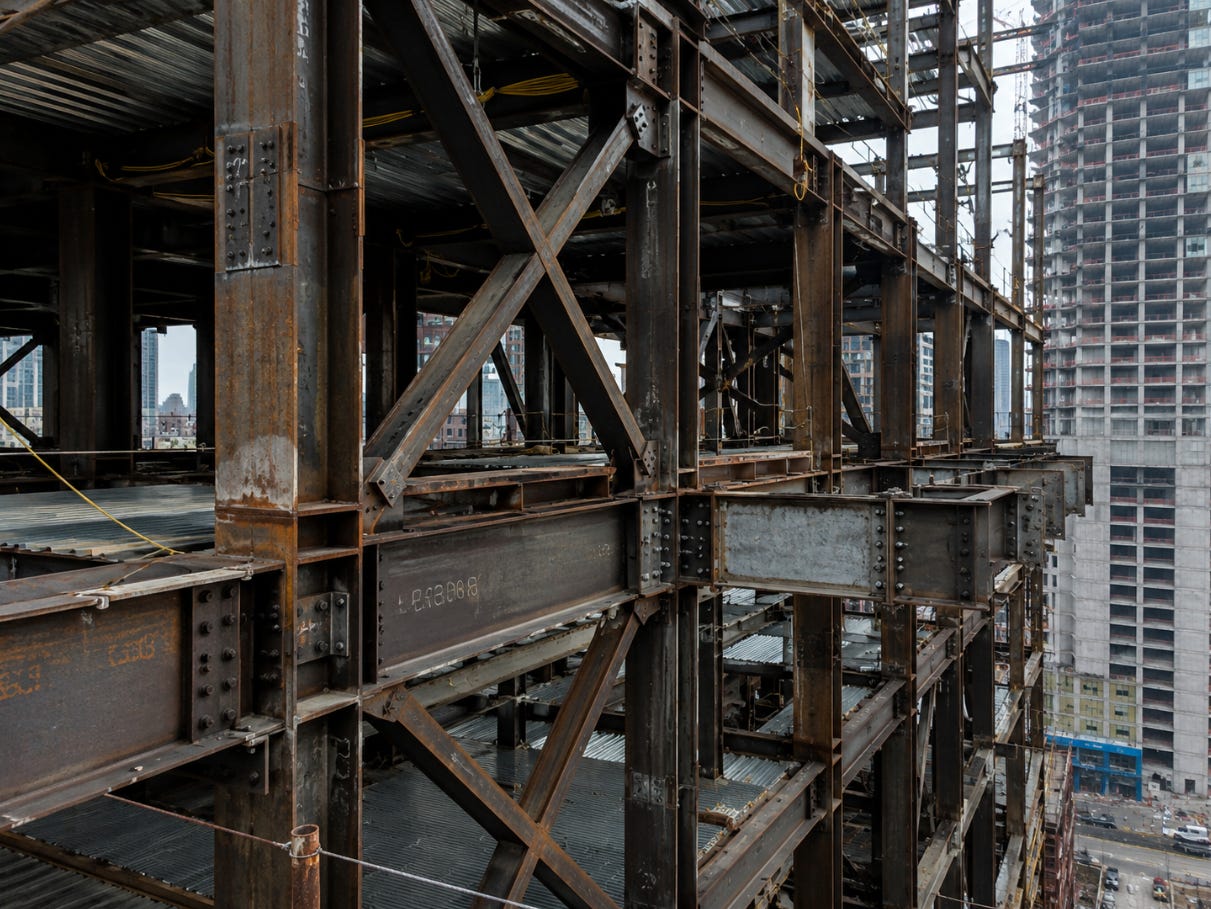
World Trade Center Building 7 was a 47-story steel-framed high-rise within the World Trade Center complex. It was not struck by an aircraft on September 11, 2001. It collapsed later that afternoon, at approximately 5:20 pm.
That fact should have kept the question open.
The collapse was total. Building 7 did not lose a corner, shed a façade, or suffer some limited structural failure. The building came down. A modern steel-framed high-rise, not directly struck by an aircraft, experienced complete global collapse within the same event that had already killed nearly 3,000 people and redirected the political, legal, military, and psychological life of the United States.
That is why World Trade Center Building 7 matters. It removes the aircraft-impact variable. The Twin Towers involved aircraft strikes, jet fuel, fire, visual trauma, and the immediate horror of people trapped above impact floors. The Pentagon raises a different set of evidentiary disputes. Building 7 is narrower. A steel-framed high-rise, not hit by a plane, collapsed completely. People noticed because the event demanded notice. The deeper question is why continued notice became impermissible.
The official investigation concluded that Building 7 collapsed because fire and debris-induced structural damage led to fire-driven progressive collapse. That conclusion became the final technical explanation. Official explanations are not meaningless. They are also not self-validating. In this case, the explanation became more than an account of the event. It became the boundary around the event.
Closure became the governing function.
The same official investigation acknowledged that, for a measurable interval during descent, Building 7 fell at gravitational acceleration — free fall — for roughly 2.25 seconds. Free fall is not metaphor. It means that during that interval the falling structure encountered no measurable resistance consistent with intact load-bearing support beneath it.
That fact does not settle the entire mechanism. It establishes a condition any adequate explanation must confront. Controlled demolition is the established engineering practice designed to produce rapid, coordinated removal of structural resistance. A fire-driven progressive-collapse explanation must therefore explain how a building not struck by an aircraft came to exhibit an interval of free fall during total global collapse. That is the central physical problem.
The handling of that problem is revealing. During the investigation, the National Institute of Standards and Technology initially stated that Building 7 did not experience free fall. After technical challenge during the public comment process, NIST revised its final report and acknowledged approximately 2.25 seconds of gravitational free fall. The record therefore contains the free-fall interval and the official correction that followed external pressure.
Before September 11, 2001, no modern steel-framed high-rise had experienced total global collapse under this category of explanation. Fires have caused severe damage, localized failure, and partial collapse in many structures. Building 7 presented something different: steel-framed high-rise, no aircraft impact, debris damage short of aircraft impact, fire-driven explanation, total global collapse.
That should have produced institutional humility. It should have produced a long, open, public technical process in which competing explanations remained serious until the evidence closed them. Instead, the explanation hardened. The anomaly was absorbed into official settlement.
This is the architecture of containment: explanation converted into boundary.
Once the official account was established, the inquiry changed character. The question was no longer treated as open. Alternative hypotheses were socially degraded. To ask why Building 7 collapsed became, in many settings, a way to place oneself outside permissible seriousness. The containment was technical, institutional, social, and linguistic. The official explanation did not simply describe the event. It regulated the discussion that followed it.
The pre-collapse information environment makes that closure harder to accept.
During the late afternoon of September 11, BBC World News broadcast a live segment reporting that the Salomon Brothers Building — World Trade Center Building 7 — had collapsed. The report was introduced as a confirmed development and stated that the building had come down because it had been weakened during the day’s events. The broadcast then cut to BBC correspondent Jane Standley in New York. During the live transmission, Building 7 remained standing and was visible in the background. The building collapsed approximately twenty minutes later.
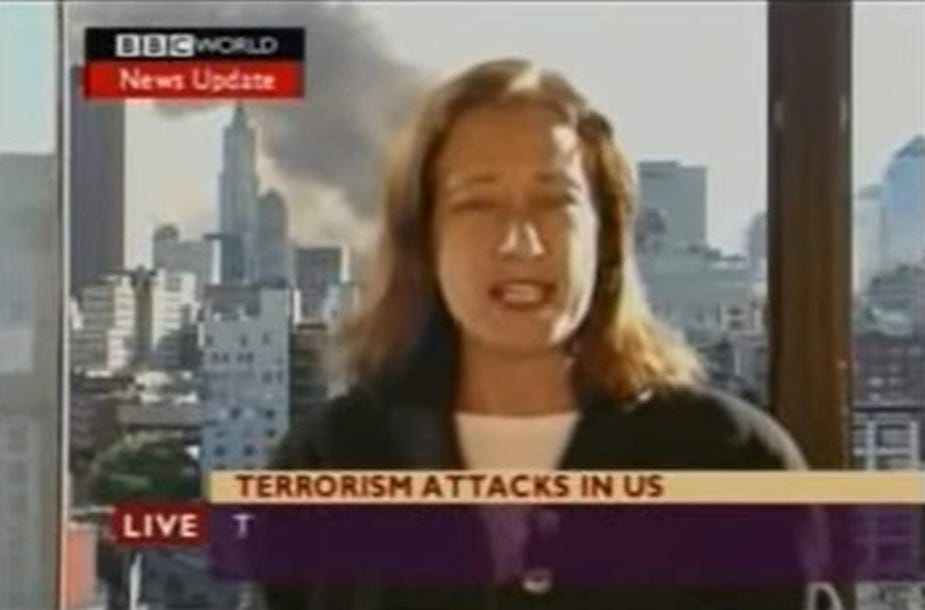
The BBC report does not identify collapse mechanism. It establishes a different fact: a completed outcome and causal explanation appeared in the information environment before the physical event occurred. That timing relationship belongs to the record. Discomfort does not make it irrelevant.
Fire department command also established a collapse perimeter around Building 7 during the afternoon. Personnel were withdrawn from the structure and surrounding area, and access was restricted based on the operational expectation that the building would fail. Emergency withdrawal can be prudent and still establish pre-collapse expectation. Under a Pre-Event Knowledge Posture framework, the significance is posture: operational positioning around a specific anticipated structural outcome before that outcome occurred.
Category discipline matters here. Operational expectation is not culpable foreknowledge. A premature media report is not proof of mechanism. Both facts still matter. Before Building 7 collapsed, the building already existed inside an environment of expectation. Its collapse was anticipated, reported, and operationally positioned before it physically occurred.
Larry Silverstein was the leaseholder of the World Trade Center complex. In July 2001, approximately seven weeks before September 11, his company completed a 99-year lease of the property and secured a new property insurance program covering the complex, with total coverage of approximately $3.55 billion, including terrorism coverage. After the attacks, Silverstein Properties filed claims asserting that the destruction constituted two separate insured occurrences, based on the two aircraft impacts. The classification of the event determined the applicable coverage limits and the total potential payout. Litigation over that issue continued for years.
Silverstein later stated that he did not attend his customary morning breakfast meeting at Windows on the World in the North Tower that morning because he had a dermatology appointment.
In the 2002 PBS documentary America Rebuilds, Silverstein described a conversation concerning Building 7. He stated: “I remember getting a call from the fire department commander telling me that they were not sure they were going to be able to contain the fire. And I said, you know, ‘We’ve had such terrible loss of life, maybe the smartest thing to do is pull it.’ And they made that decision to pull, and then we watched the building collapse.”
That statement has been contested for more than two decades. Silverstein’s defenders read “pull it” as a reference to pulling personnel or abandoning firefighting efforts. Critics read it as demolition language. The narrower point is enough. The public record contains a pre-collapse decision, contested language, and the phrase “then we watched the building collapse.” In an ordinary event, that ambiguity would have required sustained clarification. In this event, the ambiguity was absorbed into closure.
There were also eyewitness reports of explosive events.
Barry Jennings, Deputy Director of Emergency Services for the New York City Housing Authority, entered Building 7 on the morning of September 11 with Corporation Counsel Michael Hess. While attempting to evacuate after a loss of power, Jennings reported that a powerful explosion occurred inside the building, blowing out walls in the stairwell and trapping them for several hours. His broader account included details that remain disputed or unconfirmed, but the relevant point here is narrower: he repeatedly described a powerful internal explosion, serious damage inside the building, and being trapped for hours before the later collapse.
The Jennings account gives the BBC report additional significance. If Building 7 had merely been expected to collapse because of visible fire damage, the premature report could be treated as an information cascade error. But Jennings described a powerful internal explosion and significant damage inside the building hours before the later collapse. That earlier internal event complicates the sequence. It raises a more serious possibility: that the information environment reflected an expected collapse sequence whose timing did not match the physical event. The BBC may not have been early because it knew more. It may have been early because it received the correction later. On that reading, the broadcast exposed a projected collapse sequence whose timing no longer matched the event as it unfolded.
This would explain why the later record contains so many timing anomalies: internal explosion accounts, pre-collapse operational posture, premature media reporting, and eventual collapse hours later. The problem is not one isolated inconsistency. It is a sequence problem. The physical event, the witness record, the operational posture, and the information environment do not align cleanly under a simple fire-collapse narrative.
Multiple first responders near Building 7 also reported hearing explosions or sequences of explosive sounds before or during the collapse sequence. First responder Kevin McPadden stated, “We heard a loud explosion, and then there was a series of explosions. We were backing up, and then the building came down.” Paramedic Daniel Rivera described hearing what he characterized as explosions before the structure failed.
These accounts are field observations. Their source is a matter for inquiry; their existence is part of the evidentiary record. A truth-seeking system would preserve them, classify them carefully, and test them against competing mechanisms. A closure-seeking system would absorb or marginalize them.
World Trade Center Building 7 does not require the entire 9/11 record to be resolved. Its importance lies in the opposite direction. A small number of high-signal facts are enough to expose the closure mechanism.
A building not struck by an aircraft collapsed completely. The collapse included an acknowledged interval of gravitational free fall. No comparable modern steel-framed high-rise had previously suffered total global collapse under this category of official explanation. A major international broadcaster reported the collapse before it occurred, with a causal explanation already attached, while the building remained visible behind the correspondent. Emergency personnel were positioned around the expectation of collapse before the event occurred. The leaseholder had acquired the complex only weeks earlier, secured large-scale terrorism insurance, missed his usual breakfast meeting in the North Tower that morning according to his own later account, and later used contested language about “pulling” Building 7 before saying that “then we watched the building collapse.” Barry Jennings reported an internal explosion and significant damage inside the building hours before the collapse. First responders reported explosions or sequences of explosive sounds before or during the collapse sequence. NIST initially denied free fall and later acknowledged it after technical challenge. The official explanation then became settled, while alternative inquiry became socially and institutionally disfavored.
Each item can be argued about in isolation. That is one way containment works. The BBC report can be called a media error. The collapse perimeter can be called prudent emergency judgment. The Silverstein statement can be read in its most innocent sense. Explosion accounts can be treated as confusion in a disaster zone. Free fall can be absorbed into a technical model. The insurance posture can be treated as commercial background. The missed breakfast can be treated as coincidence. The NIST revision can be treated as ordinary correction. But the analytical question is not whether each fact can be separately domesticated. The question is what happens when they are read together.
Read together, they do not behave like a settled record. They behave like a record that required containment.
This is why the essay does not depend on confession as the evidentiary baseline. As developed in Strategic Intent Analysis: Inferring Direction Through Structural Convergence, direction in complex systems is inferred through preparation, decision, incentive, outcome alignment, and the narrowing of alternatives. Systems reveal themselves through what they reinforce. Building 7 matters because the record contains physical anomaly and the institutional conduct by which anomaly was converted into closure.
Strategic Intent Analysis examines whether a system behaves like a system discovering the truth or stabilizing an outcome. In high-consequence events — especially events that produce war, surveillance expansion, emergency power, institutional immunity, and durable changes to public life — post-event institutional behavior matters. Rapid certainty, narrowed explanations, protection of senior leadership, and conversion of crisis into lasting authority are structural signals.
Operation Northwoods: A Completed Conspiracy, Not a Theory matters here because it establishes that high-level national-security planning has contemplated staged violence, manipulated evidence, false attribution, media management, and public outrage as instruments of policy. Its relevance is evidentiary baseline, not direct proof. Once that baseline is restored, the question is not whether such categories are comfortable. The question is whether they are lawful to examine.
The WTC 7 record should therefore be read with category discipline. The collapse occurred. The free-fall interval was acknowledged. The BBC report occurred before the collapse. Collapse expectation existed before the collapse. Silverstein’s lease, insurance posture, absence from Windows on the World, and “pull it” statement are part of the public record. Explosion accounts exist. NIST revised its position on free fall after challenge. The official explanation became settled. These are documented facts and posture indicators. They are distinct from a final mechanism conclusion.
The SIA conclusion is also distinct. The conclusion is that the system’s behavior around Building 7 does not resemble open-ended truth seeking after an unprecedented high-rise collapse within a mass-death event. It resembles containment: the establishment of a permissible explanation, the narrowing of inquiry, and the conversion of unresolved evidence into closed institutional settlement.
This matters because nearly 3,000 people were murdered on September 11. The families of the dead were owed truth, not procedure alone. The public was owed inquiry, not explanation alone. The wars, surveillance architecture, security state, emergency mentality, and moral transformations that followed were justified by the event as officially understood. If part of that event was prematurely closed, the closure was not harmless. It affected the legitimacy of everything built upon it.
The consequences did not remain inside the engineering record. As examined in The Classified Security State, the post-9/11 order expanded secrecy, surveillance, emergency authority, and institutional insulation. A security system that acts behind walls the public cannot see can produce consequences the public must bear, while invoking national necessity to prevent meaningful judgment. Building 7 therefore bears on more than structural engineering. It bears on the legitimacy of the security architecture built afterward.
Whatever wider frame is later applied to September 11 — terrorism, state failure, covert operation, ritual sacrifice, or permanent-emergency architecture — World Trade Center Building 7 remains analytically distinct. The ritual-sacrifice question belongs to a later inquiry because it concerns the meaning, symbolism, and public transformation of the wider event. Building 7 comes first because it is narrower. It does not require interpretation of aircraft impact, battlefield confusion, or the emotional spectacle of the towers. It asks why a high-rise collapse without aircraft impact was converted so quickly from anomaly into settled explanation.
That question remains open because reality did not close it. Authority attempted to close it.
World Trade Center Building 7 stands as more than a collapsed building. It is a record of how institutional systems manage contradiction after transformative events. The physical collapse was followed by a second collapse: the collapse of permissible inquiry. A lawful system would have treated Building 7 as a reason to keep asking. The post-9/11 order treated it as a reason to stop.
This is the record of World Trade Center Building 7: a structural failure enclosed by an architecture of containment.