

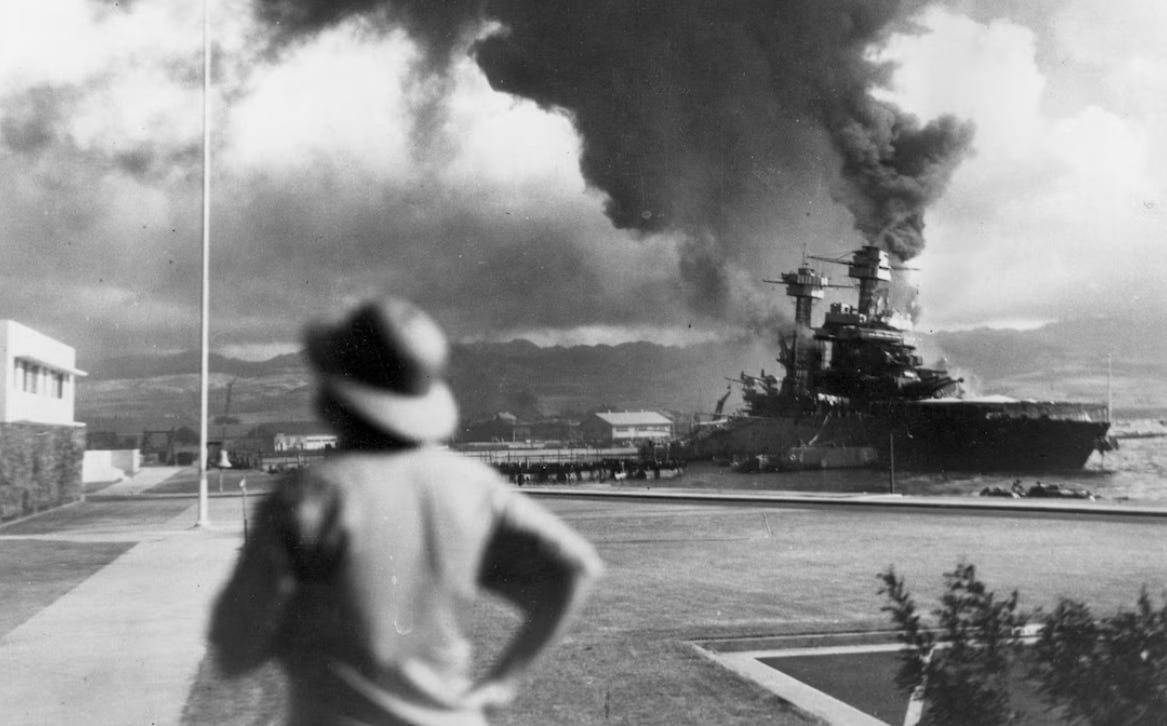
Pearl Harbor is usually forced into a false binary.
Either Franklin Roosevelt knew the Japanese attack was coming and allowed it to happen, or Pearl Harbor was simply an intelligence failure: tragic, catastrophic, but fundamentally accidental.
Strategic Intent Analysis suggests a third category.
Pearl Harbor does not need to be proven as a tactically engineered event in order to be understood as structurally produced. The stronger finding is narrower, but more durable. By late November 1941, Washington’s governing requirement was that Japan be seen to fire first. That requirement did not order American commanders to stand down, but it did subordinate military readiness to political non-provocation. It shaped the warnings sent to the field, encouraged restrained rather than unmistakable combat posture, and left Hawaii insufficiently prepared for air and naval attack. When Washington received evidence that Hawaii had interpreted the danger as sabotage rather than imminent attack, no urgent correction followed before the shock arrived.
This essay applies the method developed in Strategic Intent Analysis. That method does not begin with confession. It asks whether preparation, policy constraint, selection among alternatives, incentives, warnings, and outcomes repeatedly reinforce the same future. Reaction remains exploratory and reversible. Strategy selects a path, reinforces it, and progressively narrows alternatives. Pearl Harbor is assessed by that standard: whether the first-shot policy, the warning language, the field response, Washington’s notice, non-correction, and political conversion converged toward structurally permitted war entry.
That method matters especially in questions of war. Operation Northwoods established that false attribution, engineered perception, and civilian manipulation were not imaginary categories. The plan was proposed inside formal U.S. military planning and rejected before execution. That rejection matters: Northwoods does not prove that such plans are always carried out, and it does not prove Pearl Harbor. It changes the evidentiary baseline more narrowly and more precisely. It shows that provocation, false attribution, and narrative control have entered formal war-planning thought as proposed instruments for creating public consent.
The War Machine supplies the larger institutional setting. War is not merely an event. It is a standing architecture of capability, industry, procurement, threat narrative, legal authority, and political incentive. Once activated, that architecture tends to preserve itself. Pearl Harbor therefore matters not only as an attack, but as a conversion event: the moment a desired war posture became publicly unavoidable.
Breaker Morant and Kitchener’s Scapegoats supplies the command-logic parallel. That essay examines how imperial policy can move downward as ambiguous field expectation while responsibility is later isolated in the men who acted inside the environment command created. Pearl Harbor presents the pre-war version of that same logic. Political necessity moved downward as conditioned warning; operational failure remained local enough to be blamed downward. In both cases, the instruction is clear enough to shape conduct and vague enough to be disowned.
By late 1941, Roosevelt faced a political problem. The United States was already moving toward war. Lend-Lease, Atlantic naval conflict, economic pressure on Japan, and military planning all pointed in that direction. But public consent lagged behind policy. The administration could prepare for war more easily than it could openly sell war.
Japan supplied the pressure point. In July 1941, the United States froze Japanese assets, bringing Japanese financial and trade activity under American control. In practical effect, this helped cut Japan off from oil and pushed the Japanese empire toward a resource crisis. Japan still bore responsibility for its imperial choices. But the strategic channel was narrowing. Washington did not need to invent Japanese aggression. It needed Japan to make the first overt move.
That distinction matters. The question is not whether Japan was innocent. It was not. The question is whether Washington’s policy required Japan to appear as the initiator.
On November 25, 1941, Secretary of War Henry Stimson recorded the central problem in his diary after a White House meeting with Roosevelt, Hull, Knox, Marshall, Stark, and Stimson. Roosevelt raised the possibility that the United States was likely to be attacked soon, perhaps as early as the following Monday. The question, as Stimson recorded it, was how to maneuver Japan into firing the first shot without allowing too much danger to the United States.
That phrase is the hinge.
“Without allowing too much danger to ourselves” means danger was not an unforeseen consequence discovered later. It was part of the governing calculation. The political requirement was not merely to prepare for war. It was to enter war in the morally usable posture of having been attacked first.
Two days later, that requirement was operationalized. The November 27 warning to General Short stated that Japanese future action was unpredictable but hostile action was possible at any moment. It then added that if hostilities could not be avoided, the United States desired that Japan commit the first overt act. The same warning directed reconnaissance and other measures, but instructed that they be carried out so as not to alarm the civilian population or disclose intent.
This was not a clean combat-readiness order. It was a politically conditioned readiness order.
The qualification matters: the warning also said the first-shot policy should not be construed as restricting defense. Washington did not explicitly order commanders to remain undefended. But the order contained an operational contradiction. Prepare for hostile action at any moment, but preserve the political appearance that Japan must move first. Take measures, but avoid visible signs that might alarm civilians or disclose intent.
The political constraint also had a visible military dimension. Washington knew Japan was collecting detailed Pearl Harbor-specific intelligence. Tokyo had instructed its Honolulu consulate to report the location of warships and carriers by harbor area, anchorage, wharf, buoy, dock, and even double-moored position. Later instructions demanded “ships in harbor” reports at least twice weekly and reports even when there was no movement. This means the first-shot policy was operating under surveillance. A visibly hardened Pearl Harbor — ships dispersed, aircraft protected, reconnaissance sustained, guns manned, commanders unmistakably on air/naval alert — would not have presented the same target picture to Japan. Non-provocation was therefore not merely a diplomatic posture. It preserved Pearl Harbor’s appearance as an available target at the very moment Japan was watching it.
That is the sort of order that creates restrained readiness, ambiguous responsibility, and later deniability.
The crucial point is what happened next. Short replied that he had alerted against sabotage and was liaising with the Navy. That reply showed that Hawaii had not moved into a full air/naval attack posture. Aircraft dispersal, long-range reconnaissance, and combat readiness were not being treated as the central threat response.
Washington now had notice that the warning had produced inadequate posture. This was the reversal point. Correction was still cheap and available: Washington could have clarified the warning, required air/naval attack readiness, ordered reconnaissance, and corrected the sabotage-only posture before the shock arrived.
No urgent correction followed.
This is where the SIA finding becomes stronger than a generic claim of intelligence failure. Before Short’s reply, one might argue that Washington accepted only bounded risk: Japan might strike somewhere, but commanders remained free to defend themselves. After Short’s reply, Washington had evidence that the field implementation was wrong. Non-correction converted foreseeable risk into tolerated vulnerability.
Pearl Harbor was not the only theater where this pattern appeared. In the Philippines, General MacArthur’s command also operated under the first-shot constraint. After Pearl Harbor was known, General Brereton sought authorization for offensive action against Japanese airfields on Formosa. He was delayed and blocked through the morning. Japanese aircraft later destroyed large numbers of American aircraft on the ground at Clark and Iba Fields.
This second theater matters because it weakens the claim that Pearl Harbor can be reduced to Short’s individual misjudgment. The same governing constraint produced the same failure mode elsewhere: hesitation, restrained action, aircraft caught on the ground, and catastrophic loss at the opening of war.
The official narrative can absorb one failure as local error. It has much more difficulty absorbing two parallel failures under the same political architecture.
Strategic Intent Analysis does not require proof that Roosevelt knew the exact Japanese carrier route. It does not require proof that Washington anticipated the full magnitude of the disaster. It does not even require proof that senior officials psychologically desired the deaths that followed. Those are not the necessary claims.
The necessary claim is structural.
Washington needed Japan to fire first. That requirement was discussed at the highest level. It was embedded into operational warning language. It created a command climate in which visible or offensive readiness was politically dangerous. It produced inadequate readiness in at least two theaters. In Hawaii, Washington received evidence of inadequate posture and failed to correct it.
That is the finding.
Pearl Harbor was not necessarily tactically engineered. It was structurally produced: a foreseeable shock generated by a documented political constraint, transmitted through politically conditioned warnings, and left uncorrected when the warning system visibly failed.
The result was not merely military surprise. It was political transformation.
Before Pearl Harbor, war remained difficult to sell. After Pearl Harbor, the question disappeared. The attack converted policy into consent. It gave Roosevelt the moral posture he needed: not entry into war by executive design, but national response to infamy.
This is where Pearl Harbor meets the larger argument of The War Machine. Once the initiating shock occurred, the war system no longer had to justify itself as preparation. It became response. Capability, production, command authority, intelligence, industry, and narrative all moved into alignment. The event did not create the architecture from nothing. It activated an architecture already moving toward war.
The same logic also connects Pearl Harbor to Breaker Morant and Kitchener’s Scapegoats. In Morant, imperial command created a deniable field environment and then isolated responsibility in the men who acted inside it. Pearl Harbor operates one step earlier in the sequence. The command environment did not produce an atrocity to be punished; it produced vulnerability to be blamed. In both cases, higher policy shaped the field while remaining insulated from the field’s consequences.
That is why Pearl Harbor remains such a powerful SIA case. The event does not require a confession, a disclosed operational plan, or proof that Washington knew the exact Japanese carrier route. The deeper pattern is structural: policy created vulnerability, warning revealed that vulnerability, and the failure to correct it made the coming shock more likely.
A state can create the conditions in which a shock becomes likely. It can constrain its own defenses for political reasons. It can receive warning that the constraint has produced dangerous unreadiness. It can fail to correct that unreadiness before the shock arrives.
Washington did not need to want the full disaster for its policy to produce it. The state received warning that its own first-shot constraint had created danger, and it did not act on that warning in time.
That is not an accident in the ordinary sense.
It is the first-shot state.